

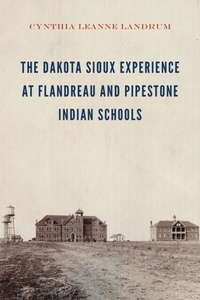
The Dakota Sioux Experience at Flandreau and Pipestone Indian Schools
1. Auflage
Erschienen am 1. März 2019
312 Seiten
978-1-4962-1355-6 (ISBN)
Beschreibung
The Dakota Sioux Experience at Flandreau and Pipestone Indian Schools illuminates the relationship between the Dakota Sioux community and the schools and surrounding region, as well as the community's long-term effort to maintain its role as caretaker of the "sacred citadel" of its people.
Cynthia Leanne Landrum explores how Dakota Sioux students at Flandreau Indian School in South Dakota and at Pipestone Indian School in Minnesota generally accepted the idea that they should attend these particular boarding institutions because they saw them as a means to an end and ultimately as community schools. This construct operated within the same philosophical framework in which some Eastern Woodland nations approached a non-Indian education that was simultaneously tied to long-term international alliances between Europeans and First Peoples beginning in the seventeenth and eighteenth centuries.
Landrum provides a new perspective from which to consider the Dakota people's overt acceptance of this non-Native education system and a window into their ongoing evolutionary relationships, with all of the historic overtures and tensions that began the moment alliances were first brokered between the Algonquian Confederations and the European powers.
Cynthia Leanne Landrum explores how Dakota Sioux students at Flandreau Indian School in South Dakota and at Pipestone Indian School in Minnesota generally accepted the idea that they should attend these particular boarding institutions because they saw them as a means to an end and ultimately as community schools. This construct operated within the same philosophical framework in which some Eastern Woodland nations approached a non-Indian education that was simultaneously tied to long-term international alliances between Europeans and First Peoples beginning in the seventeenth and eighteenth centuries.
Landrum provides a new perspective from which to consider the Dakota people's overt acceptance of this non-Native education system and a window into their ongoing evolutionary relationships, with all of the historic overtures and tensions that began the moment alliances were first brokered between the Algonquian Confederations and the European powers.
Weitere Details
Sprache
Englisch
Verlagsort
Lincoln
USA
Zielgruppe
Für Beruf und Forschung
Illustrationen
index
Dateigröße
4,05 MB
ISBN-13
978-1-4962-1355-6 (9781496213556)
Copyright in bibliographic data and cover images is held by Nielsen Book Services Limited or by the publishers or by their respective licensors: all rights reserved.
Schweitzer Klassifikation
Weitere Ausgaben
Person
Cynthia Leanne Landrum teaches history and Indigenous studies at Portland State University and Clark College. She is the author of The Valley of the Kings: Rehabilitation of the People of the Columbia River and Pacific Rim through Ceremonialism.
Inhalt
- Cover
- Title Page
- Copyright Page
- Contents
- Preface
- Acknowledgments
- Introduction
- Part 1
- 1. Missionaries and Education in the Upper Midwest
- 2. The Early Years
- 3. The Indian New Deal
- 4. Termination Legislation and Closure of Pipestone Indian School
- 5. Self-Determination
- Part 2
- 6. Flandreau Indian School
- 7. Pipestone Indian School
- Conclusion
- Notes
- Bibliography
- Index
