

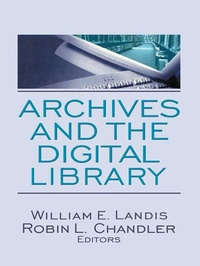
Archives and the Digital Library
1. Auflage
Erschienen am 13. Mai 2013
286 Seiten
978-1-136-45323-6 (ISBN)
Beschreibung

Technological advances and innovative perspectives constantly evolve the notion of what makes up a digital library. Archives and the Digital Library provides an insightful snapshot of the current state of archiving in the digital realm. Respected experts in library and information science present the latest research results and illuminating case studies to provide a comprehensive glimpse at the theory, technological advances, and unique approaches to digital information management as it now stands. The book focuses on digitally reformatted surrogates of non-digital textual and graphic materials from archival collections, exploring the roles archivists can play in broadening the scope of digitization efforts through creatively developing policies, procedures, and tools to effectively manage digital content.
Many of the important advances in digitization of materials have little to do with the efforts of archivists. Archives and the Digital Library concentrates specifically on the developments in the world of archives and the digitization of the unique content of information resources archivists deal with on a constant basis. This resource reviews the current issues and challenges, effective user assessment techniques, various digital resources projects, collaboration strategies, and helpful best practices. The book is extensively referenced and includes helpful illustrative figures.
Topics in Archives and the Digital Library include:
a case study of LSTA-grant funded California Local History Digital Resources Project
expanding the scope of traditional archival digitations projects beyond the limits of a single institution
a case study of the California Cultures Project
the top ten themes in usability issues
case studies of usability studies, focus groups, interviews, ethnographic studies, and web log analysis
developing a reciprocal partnership with a digital library
the technical challenges in harvesting and managing Web archives
metadata strategies to provide descriptive, technical, and preservation related information about archived Web sites
long-term preservation of digital materials
building a trusted digital repository
collaboration in developing and supporting the technical and organizational infrastructure for sustainability in both academic and state government
the Archivists' Toolkit software application
Archives and the Digital Library is timely, important reading for archivists, librarians, library administrators, library information educators, archival educators, and students.
Many of the important advances in digitization of materials have little to do with the efforts of archivists. Archives and the Digital Library concentrates specifically on the developments in the world of archives and the digitization of the unique content of information resources archivists deal with on a constant basis. This resource reviews the current issues and challenges, effective user assessment techniques, various digital resources projects, collaboration strategies, and helpful best practices. The book is extensively referenced and includes helpful illustrative figures.
Topics in Archives and the Digital Library include:
a case study of LSTA-grant funded California Local History Digital Resources Project
expanding the scope of traditional archival digitations projects beyond the limits of a single institution
a case study of the California Cultures Project
the top ten themes in usability issues
case studies of usability studies, focus groups, interviews, ethnographic studies, and web log analysis
developing a reciprocal partnership with a digital library
the technical challenges in harvesting and managing Web archives
metadata strategies to provide descriptive, technical, and preservation related information about archived Web sites
long-term preservation of digital materials
building a trusted digital repository
collaboration in developing and supporting the technical and organizational infrastructure for sustainability in both academic and state government
the Archivists' Toolkit software application
Archives and the Digital Library is timely, important reading for archivists, librarians, library administrators, library information educators, archival educators, and students.
Weitere Details
Sprache
Englisch
Verlagsort
London
Großbritannien
Verlagsgruppe
Taylor & Francis Ltd
Zielgruppe
Für höhere Schule und Studium
Produkt-Hinweis
Reflowable
Dateigröße
10,46 MB
ISBN-13
978-1-136-45323-6 (9781136453236)
Copyright in bibliographic data and cover images is held by Nielsen Book Services Limited or by the publishers or by their respective licensors: all rights reserved.
Schweitzer Klassifikation
Weitere Ausgaben
Andere Ausgaben
William E. Landis | Robin L. Chandler
Archives and the Digital Library
Buch
06/2007
1. Auflage
Routledge
132,70 €
Versand in 10-20 Tagen
William E. Landis | Robin L. Chandler
Archives and the Digital Library
Buch
06/2007
1. Auflage
Routledge
78,80 €
Versand in 10-20 Tagen
Personen
William E. Landis, MILS, is Head of Arrangement and Description & Metadata Coordinator in Manuscripts and Archives, Yale University Library. Prior to that he served as Metadata Coordinator for the California Digital Library; as Manuscripts Librarian in Special Collections and Archives at the University of California, Irvine; and as the first Production Coordinator for the JSTOR Mass Periodical Digitization Initiative. He is an active member of the Society of American Archivists, and has contributed to the Creation, Documentation, and Maintenance of Encoded Archival Description (EAD) and Describing Archives: A Content Standard (DACS). He also serves on the services working group of the Digital Library Federation's Aquifer Project.
Robin L. Chandler, MA, MLIS, is Director of Data Acquisitions at the California Digital Library and oversees digital content submissions to the online archive of California and Calisphere (Resource for archival finding aids, digital images, and electronic texts) as well as coordinating frameworks to surface digital collections across the University of California through projects like the Open Content Alliance. She has experience providing online access to digital content, including tobacco industry documents at the UCSF library and high-energy physics preprints at the Stanford Linear Accelerator Center (SLAC).
Robin L. Chandler, MA, MLIS, is Director of Data Acquisitions at the California Digital Library and oversees digital content submissions to the online archive of California and Calisphere (Resource for archival finding aids, digital images, and electronic texts) as well as coordinating frameworks to surface digital collections across the University of California through projects like the Open Content Alliance. She has experience providing online access to digital content, including tobacco industry documents at the UCSF library and high-energy physics preprints at the Stanford Linear Accelerator Center (SLAC).
Inhalt
INTRODUCTION
Archives and Archivists: Key Collaborators in the Digital Library (William E. Landis and Robin L. Chandler)
DEVELOPING NON-LICENSED CONTENT
Committing to Memory: A Project to Publish and Preserve California Local History Digital Resources (Adrian L. Turner)
Technologically Enhanced Archival Collections: Using the Buddy System (Dayna Holz)
California Cultures: Implementing a Model for Virtual Collections (Genie Guerard and Robin L. Chandler)
USABILITY ISSUES AND OPTIONS FOR THE END USER
The Importance of User-Centered Design: Exploring Findings and Methods (Rosalie Lack)
How and Why of User Studies: RLG's RedLightGreen as a Case Study (Merrilee Proffitt)
From Horse-Drawn Wagon to Hot Rod: The University of California's Digital Image Service Experience (Maureen A. Burns)
TECHNOLOGY, PRESERVATION, AND MANAGEMENT ISSUES
Archiving Web Sites for Preservation and Access: MODS, METS and MINERVA (Rebecca Guenther and Leslie Myrick)
Video Preservation and Digital Reformatting: Pain and Possibility (Jerome McDonough and Mona Jimenez)
Digital Archiving and Preservation: Technologies and Processes for a Trusted Repository (Ronald Jantz and Michael Giarlo)
The Complexities of Digital Resources: Collection Boundaries and Management Responsibilities (Joanne Kaczmarek)
The Archivists' Toolkit: Another Step Toward Streamlined Archival Processing (Bradley D. Westbrook, Lee Mandell, Kelcy Shepherd, Brian Stevens, and Jason Varghese)
Index
Reference Notes Included
Archives and Archivists: Key Collaborators in the Digital Library (William E. Landis and Robin L. Chandler)
DEVELOPING NON-LICENSED CONTENT
Committing to Memory: A Project to Publish and Preserve California Local History Digital Resources (Adrian L. Turner)
Technologically Enhanced Archival Collections: Using the Buddy System (Dayna Holz)
California Cultures: Implementing a Model for Virtual Collections (Genie Guerard and Robin L. Chandler)
USABILITY ISSUES AND OPTIONS FOR THE END USER
The Importance of User-Centered Design: Exploring Findings and Methods (Rosalie Lack)
How and Why of User Studies: RLG's RedLightGreen as a Case Study (Merrilee Proffitt)
From Horse-Drawn Wagon to Hot Rod: The University of California's Digital Image Service Experience (Maureen A. Burns)
TECHNOLOGY, PRESERVATION, AND MANAGEMENT ISSUES
Archiving Web Sites for Preservation and Access: MODS, METS and MINERVA (Rebecca Guenther and Leslie Myrick)
Video Preservation and Digital Reformatting: Pain and Possibility (Jerome McDonough and Mona Jimenez)
Digital Archiving and Preservation: Technologies and Processes for a Trusted Repository (Ronald Jantz and Michael Giarlo)
The Complexities of Digital Resources: Collection Boundaries and Management Responsibilities (Joanne Kaczmarek)
The Archivists' Toolkit: Another Step Toward Streamlined Archival Processing (Bradley D. Westbrook, Lee Mandell, Kelcy Shepherd, Brian Stevens, and Jason Varghese)
Index
Reference Notes Included
