

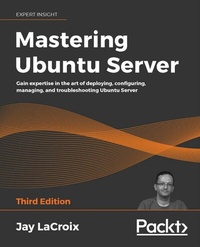
Mastering Ubuntu Server
Gain expertise in the art of deploying, configuring, managing, and troubleshooting Ubuntu Server
3. Auflage
Erschienen am 23. September 2024
702 Seiten
978-1-80056-805-1 (ISBN)
Beschreibung
This is the third edition of the bestselling one-stop resource for sysadmins and DevOps professionals to learn, configure and use Ubuntu 20.04 for their day-to-day operations and deployments.Key Features - A hands-on book that will teach you how to deploy, maintain and troubleshoot Ubuntu Server
- Learn to leverage the improved performance and security-related aspects of Ubuntu Server 20.04 LTS
- New chapters dedicated to exploring Ubuntu for cloud
Book DescriptionUbuntu Server has taken data centers around the world by storm. Whether you're deploying Ubuntu for a large-scale project or for a small office, it is a stable, customizable, and powerful Linux distribution with innovative and cutting-edge features. For both simple and complex server deployments, Ubuntu's flexible nature can be easily adapted to meet to the needs of your organization. This third edition is updated to cover the advancements of Ubuntu 20.04 LTS and further train you to understand how to use Ubuntu Server, from initial deployment to creating production-ready resources for your network. The book begins with the concepts of user management, group management, and file system permissions. Continuing into managing storage volumes, you will learn how to format storage devices, utilize logical volume management, and monitor disk usage. Later, you will learn how to virtualize hosts and applications, which will include setting up QEMU & KVM, as well as containerization with both Docker and LXD. As the book continues, you will learn how to automate configuration with Ansible, as well as take a look at writing scripts. Lastly, you will explore best practices and troubleshooting techniques when working with Ubuntu Server that are applicable to real-world scenarios. By the end of this Ubuntu Server book, you will be well-versed in Ubuntu server's advanced concepts and attain the required proficiency needed for Ubuntu Server administration.What you will learn - Manage users, groups, and permissions
- Optimize the performance of system resources
- Perform disk encryption and decryption with Linux Unified Key Setup (LUKS)
- Set up Secure Shell (SSH) for remote access, and connect it to other nodes
- Share directories using Samba and Network File System (NFS)
- Get familiar with scripting to improve command-line efficiency
- Configure VMs, containers, and orchestrate with MicroK8s and Kubernetes
- Automate server deployments with Ansible and cloud server deployments with Terraform
Who this book is forThe book is written to cater to sysadmins and DevOps professionals whose teams are planning to employ an Ubuntu/Linux environment for their development needs. Prior knowledge of Ubuntu is not required. However, it is assumed that you possess some IT admin, Linux, and shell scripting experience.
- Learn to leverage the improved performance and security-related aspects of Ubuntu Server 20.04 LTS
- New chapters dedicated to exploring Ubuntu for cloud
Book DescriptionUbuntu Server has taken data centers around the world by storm. Whether you're deploying Ubuntu for a large-scale project or for a small office, it is a stable, customizable, and powerful Linux distribution with innovative and cutting-edge features. For both simple and complex server deployments, Ubuntu's flexible nature can be easily adapted to meet to the needs of your organization. This third edition is updated to cover the advancements of Ubuntu 20.04 LTS and further train you to understand how to use Ubuntu Server, from initial deployment to creating production-ready resources for your network. The book begins with the concepts of user management, group management, and file system permissions. Continuing into managing storage volumes, you will learn how to format storage devices, utilize logical volume management, and monitor disk usage. Later, you will learn how to virtualize hosts and applications, which will include setting up QEMU & KVM, as well as containerization with both Docker and LXD. As the book continues, you will learn how to automate configuration with Ansible, as well as take a look at writing scripts. Lastly, you will explore best practices and troubleshooting techniques when working with Ubuntu Server that are applicable to real-world scenarios. By the end of this Ubuntu Server book, you will be well-versed in Ubuntu server's advanced concepts and attain the required proficiency needed for Ubuntu Server administration.What you will learn - Manage users, groups, and permissions
- Optimize the performance of system resources
- Perform disk encryption and decryption with Linux Unified Key Setup (LUKS)
- Set up Secure Shell (SSH) for remote access, and connect it to other nodes
- Share directories using Samba and Network File System (NFS)
- Get familiar with scripting to improve command-line efficiency
- Configure VMs, containers, and orchestrate with MicroK8s and Kubernetes
- Automate server deployments with Ansible and cloud server deployments with Terraform
Who this book is forThe book is written to cater to sysadmins and DevOps professionals whose teams are planning to employ an Ubuntu/Linux environment for their development needs. Prior knowledge of Ubuntu is not required. However, it is assumed that you possess some IT admin, Linux, and shell scripting experience.
Alle Preise
Weitere Details
Weitere Ausgaben
Person
LaCroix Jay :
Jeremy "Jay" LaCroix is a technologist and open-source enthusiast, specializing in Linux. He has a net field experience of 20 years across different firms as a Solutions Architect and holds a master's degree in Information Systems Technology Management from Capella University. In addition, Jay also has an active Linux-focused YouTube channel with over 250K followers and over 20M views, available at LearnLinuxTV, where he posts instructional tutorial videos and other Linux-related content. He has also written Linux Mint Essentials and Mastering Linux Network Administration, published by Packt Publishing.
Jeremy "Jay" LaCroix is a technologist and open-source enthusiast, specializing in Linux. He has a net field experience of 20 years across different firms as a Solutions Architect and holds a master's degree in Information Systems Technology Management from Capella University. In addition, Jay also has an active Linux-focused YouTube channel with over 250K followers and over 20M views, available at LearnLinuxTV, where he posts instructional tutorial videos and other Linux-related content. He has also written Linux Mint Essentials and Mastering Linux Network Administration, published by Packt Publishing.
Inhalt
Table of Contents - Deploying Ubuntu Server
- Managing Users and Permissions
- Managing Software Packages
- Navigating and Essential Commands
- Managing Files and Directories
- Boosting your Command-line Efficiency
- Controlling and Managing Processes
- Monitoring System Resources
- Managing Storage Volumes
- Connecting to Networks
- Setting up Network Services
- Sharing and Transferring Files
- Managing Databases
- Serving Web Content
- Automating Server Configuration with Ansible
- Virtualization
- Running Containers
- Container Orchestration
- Deploying Ubuntu in the Cloud
- Automating cloud deployments with Terraform
- Securing your Server
- Troubleshooting Ubuntu Servers
- Preventing Disasters
- Managing Users and Permissions
- Managing Software Packages
- Navigating and Essential Commands
- Managing Files and Directories
- Boosting your Command-line Efficiency
- Controlling and Managing Processes
- Monitoring System Resources
- Managing Storage Volumes
- Connecting to Networks
- Setting up Network Services
- Sharing and Transferring Files
- Managing Databases
- Serving Web Content
- Automating Server Configuration with Ansible
- Virtualization
- Running Containers
- Container Orchestration
- Deploying Ubuntu in the Cloud
- Automating cloud deployments with Terraform
- Securing your Server
- Troubleshooting Ubuntu Servers
- Preventing Disasters
