
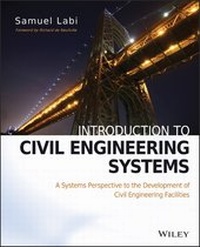
Introduction to Civil Engineering Systems
Beschreibung
Alles über E-Books | Antworten auf Fragen rund um E-Books, Kopierschutz und Dateiformate finden Sie in unserem Info- & Hilfebereich.
Weitere Details
Weitere Ausgaben
Andere Ausgaben
Person
Inhalt
Foreword xvii
Preface xix
Author Biography xxiii
I Introduction 1
1 Civil Engineering Systems and Their Evolution 3
2 Fundamental Concepts in Systems Engineering 50
3 Goals and Objectives of Civil Engineering Systems 74
II The Tasks at Each Phase of Systems Development 99
4 Tasks within the Phases of Systems Development 101
III Tools Needed to Carry Out the Tasks 125
5 Probability 127
6 Statistics 165
7 Modeling 201
8 Simulation 240
9 Optimization 267
10 Cost Analysis 321
11 Economic Analysis 368
12 Multiple-Criteria Analysis 407
13 Risk and Reliability 450
14 System Dynamics 491
15 Real Options Analysis 507
16 Decision Analysis 529
17 Network Analysis Tools 550
18 Queuing Analysis 595
IV The Phases of Systems Development 615
19 The Needs Assessment Phase 617
20 Systems Planning 651
21 System Design 679
22 Systems Construction 712
23 System Operations 757
24 System Monitoring 784
25 System Preservation (Maintenance and Rehabilitation) 815
26 System End of Life 858
V Other Topics Related to Civil Systems Development 889
27 Threats, Exposure, and System Resilience 891
28 Sustainability 929
29 Ethics and Legal Issues in Civil Systems Development 973
30 Epilogue 1004
Index 1019

Systemvoraussetzungen
Dateiformat: PDF
Kopierschutz: Adobe-DRM (Digital Rights Management)
Systemvoraussetzungen:
- Computer (Windows; MacOS X; Linux): Installieren Sie bereits vor dem Download die kostenlose Software Adobe Digital Editions (siehe E-Book Hilfe).
- Tablet/Smartphone (Android; iOS): Installieren Sie bereits vor dem Download die kostenlose App Adobe Digital Editions oder die App PocketBook (siehe E-Book Hilfe).
- E-Book-Reader: Bookeen, Kobo, Pocketbook, Sony, Tolino u.v.a.m. (nicht Kindle)
Das Dateiformat PDF zeigt auf jeder Hardware eine Buchseite stets identisch an. Daher ist eine PDF auch für ein komplexes Layout geeignet, wie es bei Lehr- und Fachbüchern verwendet wird (Bilder, Tabellen, Spalten, Fußnoten). Bei kleinen Displays von E-Readern oder Smartphones sind PDF leider eher nervig, weil zu viel Scrollen notwendig ist.
Mit Adobe-DRM wird hier ein „harter” Kopierschutz verwendet. Wenn die notwendigen Voraussetzungen nicht vorliegen, können Sie das E-Book leider nicht öffnen. Daher müssen Sie bereits vor dem Download Ihre Lese-Hardware vorbereiten.
Bitte beachten Sie: Wir empfehlen Ihnen unbedingt nach Installation der Lese-Software diese mit Ihrer persönlichen Adobe-ID zu autorisieren!
Weitere Informationen finden Sie in unserer E-Book Hilfe.