

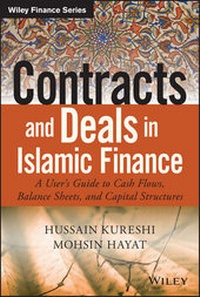
Contracts and Deals in Islamic Finance
A User s Guide to Cash Flows, Balance Sheets, and Capital Structures
Erschienen am 29. Dezember 2014
300 Seiten
978-1-119-02057-8 (ISBN)
Beschreibung

A very accessible and concise guide to Islamic finance
Contracts and Deals in Islamic Finance provides a clearbreakdown of Islamic financial contracts and deal structures forbeginners. The embedded requirements within selected Islamicfinancial contracts, such as risk weightage, capital structures,creations of cash flows, and balance sheets, are explained fully toprovide a solid understanding of the backbone of the industry.Aimed primarily at beginners and those with a background inconventional banking, this book guides readers through the majorcontracts, how they're applied, and how to discern a contract'slegitimacy. Case studies and interviews with bankers and globalregulators provide real-life examples of contract application, andthe author's own experiences provide deep insight into the everydayissues that arise. Ancillary instructor's materials includePowerPoint slides and lecture notes that facilitate use in theclassroom.
Literature describing the application of Islamic financialcontracts is few and far between, and those providing a basicbreakdown of these contracts and questioning their validity arerarer still. This book is the first of its kind, offering a basicapproach to understanding Islamic contracts, designed for the truebeginner.
* Understand the current contracts applied in Islamicbanking
* Learn how contracts are applied across differentjurisdictions
* Identify illegitimate contracts and those not in the spirit ofShariah law
* Examine the current economic realities surrounding Islamicfinance
By highlighting the underlying themes in Islamic finance andassessing the current practices, this book gives readers the solidunderstanding and up-to-date perspective that form a solidfoundation upon which successful Islamic finance is practiced. Fora solid introduction to the Islamic finance industry, Contracts andDeals in Islamic Finance is an accessible, practical guide.
Weitere Details
Weitere Ausgaben
Andere Ausgaben
Hussein Kureshi | Mohsin Hayat
Contracts and Deals in Islamic Finance
A User's Guide to Cash Flows, Balance Sheets, and Capital Structures
Buch
03/2015
Wiley
56,00 €
Versand in 15-20 Tagen
Personen
HUSSAIN KURESHI has extensive experience in consumerbanking, credit risk management, loan origination, and monitoringfor SME and commercial clients. He has a successful banking careerthat spans over 15 years and specializing in banking operations andmanagement with international organizations.
MOHSIN HAYAT has over 20 years of institutional andinternational capital market experience. Simultaneously as anentrepreneur and investor, he has specialized in creating strategicalliances in over 45 countries and building businesses in New York,Hong Kong and across Asia-Pacific. His success is driven by a keeninterest in combining business knowledge and investment managementfundamentals.
Inhalt
- Cover
- Title Page
- Copyright
- Contents
- Foreword
- Preface
- Acknowledgments
- Product Offerings
- Introduction
- Chapter 1 The Islamic Finance Space
- Modern Phase of Islamic Finance
- Chapter 2 Bai al Inah
- Definitions of Bai al Inah
- Bai al Inah Process Flow
- Legal Issues with Bai al Inah
- Bai al Inah as a Financial Product
- Asset Product
- Liability Product
- Transfer of Ownership
- Documentation Involved
- Resolutions on Bai al Inah
- Conclusion
- Chapter 3 Murabahah, Bai Mu'ajjal, and Bai Bithman Ajil
- Murabahah Sale/Credit Sale/Credit
- Enhancements to Murabahah
- Murabahah Working Capital
- Credit-Based Sale/Markup or Riba
- Bonafide Murabahah/True Sale
- Trading House Model
- Financial Services Division of a Manufacturer or Retailer
- Bai Bithman Ajil
- BBA with Inah
- Conclusion
- Chapter 4 Tawarruq
- Issue of Price Fixing
- Scenario 1
- Scenario 2
- Scenario 3
- Transfer of Title
- Payment of Sales Tax
- Three Sales and Tawarruq
- Specialized Trading Platform
- Applications of Tawarruq in Banking Products
- Asset Products
- Commodity Murabahah Liability Product
- Real Economic Activity
- Conclusion
- Chapter 5 Deferred Payment Sale or Credit Sale
- Accounting Entries for Murabahah by Purchase Orderer
- Accounting Entries for a Bai al Inah Contract
- Pricing of Deferred Sales under Murabahah, BBA, Inah, and Tawarruq
- Modes of Payment of Spot Price and Deferred Price
- How Is the Deferred Price Calculated?
- Is Profit Mechanism Fixed or Floating?
- Discounting Receivable of a Murabahah Financing Contract
- Can Collateral Be Taken by the Seller?
- Risk Treatment of Deferred Payment Sales
- Credit Analysis and Credit Risk
- Risk-Weightage Charges and Expected Losses
- Risk Concentration
- Fixed Income Portfolio
- Conclusion
- Chapter 6 Bai Al Wafa
- Financial Assets as Subject of Sale
- Bai Al Wafa and Sale of Equities
- Bai Al Wafa and Sale of Sukuk
- Conclusion
- Chapter 7 Salaam and Istisna: Deferred Delivery Sale
- Salaam
- Accounting Treatment for Salaam Contract
- Can the Buyer Sell the Asset before Delivery to a Third Party?
- Default Scenarios
- Payment of Partial Purchase Price
- Types of Assets
- Istisna
- Accounting Treatment for Istisna
- Conclusion
- Chapter 8 Bai al Sarf
- Basic Rulings on Bai al Sarf
- Conclusion
- Chapter 9 Bai al Dayn
- Purchase Price, Rental Payments, Receivables, and Debt
- Rental Payments Due in an Ijara Contract
- Financial Products
- Sale of Equity
- Conclusion
- Chapter 10 Bai al Urbun
- Conclusion
- Chapter 11 Ijarah and Its Variants
- Normal Ijarah
- Accounting Entries for Ijarah Contract
- Ijarah Muntahiya Bi Tamleek
- Al Ijarah Thumma al Bai (AITAB)
- Sale and Leaseback
- Conclusion
- Chapter 12 Wadiah
- Forms of Wadiah
- Enhancements to Wadiah
- Money Creation
- Conclusion
- Chapter 13 Qard
- Applications of the Contract of Qard
- Qard as a Deposit Instrument
- Recording of Qard
- Conclusion
- Chapter 14 Mudharabah
- Simple Application of Mudharabah
- Perpetual Mudharabah
- Re-Mudharabah
- Restricted Mudharabah and Unrestricted Mudharabah
- Mudharabah as a Deposit
- Mudharabah as a Fund
- Interbank Mudharabah Placements
- Indicative Rate of Return
- Profit Sharing Ratio
- Importance of Disclosure and Accounting Treatments
- Mudharabah as an Asset Product
- Accounting Treatment of Mudharabah Transactions
- Conclusion
- Chapter 15 Musharakah
- Musharakah and Banking
- Mushrakah as Asset Product
- Pooling of Assets in Mushrakah
- Mushrakah Mutanaqisah
- Capital Charge
- Collateral
- Conclusion
- Chapter 16 Hibah
- Forms of Hibah
- Restrictions on Hibah
- Applications of Hibah in Banking
- Hibah Coupled with Ijarah
- Hibah Coupled with Wadiah
- Hibah and Bai al Wafa
- Hibah and Other Contracts of Sale and Exchange
- Enhancements to Hibah
- Hibah and Cost of Fund
- Conclusion
- Chapter 17 Kafalah
- Who Can Be a Guarantor?
- Products Based on Kafalah
- Back-to-Back Guarantees
- Conclusion
- Chapter 18 Wakalah, Hawalah, Ibra, and Rahn
- Wakalah
- Contemporary Application of Wakalah
- Hawalah
- Types of Hawalah
- Modern Use of the Contract of Hawalah
- Issues in Hawalah
- Hawalah and Bai al Dayn
- Ibra
- Disclosure of Ibra
- Rahn
- Can Financial Assets Be Used as a Pledge Item as Well?
- Conclusion
- Chapter 19 Shariah: Sources, Interpretation, and Implementation
- Modern-Day Ijtihad
- Whose Shariah Is It, Anyway?
- Conclusion
- Chapter 20 Islamic Asset Management and Shariah Screening
- Capital Markets
- IPO Stage
- Market Integrity
- Market Regulation
- Valuations
- Zero Sum Game
- The Role of Capital Markets in the Sphere of Islamic Finance
- Farmer Sukuk or Equity Notes
- Conclusion
- Chapter 21 Pricing, Income Distribution, and Risk Sharing in Islamic Banks
- Pricing of Islamic Financial Products
- Price versus Shariah
- Benchmark for Pricing
- Criticism on Pricing Models
- Profit Equalization Reserve
- Income Distribution
- Risk Sharing in Islamic Banks
- Conclusion
- Chapter 22 Sukuk and Rights of Sukuk Holders
- Rights of Lenders in Debt Financing
- Rights of Equity Holders
- Rights of Bondholders
- Use of Subsidiary Companies and Special-Purpose Vehicles
- How Sukuk Financing Could Work?
- Sale and Leaseback
- The Role of the SPV
- Other Sukuk Structures
- Istisna Sukuk
- Simple Sukuk
- Vanilla Sukuk
- Vanilla Sukuk with Toppings
- Vanilla Sukuk with Extra Toppings
- Sovereign Sukuk
- Conclusion
- Chapter 23 Risk Management for Islamic Banks
- Credit Risk
- Capital Adequacy
- Capital Adequacy Ratio
- Implications of CAR
- Risk Weightages
- Components of Risk Weightage Calculations
- Calculation of Risk Weightage
- Balance Sheet Analysis
- Credit Risk Mitigation
- Market Risk
- Scenario 1
- Scenario 2
- Scenario 3
- Liquidity Risk
- Profit-Sharing Investment Account
- Conclusion
- References
- Chapter 24 Asset/Liability Management for Islamic Banks
- Gap Limit
- Spot Rates and Forward Rates
- Funding Scenarios
- Short-Term and Long-Term Rates
- Time Value of Money
- Conclusion
- Chapter 25 Takaful
- Contract of Agency
- Shariah Issues with Insurance
- Contract of Tabarru
- Product Menu
- General Takaful
- Automobile Takaful Plans
- Fire Takaful Plans
- Medical Takaful Plans
- Personal Accident Takaful Plans
- Personal Takaful Plans and Commercial Takaful Plans
- Liability Takaful Plans
- General Takaful Business Model
- Concepts Related to Takaful
- Financial Loss and Permissible Interest
- Multiple Plans
- No Loss Bonus
- Deductibles
- The Rights of the Fund over the Participant and the Rights of the Participant over the Fund
- Acts of God
- Calamities
- Frequency and Severity
- Pricing General Takaful Plans
- Measuring and Pricing Risk
- Risk Contribution
- Importance of Data
- Observations of General Takaful
- Family Takaful
- Family Takaful Process Flows
- Basic Accounting Entries for Takaful
- Takaful Operator Models
- Wakalah Model
- Modified Wakalah Model or Wakalah Mudharbah Model
- Distribution of Underwriting Surplus
- Conclusion
- Chapter 26 Pricing of Takaful Policies and Retakaful
- Case Study 1: Corporate Medical Takaful Plan under General Takaful
- Case Study 2: Corporate Medical Takaful Plan under General Takaful
- Method A
- Method B
- Case Study 3: Corporate Family Takaful Plan
- Detailed Mortality Table for Life Takaful
- Mortality Tables and Probability Calculations
- Risk Profiling
- Conclusion
- Afterword
- About the Authors
- Bibliography
- Index
- EULA
