

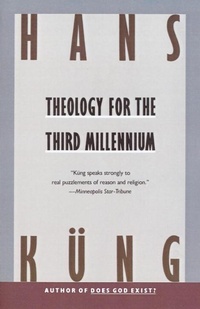
Theology for the Third Millennium
An Ecumenical View
Erschienen am 21. September 2011
336 Seiten
978-0-307-80588-1 (ISBN)
Beschreibung

In Theology for the Third Millennium, which culminates thirty years of scholarship, Hans Küng reaffirms the relevance of theology in a modern world where religion is constantly questioned-and frequently attacked.
Weitere Details
Weitere Ausgaben
Andere Ausgaben
Buch
01/1990
Anchor Books
19,00 €
Artikel ist vergriffen; siehe andere Ausgabe
Person
Hans Kung obtained a doctorate in theology from the Sorbonne in 1957. He was ordained a Roman Catholic priest in 1954. In 1962 he was named by Pope John XXIII a theological consultant for the second Vatican Council and played the key role in the writing of Vatican II, which radically modernized key areas of Catholic teaching. His questioning of traditional Church doctrines led to a 1979 Vatican censure that banned his teaching as a Catholic theologian, provoking huge international controversy. A settlement was reached a year later. He lives and teaches in Tubingen, Germany. His many books include On Being a Christian and Christianity: Essence, History, and Future.
Inhalt
- Intro
- Title Page
- Copyright
- Dedication
- Contents
- Foreword
- Direction: On the Way to "Postmodernity"
- 1. Postmodern-a Heuristic Concept
- 2. Crisis and the Departure Toward the New
- 3. The Function of Religion in Postmodernity
- A: Classical Conflicts
- I: Ecumenical Theology Caught in the Cross Fire: Consequences of the Dispute Between Rome, Luther, and Erasmus
- 1. Chances for a Third Force?
- 2. The Restoration of the Counter-Reformation
- 3. Erasmus the Unloved
- 4. A Reformer Before the Reformers
- 5. The Emergency: Wittenberg Versus Rome
- 6. Between Rome and Wittenberg: Neutrality Instead of Commitment
- 7. Martin Luther's Share of the Guilt
- 8. On the Responsibility of Theology at the Moment of Truth
- 9. Ecumenical Theology Between Aggression and Flight
- II: The Bible and Church Tradition: Unfinished Business Between Catholicism, Protestantism and Orthodoxy
- 1. Scripture "and" Tradition: The Catholic Answer to Luther
- 2. Scripture "or" Tradition: A Weak Compromise by Vatican II
- 3. Scripture-Taken Literally: The Protestant Version of Infallibility
- 4. Does Inspired Mean Unerring? Vatican II and the Bible
- 5. The Ecumenical Solution: Scripture as Testimony to Revelation
- 6. Is the Orthodox Tradition in Keeping with Scripture?: The Problem of the Eastern Church
- 7. Yes to the Bible, Tradition, and Authority
- No to Biblicism, Traditionalism, and Authoritarianism
- 8. What Christians Believe In
- III: Schism Because of the Bible?: On the Problem of the Unity of Scripture and the Church
- 1. Is the Unity of the Church Grounded in the New Testament Canon?: Ernst Käsemann
- 2. The Dispute over Unity: Hermann Diem
- 3. Narrowing the Area of Discussion: Agreements
- 4. The Reason for the Multiplicity of Confessions: Selection
- 5. Evangelical Catholicity as an Imperative
- 6. Postscript 1986
- IV: Dogma Versus the Bible?: Historico-Critical Exegesis as a Challenge to Dogmatic Theology
- 1. On the Misery of Today's Dogmatic Theology
- 2. The Sacraments-"Instituted by Christ"?
- 3. Church Offices-"in the Apostolic Succession"?
- 4. Jesus Christ-in the Shadow of Dogma?
- B: Future Perspectives
- I: How Does One Do Christian Theology?: Steps Toward Understanding
- 1. Vatican II and Its Consequences
- 2. A Comparison of Two Christologies: Edward Schillebeeckx
- 3. What Is the Norm for Christian Theology?
- 4. The Consensus on Historico-critical Exegesis
- 5. What to Do in the Jungle of Hypotheses?
- 6. What Is the Horizon of Catholic Theology?
- 7. Critical Correlation Without Critical Confrontation?
- II: Paradigm Change in Theology and Science: A Fundamental Historical-Theological Clarification
- 1. In Search of Connections
- 2. The Theoretical Framework
- 3. What Does Paradigm Change Mean?: Thomas S. Kuhn
- 4. Macro-, Meso-, and Microparadigms
- 5. How Does Novelty Come into Being?: Parallels from Natural Science and Theology
- 6. A Total Break? The Question of Continuity
- 7. Differences Between Theology and Science
- 8. A Critical Ecumenical Theology
- 9. Horizon? The World (First Constant)
- 10. What Standard? The Christian Message (Second Constant)
- III: A New Basic Model of Theology?: Disputable and Indisputable Points
- 1. "Paradigm": A Controversial Concept
- 2. Clarifications
- 3. The Present-day Crisis: What We Don't Have to Argue About Any More
- 4. Four Dimensions of the Postmodern Paradigm
- IV: Theology on the Way to a New Paradigm: Reflections on My Own Career
- 1. The Paradigm of Catholic Traditionalism
- 2. Speculative Escape Routes?: Karl Rahner
- 3. A Theology of Crisis: Karl Barth
- 4. Bridging the Gap Between Exegesis and Dogmatic Theology
- 5. The Christian Message as the Basic Norm of Theology
- 6. Today's World of Experience as the Horizon of Theology
- 7. From the Modern-Enlightened to the Postmodern Paradigm
- 8. Theology in the Postmodern Paradigm
- 9. Ethos and Style of Critical Ecumenical Theology
- C: A New Departure Toward a Theology of the World Religions
- I: On Paradigm Change in the World Religions: Preliminary Reflections on an Analysis of the Religious Situation of the Age
- 1. The Distinction Between Religion and Paradigm
- 2. The Question of Epochal Thresholds
- 3. The Survival of "Outdated" Paradigms in Art and Religion
- 4. Does Paradigm Change Mean Progress?
- 5. Constants and Variables in Buddhism
- II: Is There One True Religion?: An Essay in Establishing Ecumenical Criteria
- 1. One or Several: A Pragmatic Solution?
- 2. Four Basic Positions
- 3. The Knotty Question of a Criterion for Truth
- 4. The Human Element: General Ethical Criterion
- 5. The Authentic or Canonical: General Religious Criterion
- 6. On the Specifically Christian Criterion
- 7. On the Way to Ever Greater Truth
- D: Karl Barth and the Postmodern Paradigm
- 1. Theological Confrontation
- 2. Catholic Attempts at Understanding
- 3. Ecumenical Understanding
- 4. Karl Barth-Initiator of a "Postmodern" Paradigm in Theology
- 5. Karl Barth-Not the Perfector of the Postmodern Paradigm in Theology
- 6. Creation-Revelation: The Permanent Challenge of "Natural Theology"
- 7. Criticism of "Theological Exegesis": The Permanent Challenge of Rudolf Bultmann
- 8. A Critical-sympathetic Rereading of Barth Against the Background of Postmodernity
- Notes
- Dates and Places of Original Publication
- About the Author
