

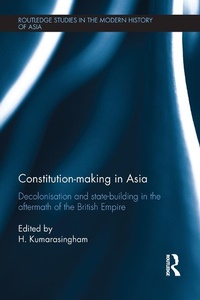
Constitution-making in Asia
Decolonisation and State-Building in the Aftermath of the British Empire
Erschienen am 31. März 2016
222 Seiten
978-1-317-24510-0 (ISBN)
Beschreibung

Britain's main imperial possessions in Asia were granted independence in the 1940s and 1950s and needed to craft constitutions for their new states. Invariably the indigenous elites drew upon British constitutional ideas and institutions regardless of the political conditions that prevailed in their very different lands. Many Asian nations called upon the services of Englishman and Law Professor Sir Ivor Jennings to advise or assist their own constitution making. Although he was one of the twentieth century's most prominent constitutional scholars, his opinion and influence were often controversial and remain so due to his advocating British norms in Asian form.
This book examines the process of constitutional formation in the era of decolonisation and state building in Asia. It sheds light upon the influence and participation of Jennings in particular and British ideas in general on democracy and institutions across the Asian continent. Critical cases studies on India, Pakistan, Sri Lanka, Malaysia and Nepal - all linked by Britain and Jennings - assess the distinctive methods and outcomes of constitution making and how British ideas fared in these major states. The book offers chapters on the Westminster model in Asia, Human Rights, Nationalism, Ethnic politics, Federalism, Foreign influence, Decolonisation, Authoritarianism, the Rule of Law, Parliamentary democracy and the power and influence of key political actors. Taking an original stance on constitution making in Asia after British rule, it also puts forward ideas of contemporary significance for Asian states and other emerging democracies engaged in constitution making, regime change and seeking to understand their colonial past.
The first political, historical or constitutional analysis comparing Asia's experience with its indelible British constitutional legacy, this book is a critical resource on state building and constitution making in Asia following independence. It will appeal to students and scholars of world history, public law and politics.
This book examines the process of constitutional formation in the era of decolonisation and state building in Asia. It sheds light upon the influence and participation of Jennings in particular and British ideas in general on democracy and institutions across the Asian continent. Critical cases studies on India, Pakistan, Sri Lanka, Malaysia and Nepal - all linked by Britain and Jennings - assess the distinctive methods and outcomes of constitution making and how British ideas fared in these major states. The book offers chapters on the Westminster model in Asia, Human Rights, Nationalism, Ethnic politics, Federalism, Foreign influence, Decolonisation, Authoritarianism, the Rule of Law, Parliamentary democracy and the power and influence of key political actors. Taking an original stance on constitution making in Asia after British rule, it also puts forward ideas of contemporary significance for Asian states and other emerging democracies engaged in constitution making, regime change and seeking to understand their colonial past.
The first political, historical or constitutional analysis comparing Asia's experience with its indelible British constitutional legacy, this book is a critical resource on state building and constitution making in Asia following independence. It will appeal to students and scholars of world history, public law and politics.
Weitere Details
Reihe
Sprache
Englisch
Verlagsort
London
Großbritannien
Verlagsgruppe
Taylor & Francis Ltd
Zielgruppe
Für höhere Schule und Studium
Illustrationen
3 s/w Tabellen
3 Tables, black and white
Dateigröße
3,77 MB
ISBN-13
978-1-317-24510-0 (9781317245100)
Copyright in bibliographic data and cover images is held by Nielsen Book Services Limited or by the publishers or by their respective licensors: all rights reserved.
Schweitzer Klassifikation
Weitere Ausgaben
Andere Ausgaben
H. Kumarasingham
Constitution-making in Asia
Decolonisation and State-Building in the Aftermath of the British Empire
Buch
09/2018
1. Auflage
Routledge
73,30 €
Versand in 15-20 Tagen
H. Kumarasingham
Constitution-making in Asia
Decolonisation and State-Building in the Aftermath of the British Empire
Buch
03/2016
1. Auflage
Routledge
231,60 €
Versand in 15-20 Tagen
Person
H. Kumarasingham is a Researcher at the Max Planck Institute for European Legal History in Frankfurt, Germany and Senior Research Fellow at the Institute of Commonwealth Studies, University of London, UK.
Inhalt
1. Eastminster - Decolonisation and State-Building in British Asia 2. British constitutional thought and the emergence of bills of rights in Britain's overseas territories in Asia at decolonization 3. Discretionary reserve powers of heads of state 4. A British Misreading: Sir Ivor Jennings' Early Assessment of the Indian Constitution 5. Pakistan's First Decade: Democracy and Constitution - A Historical Appraisal of Centralization 6. 'Specialist In Omniscience'? Nationalism, Constitutionalism, And Sir Ivor Jennings' Engagement With Ceylon7. Constitutionalism and the politics of constitution-making in Malaya, 1956-1957 8. Constitution Drafting as Cold War Realpolitik: Sir Ivor Jennings and Nepal's 1959 Constitution 9. Sir William Ivor Jennings: A Centennial Paper
