

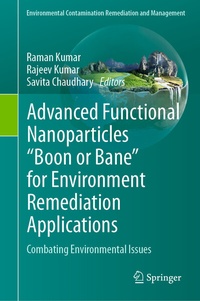
Advanced Functional Nanoparticles "Boon or Bane" for Environment Remediation Applications
Combating Environmental Issues
Erschienen am 17. Mai 2023
XV, 363 Seiten
978-3-031-24416-2 (ISBN)
Beschreibung
This textbook provides an overview of applications of advanced nanomaterials, basic lab set up and requirements in for their synthesis, techniques and career scope of nanotechnology in industries and research.
Pollution of air, water, soil is an ever increasing environmental problem attributed to increasing population, global industrialization and unplanned urbanization, has acquired alarming dimensions. It is the most dangerous and worst problem that puts the lives of people, animals, and plants on the earth in danger. An effective, efficient and sustainable approach for managing pollution related problems requires the utmost attention of the scientific community to tackle this menace for the society to lead a healthy and quality life. A number of techniques and books, literatures have been developed in recent years to treat environmental contaminants. However, most of these are not economically viable, environmentally benign and suffer due to cumbersome multi-step manipulations. The purpose of this textbook is to inform students about the application of functionalized nanoparticles as a new approach to supplement traditional treatment methods in cost and time effective manner. The simplistic means to assemble nanoparticles to the constituents of next generation technologies in environment cleanup and sensing are the main objectives of the book. The toxicological footprinting of released advanced functional nanomaterials in ecosystem will also be discussed in the book.Weitere Details
Weitere Ausgaben
Personen
Dr Raman Kumar
is working as Senior Associate Professor in Department of Biotechnology, Maharishi Markendeshwar (Deemed to be University), Mullana (Ambala), Haryana, India Since 2011. He has also worked as Senior Research Fellow, Division of Soil and Crop Management, Central Soil Salinity Research Institute, Karnal, India from 2007 to 2010. He has experience of about 17 years in the field of Teaching and Research in the area of Microbial and Environmental Biotechnology. He has published more than 65 publications and 03 books in Various National and International Peer Reviewed Journals. He is also the Associate Editor for the research Journal "Current Trends in Biotechnology and Chemical Research" (eISSN 2321-0265;pISSN 2249-4073) which we initiated from this University (M.M. (Deemed to be University) which is currently indexed in many reputed databases including CAS, Medical Journal Links etc. He has been working in area of Environmental Biotechnology and also get Major project from Haryana DST in the area of Environmental Microbiology. He developed many bacterial and fungal strains for removal of heavy metals from wastewater. His current research areas are Bioremediation and Biodegradation of toxic pollutants, Pesticides and azo dyes using microbial consortium from the industrial Effluents, Mechanism involved in the heavy metal bioremediation.
Dr. Rajeev Kumar is a permanent faculty at the Department of Environment Studies, Panjab University, Chandigarh since July 2010. Dr. Kumar obtained his Ph.D degree in Chemistry from the Department of Chemistry, Panjab University, Chandigarh during which he published various research articles in journal of international repute. His laboratory focuses on the eco-friendly removal of environmental pollutants, specifically on the fungal remediation of recalcitrant compounds. His research group makes use of different modern technologies based on organometallics and nano- chemistry for this purpose. Dr. Kumar is the recipient research awards from the different funding agencies of the Government of India viz. Science and Engineering Research Board (SERB)- a statutory body of the Department of Science & Technology (DST) and University Grants Commission (UGC) for his research endeavors. He has also been the Project Director of "Indo-US Partnership on Green Chemistry/Engineering and Technologies Education, Research and Outreach for Sustainable Development funded by UGC and Ministry for Human Resource and Development (MHRD), India. He has published 62 International research papers in with more than 180 citations in journal of international repute making his H-index of 21. His publications also include 17 International book chapters with Springer International; CRC, London and Wiley Interscience etc. Dr. Rajeev Kumar has visited several countries for his research work and has International collaborators from various countries including USA, Israel, Singapore, Vietnam and Australia.
Savita Chaudhary is working as an Assistant Professor in Department of Chemistry & Centre of Advanced Studies, Panjab University, Chandigarh. She has made significant contributions in the visionary mission of the central government under Swachata Abhiyan by using the application of advanced nanomaterials. The current state of her work offers a sustainable use of nanoparticles in treating realistic water and harmful radiation problems. Her research methodology provides the better option of waste biomass conversion into useful advanced carbon dots. Therefore her research work, overcomes the problem of waste disposal and burning of crop stubble to a greater extent. The fabrication of chemodosimeters, fluorescence and electrochemical based sensors by Chaudhary et al. has un-wrapped colossal range of prospects of their utilization from laboratory study to realistic waste water treatment. Dr. Chaudhary is credited with "140 publications inrepute journals with h-index of 28, i10 index of 70 and 2640 citations". The consolidated impact factor of her research work is 400. Her work is acknowledged at various National and International platform. She has authored 1book and 14 book chapters. She has been conferred with "Haryana Yuva Vigyan Ratan Award (2014-15)", "DST-DAAD fellowship (2008)" and best posters and presentation awards. Dr. Chaudhary has handled 5 independent major research projects.
Dr. Rajeev Kumar is a permanent faculty at the Department of Environment Studies, Panjab University, Chandigarh since July 2010. Dr. Kumar obtained his Ph.D degree in Chemistry from the Department of Chemistry, Panjab University, Chandigarh during which he published various research articles in journal of international repute. His laboratory focuses on the eco-friendly removal of environmental pollutants, specifically on the fungal remediation of recalcitrant compounds. His research group makes use of different modern technologies based on organometallics and nano- chemistry for this purpose. Dr. Kumar is the recipient research awards from the different funding agencies of the Government of India viz. Science and Engineering Research Board (SERB)- a statutory body of the Department of Science & Technology (DST) and University Grants Commission (UGC) for his research endeavors. He has also been the Project Director of "Indo-US Partnership on Green Chemistry/Engineering and Technologies Education, Research and Outreach for Sustainable Development funded by UGC and Ministry for Human Resource and Development (MHRD), India. He has published 62 International research papers in with more than 180 citations in journal of international repute making his H-index of 21. His publications also include 17 International book chapters with Springer International; CRC, London and Wiley Interscience etc. Dr. Rajeev Kumar has visited several countries for his research work and has International collaborators from various countries including USA, Israel, Singapore, Vietnam and Australia.
Savita Chaudhary is working as an Assistant Professor in Department of Chemistry & Centre of Advanced Studies, Panjab University, Chandigarh. She has made significant contributions in the visionary mission of the central government under Swachata Abhiyan by using the application of advanced nanomaterials. The current state of her work offers a sustainable use of nanoparticles in treating realistic water and harmful radiation problems. Her research methodology provides the better option of waste biomass conversion into useful advanced carbon dots. Therefore her research work, overcomes the problem of waste disposal and burning of crop stubble to a greater extent. The fabrication of chemodosimeters, fluorescence and electrochemical based sensors by Chaudhary et al. has un-wrapped colossal range of prospects of their utilization from laboratory study to realistic waste water treatment. Dr. Chaudhary is credited with "140 publications inrepute journals with h-index of 28, i10 index of 70 and 2640 citations". The consolidated impact factor of her research work is 400. Her work is acknowledged at various National and International platform. She has authored 1book and 14 book chapters. She has been conferred with "Haryana Yuva Vigyan Ratan Award (2014-15)", "DST-DAAD fellowship (2008)" and best posters and presentation awards. Dr. Chaudhary has handled 5 independent major research projects.
Inhalt
Chapter 1. Advanced Nanomaterials: From Properties and Perspective Applications, to Their Interlinked Confronts (Chitven Sharma).- Chapter 2. Advanced Nanoparticles: Boon or a Bane for Environmental Remediation Applications (Deepak Rohilla).- Chapter 3. Nanomaterials in Environment: Sources, Risk Assessment and Safety Aspect (Ashpreet Kaur).- Chapter 4. Environmental Fate descriptors for screening Nanotoxicity and pollutant sensing (Pooja Chauhan).- Chapter 5. Nanomaterials in Combating Water Pollution and Related Ecotoxicological Risk (Teenu Jasrotia).- Chapter 6. Nanotechnology: Emerging Opportunities and Regulatory Aspects in Water Treatment (Yogita Lugani).- Chapter 7. Nanoparticles in Dye Degradation: Achievement and Confronts (Rekha Dhull).- Chapter 8. Safe Appraisal of Carbon Nanoparticles in Pollutant Sensing (Manisha Kumari).- Chapter 9. Advanced Nanomaterials in Biomedicine: Benefits and Challenges (Avtar Singh).- Chapter 10. New Perspectives application and hazards ofNanomaterials in aquatic environment (Renuka Chaudhary).- Chapter 11. Risk Governance Policies for Sustainable Use of Nanomaterials (Pooja Chauhan).- Chapter 12. Misconceptions in Nanotoxicity Measurements: Exploring Facts to Strengthen Ecosafe Environmental Remediation (Chitven Sharma).
