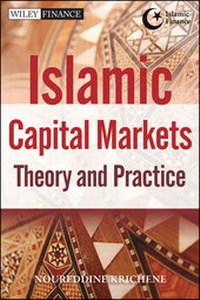
Islamic Capital Markets
Beschreibung
Weitere Details
Weitere Ausgaben
Person
Inhalt
- Intro
- Islamic Capital Markets: Theory and Practice
- Copyright
- Contents
- Preface
- Why Islamic Finance?
- Why Money and Finance?
- Why Stress Capital Theory?
- Audience
- Overview of the Contents
- Acknowledgments
- Glossary of Arabic Terms
- Part One: Islamic Capital Markets: Tools of Securities Investment, Asset Pricing, Risk Management, and Portfolio Performance
- Chapter 1: Capital Theory and Islamic Capital Markets
- On the Nature of Capital
- On the Nature of Interest and Profit
- Capital Theory in Islamic Finance
- Time Preference and Capital Markets
- Standard Intertemporal Consumer Theory
- Equilibrium Market Rate
- Capital Productivity: The Intertemporal Production Opportunity Set
- General Equilibrium: Time Preference and Capital Productivity
- Intertemporal Exchange-Production Model
- Equilibrium Market Rate of Return
- Model of Capital as a Subsistence Fund
- Capital as an Engine of Growth
- The Capital Market and the Economy
- Definition of the Sectors
- National Income and Products Accounts
- Flow-of-Funds Accounts
- The Markets
- The Intermediation Role of the Capital Market
- Summary
- References
- Questions
- Chapter 2: Portfolio Theory and Risk-Return Tradeoff
- Market Uncertainty
- Graphical Description of Uncertainty: Highly Volatile Capital Markets
- Measuring Risk and Return
- Portfolio Diversification Theory
- Mean-Variance Efficiency Frontier
- Investor's Risk Preferences: Utility Function and Indifference Curves
- A Portfolio Diversification Model
- Portfolio Diversification in the Case of Two Risky Assets
- A Model of a Riskless Asset and a Risky Asset
- The Capital Market Line
- Tobin's Two-Fund Theorem
- Asset Pricing Based on Risk-Return Tradeoff
- Systematic and Unsystematic Risk
- The Capital Asset Pricing Model (CAPM)
- The Security Market Line
- Efficiency Frontier, Capital Market Line, Characteristic Line, and Security Market Line
- The Cost of Capital Based on the Capital Asset Pricing Model
- Summary
- References
- Questions
- Chapter 3: The Analytics of Sukuks
- Valuation of an Asset
- Present Value of a Cash Flow
- Simple Compounding and Continuous Compounding
- Valuation of Sukuks
- Yield to Maturity
- Reinvestment of Sukuk Coupons
- The Par Yield
- Zero-Coupon Sukuk
- Spot Rates and Forward Rates
- Spot Rates
- Forward Rates
- Arbitrage-Free Forward Rates
- Forward Rate Agreements
- Pricing Forward Rate Agreements
- The Term Structure of Rates of Return
- Types of Yield Curve
- Theories of Term Structure
- Unbiased Market Expectations (Pure Expectations) Theory
- Liquidity Premium Theory
- Market Segmentation Theory
- Preferred Habitat Theory
- Sukuk Duration
- Definition of Duration
- Properties of Duration
- Duration and Sukuk Price Volatility
- Sukuk Convexity
- Definition of Convexity
- Properties of Convexity
- Immunization of Sukuk Portfolio
- Cash-Flow Matching
- Duration Matching
- Application of Duration to Immunization
- Hedging with Futures Contracts
- Understand Risks in Sukuks
- Summary
- References
- Questions
- Chapter 4: Islamic Stocks
- Sharia Screening
- Islamic Indexes
- Speculation and Gambling
- Stock Yield
- Dividend Yield
- Earnings Per Share
- Price-to-Earnings (P/E) Ratio
- Common Stock Valuation
- Stock Price and Expected Rate of Return
- Equilibrium Rate of Return
- Changes in Equilibrium Stock Prices and Market Volatility
- Forecasting Stock Prices
- Importance of Forecasting and Types of Forecasting Models
- Auto-Regressive Forecast Models
- Conditional Forecast
- Growth Trend Forecasting
- Historical Price-to-Earnings (P/E) Ratio
- Historical Trend Line
- Fundamental and Technical Analysis
- Fundamental Analysis
- Technical Analysis
- The Efficiency Hypotheses of Stock Markets
- Evaluating Companies
- Mechanics of Trading
- What a Stock Market Does
- Reading Stock Quotes
- Placing a Stock Order
- Trade Execution
- Summary
- References
- Questions
- Chapter 5: The Cost of Capital
- Objective of the Firm: Market Value Maximization and the Cost of Capital
- Project Selection: The Hurdle Rate
- Defining Capital Cost: The Discount Rate
- The Net Cash Flow
- Net Cash Flow to Common Equity
- Net Cash Flow to Invested Capital
- The Present Value Formula
- Valuing a Preferred Stock
- Valuing a Common Stock
- Relationship between Risk and the Cost of Capital
- Defining Risk
- Types of Risk
- Estimating the Cost of Equity Capital and Overall Cost of Capital
- Capital Asset Pricing Model (CAPM)
- Risk-Adjusted versus Certainty-Equivalent Discount Rates
- Applying the CAPM to Calculate Certainty-Equivalent Cash Flow
- The Valuation of Securities, Leverage, and the Cost of Capital: The Modigliani and Miller Theory
- The Capitalization Rate for Uncertain Income Streams
- Debt Financing and Its Effects on Security Prices
- Weighted Average Cost of Capital
- Implications of the Capital Cost Analysis for the Theory of Investment: Capital Structure and Investment Policy
- The Agency Problem
- Summary
- References
- Questions
- Chapter 6: Asset Pricing under Uncertainty
- Modeling Risk and Return
- Financial Series Are Highly Volatile and Uncertain
- Discrete Time Uncertainty: Binomial Tree Approach to Uncertainty
- Uncertainty and Efficient Capital Markets: Random Walk and Martingale
- Market Efficiency and Arbitrage-Free Pricing
- Definition of Arbitrage
- Pricing of Assets by Arbitrage
- Basic Principles of Derivatives Pricing
- Types of Derivatives
- Derivatives Payoffs
- Principles of Derivatives Pricing Theory
- Summary
- References
- Questions
- Chapter 7: The Consumption-Based Pricing Model
- Intertemporal Optimization and Implication to Asset Pricing
- Asset-Specific Pricing and Correction for Risk
- Relationship between Expected Return and Beta
- The Mean Variance (mv) Frontier
- Risk-Neutral Pricing Implied by the General Pricing Formula pt . Et(mt+1Xt+1)
- Consumption-Based Contingent Discount Factors
- Equity Premium and Interest Rate Puzzles
- Summary
- References
- Questions
- Chapter 8: Futures Markets
- Institutional Aspects of Forward and Futures Contracts
- Definitions
- The Clearinghouse
- Margin Requirement for Futures Contracts
- Settlement of Futures Contracts
- Valuation of Forward and Futures Contracts
- Replication Portfolio of a Futures Contract: Underlying Asset and Cash
- Cash-and-Carry Arbitrage When Underlying Asset Pays Dividends
- Convenience Yield
- Pricing via Expectation and the Martingale Condition
- Foreign Currencies Futures and the Yield Rate Parity
- Hedging
- Purpose of Hedging
- Short Hedge
- Long Hedge
- Rolling the Hedge Forward
- The Hedge Ratio
- Cross Hedging
- Speculating in Futures Markets
- Summary
- References
- Questions
- Chapter 9: Stock Index Futures
- Specifications of the Stock Index Futures Contract
- The Pricing of a Stock Index Futures Contract
- Hedging with Stock Index Futures
- A Short Hedge to Protect Against a Bear Market
- A Long Hedge to Benefit from a Bull Market
- The Minimum Risk Hedge Ratio
- Cross Hedging
- Target Beta and Capture Alpha with Stock Index Futures
- Target Beta
- Alpha Capture
- Constructing an Indexed Portfolio
- Asset Allocation
- Creating a Synthetic T-bill
- Creating a Synthetic Equity Position
- Synthetic Asset Allocation Using Stock and Bond Futures
- Portfolio Insurance
- Index Arbitrage
- Program Trading
- Premium Buy and Sell Execution Levels
- Dynamic Hedging and Portfolio Insurance Strategy
- Summary
- References
- Questions
- Chapter 10: Interest-Rate Futures Markets and Applications to Sukuks
- Types of Interest-Rate Futures Contracts
- Short-Term Interest Rate Futures Contracts
- Longer Maturity Interest Rate Futures
- The Conversion Factor
- Cheapest to Deliver (CTD) Bond
- The Pricing of Sukuk Forward Contracts
- Hedging with Interest-Rate Futures
- Interest-Rate Futures in Sukuk Portfolio Management
- Controlling the Interest Rate Risk of a Sukuk Portfolio: Adjusting Duration
- Duration-Based Hedging Strategies
- Cross-Hedge Ratio, Hedged and CTD Instruments, and Target Volatility
- Immunization of Sukuk Portfolio with Interest-Rate Futures
- Portfolio Immunization over a Planning Horizon
- The Bank Immunization Case
- Summary
- References
- Questions
- Chapter 11: Basic Principles of Options
- Options: Basic Definitions
- Call Option Payoff
- Put Option Payoff
- Trading Strategies
- Covered Call
- Protective Put
- Long Straddle
- Short Straddle
- Spreads
- Butterfly Spread
- Option Pricing
- Illustrating the Notion of Replication and Hedging of Option Positions
- The Binomial Model of Option Pricing
- Replicating the Call in the Binomial Model
- Pricing the Put Option
- Call-Put Parity
- The Binomial Model: Extension to Two Periods
- The Option Delta
- Delta in Hedging Options
- Delta as a Sensitivity Measure
- Sign and Magnitude of Delta
- Variability of Delta
- Implications for Replication and Hedging
- Risk-Neutral Pricing
- Advantages of Risk-Neutral Pricing
- Steps in Risk-Neutral Pricing
- Why the Risk-Neutral Method Works
- The Black-Scholes (BS) Model
- Properties of the BS Model
- Call Prices in the BS Model
- Interpreting the BS Formula
- Call Prices and Risk-Neutral Pricing: Interpretation of N(d2)
- Put Option Prices in the BS Model
- Other Features of the BS Model: Volatility and Dividends on Stock Prices
- Computing Option Pricing Using Microsoft Excel Spreadsheets
- Currency Options
- Caps and Floors
- Caps
- Floors
- Pricing of Caps and Floors
- Summary
- References
- Questions
- Chapter 12: Swaps
- Structure and Payoff of a Swap
- Motivations for the Swap
- Mismatch of the Sales and Debt Profiles
- The Comparative Advantage Argument
- The Valuation of Plain-Vanilla Swaps: The Swap Rate
- Definition of the Swap Price
- Pricing Forward Rate Agreements (FRAs)
- Pricing a Swap
- Currency Swaps
- Definition and Examples of Currency Swaps
- Motivation for Currency Swaps
- Benefits of Currency Swaps
- Drawbacks of Currency Swaps
- Pricing a Currency Swap
- Currency Forward Contract
- Valuation of a Fixed-for-Fixed Currency Swap
- Valuation of a Fixed-for-Floating Currency Swap
- Valuing a Currency Swap as a Series of Currency Forward Contracts
- Equity Swap
- Definition of Equity Swaps
- Pricing of Equity Swaps
- Credit Default Swap
- Total Return Swap
- Structured Notes: Inverse Floater and Bear Floater
- Inverse Floater
- Bear Floater
- Options on Interest Rate Swaps: Swaptions
- Definition of Swaptions
- Valuation of European Swaptions
- Interest-Rate Swaps as Hedging Instruments
- Duration of a Swap
- Interest Rate Immunization with Swaps
- Duration Gap Hedging
- Setting Interest-Rate Sensitivity with Swaps
- Summary
- References
- Questions
- Chapter 13: Mutual Funds
- How Does a Mutual Fund Work?
- Index Funds and Hedge Funds
- Types of Mutual Funds
- Asset Allocation Funds
- Fixed-Income Funds
- Stock Funds
- Money-Market Funds
- Fees and Expenses
- Shareholder Fees
- Annual Fund Operating Expenses
- Regulations
- The Mutual Fund Prospectus and Shareholder Reports
- Statement of Additional Information (SAI)
- Shareholder Reports
- Mutual Fund Performance
- How Funds Earn Money
- Measurements of Performance
- Performance Evaluation of Mutual Funds
- Presentation of Accounts
- Accounting Policies
- Annual Report
- Mutual Fund Advantages and Risks
- Advantages of Mutual Funds
- What Risks Are Associated with a Mutual Fund?
- Summary
- References
- Questions
- Chapter 14: Portfolio Performance and Value-at-Risk
- Nature and Purpose of the Performance Evaluation
- Measuring Performance
- Methodologies for Evaluating Performance
- Tracking Error
- The Treynor Index
- Sharpe Index
- The Jensen Index
- The Fama's Performance Measure
- The Fama-French Three-Factor Model
- Performance Attribution Models
- Value-at-Risk (VaR)
- Portfolio's Market Risk
- Definition of VaR
- Purpose of VaR
- Methods for Calculating VaR
- Variance Covariance Method (VCV)
- Delta Normal and the Delta Gamma Normal Valuations
- Historical Simulation
- Monte Carlo (MC) Resampling Method
- Stress Testing and Back Testing
- Summary
- References
- Questions
- Part Two: Money and Capital Markets
- Chapter 15: The Banking System
- On the Nature of Central Banking
- On the Nature of Money
- Money as a Medium of Exchange and Store of Value
- Properties of Money and Types of Money
- Fractional Banking and the Money Multiplier
- Fractional Banking
- Formulation of the Money Multiplier
- The Central Bank
- Central Bank's Money Issuance
- Balance Sheet of the Central Bank
- The Reserves Market: Demand and Supply of Reserves
- Reserves Market as a Transmission Channel of Monetary Policy
- Demand for Reserve Balances
- Supply of Reserve Balances
- The Regulatory and Supervisory Role of the Central Bank
- Supervisory Process
- Regulatory Functions
- The Debate over the Role of the Central Bank
- The Theory of Two Interest Rates
- Central Banking and Financial Markets
- Central Bank in Islamic Finance
- Summary
- References
- Questions
- Chapter 16: The Demand for Money
- Motives for Holding Money
- Demand for Money as Affected by the Rate of Interest
- The Baumol-Tobin Model of Money Demand
- Equilibrium in the Market for Money
- Demand for Money as Influenced by the Price Level
- Other Determinants of the Demand for Money
- Effects of Changes in the Money Market
- The Quantity Theory of Money and Money Demand
- The Cambridge Transaction Approach
- The Restatement of the Quantity Theory as a Demand for Money Function
- Summary
- References
- Questions
- Chapter 17: Capital Markets and the Macroeconomy
- Financial Crises and Approaches for Recovery
- The Income-Expenditure Sector
- The Monetary Sector
- Macroeconomic Equilibrium
- Fixed Price Level at P
- Flexible Prices: Aggregate Demand (AD) and Aggregate Supply (AS)
- Macroeconomic Equilibrium under Keynesian Assumptions
- Classicists' Approaches to Recovery from Depression
- Islamic Approaches to Recovery from Depression
- Stagflation and Post-2008 Crisis Unemployment
- Summary
- References
- Questions
- Part Three: Regulations and Institutions of Capital Markets and Islamic Structured Finance
- Chapter 18: Institutions and Regulations of Capital Markets
- Regulatory Legislation
- The Securities and Exchange Commission
- The U.S. Commodity Futures Trading Commission
- The Stock Market
- Brokerage Firm
- Online Trading: A Form of Discount Brokerage
- Selecting an Online Broker
- Selecting an Account
- Making Trades
- Investment Advisers
- Clearinghouses
- Central Securities Depository
- The Depository Trust Company (DTC)
- National Securities Clearing Corporation (NSCC)
- Fixed Income Clearing Corporation (FICC)
- Deriv/SERV
- EuroCCP
- Investment Banks
- Investment Companies
- Investment Funds
- Funds
- Charging Structures and Fees
- Mutual Funds
- Advantages
- Disadvantages
- History
- Types of Mutual Funds
- Investments and Classification
- Exchange-Traded Funds
- Structure
- Investment Uses
- Types of ETFs
- ETFs Compared to Mutual Funds
- Hedge Funds
- History
- Strategies
- Hedge Fund Risk
- Transparency and Regulatory Considerations
- Risks Shared with Other Investment Types
- Domicile
- Open-Ended Nature
- Comparison with Other Funds
- Money Market Funds
- Structured Investment Vehicles
- Summary
- References
- Questions
- Chapter 19: Institutions and Instruments of Islamic Capital Markets
- The Sharia Advisory Council
- Islamic Modes of Financing and Islamic Instruments
- Islamic Funds
- Murabaha Funds
- Mudaraba Funds
- Ijara Funds
- Unit Trust Funds
- Islamic Equity Funds
- Sukuk Funds
- Islamic Real Estate Investment Trusts (REITs)
- Islamic Exchange-traded Funds (ETFs)
- Islamic Private Equity and Venture Capital Funds
- Islamic Hedge Funds
- Islamic Commodity Funds
- Islamic Money Market Funds
- Islamic Derivatives Markets
- Guidelines on the Offering of Islamic Securities
- Summary
- References
- Questions
- Chapter 20: Sukuks
- Asset Securitization
- Structure and Legal Documentation of Islamic Private Debt Securities
- Types of Sukuk Structures
- Murabaha Notes Issuance Facility
- Bai Bi-Thaman Ajil Islamic Debt Securities
- Ijara Notes Issuance Facility
- Islamic Asset-backed Securitization
- Musharaka Sukuks
- Hybrid Sukuks
- Sukuk Issuance in Practice
- Malaysia Sukuk Market
- The Broader Sukuk Market
- Risks Underlying Sukuks' Structures
- Liquidity Risk
- Interest Rate Risk
- Foreign Exchange Rate Risk
- Credit and Counterparty Risk
- Sharia-Compliance Risks
- Other Risks Affecting Sukuks
- Managing the Financial Risks of Sukuk Structures
- Liquidity and Secondary Markets
- Sukuks and the Challenge of Derivatives
- Embedded Options as a Risk Management Tool
- Summary
- References
- Questions
- Chapter 21: Islamic Structured Products
- Structured Finance
- Definition of Structured Products
- Features of Structured Products
- Risks and Benefits of Structured Products
- Types of Structured Products
- Financial Engineering of Structured Products
- Custom Sizing
- Over the Rainbow
- Islamic Structured Products
- Sharia-compliant Structured Product: Ordinary Murabaha
- Sharia-compliant Structured Product: Consecutive or Rolled Murabaha
- Sharia-compliant Structuring Strategies Based on Arbun, Waad, and Khiyar al-Tayeen
- Profit Rate Swap
- Profit Rate Swap Structure Based on Parallel Murabaha
- Profit Rate Swap Structure Based on Simplified Parallel Murabaha
- Profit Rate Swap Structure Based on Waad
- Challenges for Islamic Structurers
- Examples of Structured Products
- Islamic All Stars Global Restricted Mudaraba Structured Investment-i
- Dynamic Market Rider NID-i Islamic Negotiable Instrument of Deposit
- The Islamic Best of Commodities NID-i
- CIMB Islamic Market Select
- Stride-i
- Sharia Inflation Select Fund
- Maybank Al-Sayf
- Ziyad NID-i
- Ziyad NID-ii
- Ziyad NID-iii
- Al Muwa'ama
- Tabdeel
- Reverse Convertible Deposits
- Range Accumulators
- Currency-linked Enhanced Yield Deposit
- Commodity-linked Deposits
- Callable Reverse Floaters
- Callable Corridor Deposits
- Equity-linked Notes (ELNs)
- Callable Certificates of Deposit (CDs)
- Principal-protected CDs
- Double No-touch Currency-linked Deposits
- Summary
- References
- Questions
- About the Author
- Index
Systemvoraussetzungen
Dateiformat: PDF
Kopierschutz: Adobe-DRM (Digital Rights Management)
Systemvoraussetzungen:
- Computer (Windows; MacOS X; Linux): Installieren Sie bereits vor dem Download die kostenlose Software Adobe Digital Editions (siehe E-Book Hilfe).
- Tablet/Smartphone (Android; iOS): Installieren Sie bereits vor dem Download die kostenlose App Adobe Digital Editions oder die App PocketBook (siehe E-Book Hilfe).
- E-Book-Reader: Bookeen, Kobo, Pocketbook, Sony, Tolino u.v.a.m. (nicht Kindle)
Das Dateiformat PDF zeigt auf jeder Hardware eine Buchseite stets identisch an. Daher ist eine PDF auch für ein komplexes Layout geeignet, wie es bei Lehr- und Fachbüchern verwendet wird (Bilder, Tabellen, Spalten, Fußnoten). Bei kleinen Displays von E-Readern oder Smartphones sind PDF leider eher nervig, weil zu viel Scrollen notwendig ist.
Mit Adobe-DRM wird hier ein „harter” Kopierschutz verwendet. Wenn die notwendigen Voraussetzungen nicht vorliegen, können Sie das E-Book leider nicht öffnen. Daher müssen Sie bereits vor dem Download Ihre Lese-Hardware vorbereiten.
Bitte beachten Sie: Wir empfehlen Ihnen unbedingt nach Installation der Lese-Software diese mit Ihrer persönlichen Adobe-ID zu autorisieren!
Weitere Informationen finden Sie in unserer E-Book Hilfe.