

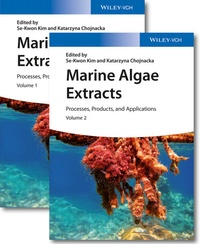
Marine Algae Extracts
Processes, Products, and Applications
1. Auflage
Erschienen am 30. Januar 2015
784 Seiten
978-3-527-67958-4 (ISBN)
Beschreibung

A modern handbook on algae biotechnology covering everything from cultivation to harvesting and processing to product extraction and formulation. Current and future applications of algae extracts in pharmacology, medicine, cosmetics, food and agriculture are described.
Weitere Details
Weitere Ausgaben
Andere Ausgaben
Buch
03/2015
1. Auflage
Wiley-VCH
419,00 €
Artikel ist vergriffen; siehe andere Ausgabe
Software
02/2015
Wiley-VCH
535,49 €
Keine Lieferinformation verfügbar
Personen
Se-Kwon Kim is professor at the Department of Chemistry and Director of the Marine Bioprocess Research Center at Pukyong National University in Busan (South Korea). He received his academic degrees from Pukyong National University and conducted his postdoctoral studies University of Illinois, Urbana-Champaign (USA). Later, he became a visiting scientist at the Memorial University of Newfoundland in Canada. Dr. Kim served as president of the Korean Society of Marine Biotechnology and is a board member of the International Society of Marine Biotechnology and the International Society of Nutraceuticals and Functional Food. His main research interests are investigation and development of bioactive substances from seafood processing wastes and other marine sources. To date, he has authored around 450 research papers, has edited more than 20 books and holds 76 patents.
Katarzyna Chojnacka is a full professor of chemical technology at Wroclaw University of Technology (Poland), where she also obtained her academic degrees. Her research is focused on biosorption and bioaccumulation and their technological application. She has published over 200 articles and written one book.
Katarzyna Chojnacka is a full professor of chemical technology at Wroclaw University of Technology (Poland), where she also obtained her academic degrees. Her research is focused on biosorption and bioaccumulation and their technological application. She has published over 200 articles and written one book.
Inhalt
Introduction to Marine algae
CULTIVATION AND IDENTIFICATION OF MARINE ALGAE
Identification of algae species
Cultivation and identification of microalgae
Dunaliella species identification using intron sizing method and the 18S rDNA
PRODUCTION AND PROCESSING OF MARINE ALGAE
Analysis of algae extracts
Algae extract production methods and process optimization
Production of seaweed extracts by biological and chemical methods
Upstream processing in technology of algal extracts - biomass harvesting and preparation for extraction process
Downstream processing in technology of algal extracts - from the component to the final formulations
Introduction of Marine Algae Extracts
CULTIVATION AND IDENTIFICATION OF MARINE ALGAE
Identification and ecology of macroalgae species existing in Poland
Identification of microalgae producers of commercial importance compounds
Cultivation and identification of microalgae (Diatom)
PRODUCTION AND PROCESSING OF MARINE ALGAE
Analysis of green algae extracts
Algae extract production methods and process optimization
Production of seaweed extracts by biological and chemical methods
Upstream processing in technology of algal extracts: Biomass harvesting and preparation for extraction process
Downstream processing in technology of algal extracts - from the component to the final formulations
Algae biomass as a raw material for production of algal extracts
Algal extracts as plant growth biostimulants
Effects of alginate oligosaccharides on the growth of marine microalgae
MARINE ALGAL PRODUCTS
Omegas: pharmaceutical high value products and one of the most functional bioactive compounds
An overview of global distribution of the diterpenes synthesized by the red algae Laurencia complex (Ceramiales, Rhodomelaceae)
Anti-Cancer Compounds from Marine Algae
A Comparative Analysis of Carrageenans Produced by Underutilized Versus Industrially Utilized Macroalgae (Gigartinales, Rhodophyta)
Biosynthesis of nanoparticles using marine algae - a review
Enzyme-assisted extraction to prepare bioactive peptides from microalgae
An Overview of Phycocolloids: The Principal Commercial Seaweed Extracts
Analytical approaches for the detailed characterization of microalgal lipids extracts for the production of biodiesel
BIOLOGICAL APPLICATIONS OF MARINE ALGAE
Algal Extracts in Dentistry
Marine algae for protecting your brain: Neuoprotective potentials of marine algae
Antiviral activities of marine algal extracts
Antihyperglycemic of Sargassum sp. Extract
Immunological activity of marine microalgae extracts
Algal polysaccharides and their biological applications
Biological Phlorotannins of Eisenia Bicyclis
BIOMEDICAL APPLICATIONS OF MARINE ALGAE
Algal extracts as a carrier of micronutrients - utilitarian properties of new formulations
Marine algae-based biomaterials for osteoblast differentiation and tissue regeneration
Marine algae derived polysaccharides for bone tissue regeneration
Wound dressings from algal polymers
Marine algae and chronic diseases
Algae wastes biomass - a new class of low-cost material with potential applications in environmental engineering
FOOD AND INDUSTRIAL APPLICATIONS OF MARINE ALGAE
Algae extract as a potential feed additive
Application of marine algae derived nutraceuticals in the food industry
Microalgal Carotenoids: Bioactive roles, Health foods and Pharmaceuticals
Biologically active organic compounds, especially plant promoters in algae extracts and their potential application in plant cultivation
Biomass and extracts of algae as material for cosmetic
CULTIVATION AND IDENTIFICATION OF MARINE ALGAE
Identification of algae species
Cultivation and identification of microalgae
Dunaliella species identification using intron sizing method and the 18S rDNA
PRODUCTION AND PROCESSING OF MARINE ALGAE
Analysis of algae extracts
Algae extract production methods and process optimization
Production of seaweed extracts by biological and chemical methods
Upstream processing in technology of algal extracts - biomass harvesting and preparation for extraction process
Downstream processing in technology of algal extracts - from the component to the final formulations
Introduction of Marine Algae Extracts
CULTIVATION AND IDENTIFICATION OF MARINE ALGAE
Identification and ecology of macroalgae species existing in Poland
Identification of microalgae producers of commercial importance compounds
Cultivation and identification of microalgae (Diatom)
PRODUCTION AND PROCESSING OF MARINE ALGAE
Analysis of green algae extracts
Algae extract production methods and process optimization
Production of seaweed extracts by biological and chemical methods
Upstream processing in technology of algal extracts: Biomass harvesting and preparation for extraction process
Downstream processing in technology of algal extracts - from the component to the final formulations
Algae biomass as a raw material for production of algal extracts
Algal extracts as plant growth biostimulants
Effects of alginate oligosaccharides on the growth of marine microalgae
MARINE ALGAL PRODUCTS
Omegas: pharmaceutical high value products and one of the most functional bioactive compounds
An overview of global distribution of the diterpenes synthesized by the red algae Laurencia complex (Ceramiales, Rhodomelaceae)
Anti-Cancer Compounds from Marine Algae
A Comparative Analysis of Carrageenans Produced by Underutilized Versus Industrially Utilized Macroalgae (Gigartinales, Rhodophyta)
Biosynthesis of nanoparticles using marine algae - a review
Enzyme-assisted extraction to prepare bioactive peptides from microalgae
An Overview of Phycocolloids: The Principal Commercial Seaweed Extracts
Analytical approaches for the detailed characterization of microalgal lipids extracts for the production of biodiesel
BIOLOGICAL APPLICATIONS OF MARINE ALGAE
Algal Extracts in Dentistry
Marine algae for protecting your brain: Neuoprotective potentials of marine algae
Antiviral activities of marine algal extracts
Antihyperglycemic of Sargassum sp. Extract
Immunological activity of marine microalgae extracts
Algal polysaccharides and their biological applications
Biological Phlorotannins of Eisenia Bicyclis
BIOMEDICAL APPLICATIONS OF MARINE ALGAE
Algal extracts as a carrier of micronutrients - utilitarian properties of new formulations
Marine algae-based biomaterials for osteoblast differentiation and tissue regeneration
Marine algae derived polysaccharides for bone tissue regeneration
Wound dressings from algal polymers
Marine algae and chronic diseases
Algae wastes biomass - a new class of low-cost material with potential applications in environmental engineering
FOOD AND INDUSTRIAL APPLICATIONS OF MARINE ALGAE
Algae extract as a potential feed additive
Application of marine algae derived nutraceuticals in the food industry
Microalgal Carotenoids: Bioactive roles, Health foods and Pharmaceuticals
Biologically active organic compounds, especially plant promoters in algae extracts and their potential application in plant cultivation
Biomass and extracts of algae as material for cosmetic
