

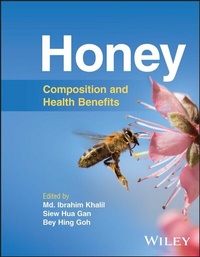
Honey
Beschreibung

A vital understanding of the health effects of this renowned natural food
Honey is among the most famous and widely available natural food products in the world, and its flavor profiles are well understood. Despite its use as a natural remedy by many societies, however, there has until recently been no systematic attempt to assess the scientific basis for claims about honey's health benefits. The ubiquity of honey and honey-derived natural remedies make such an assessment highly desirable.
Honey: Composition and Health Benefits offers a systematic assessment for the first time, analyzing the substances that make up honey and their health effects, both separately and in combination. Dedicating full chapters to each of honey's constituent materials, this book provides the first full-length and comprehensive treatment of this natural food. It also includes content on other honey products such as royal jelly, propolis, and bee venom. It promises to shed scientific light on centuries of tradition.
Honey readers will also find:
* Detailed treatment of honey's constituent carbohydrates, amino acids, organic acids, and more
* Closing chapters dealing with contaminants and toxins found in honey
* A vast and distinguished team of global contributors with decades of expertise
Honey promises to be essential for food scientists, nutritionists, and health scientists, both in academic research and in industry.
Weitere Details
Weitere Ausgaben
Andere Ausgaben
Personen
Md. Ibrahim Khalil is Professor in the Department of Biochemistry and Molecular Biology, Jahangirnagar University, Savar, Dhaka, Bangladesh.
Siew Hua Gan is Professor in the School of Pharmacy, Monash University Malaysia, Bandar Sunway, Malaysia.
Bey Hing Goh is Associate Professor in the School of Pharmacy, Monash University Malaysia, Bandar Sunway, Malaysia and at the College of Pharmaceutical Sciences, Zhejiang University, Hangzhou, Zhejiang, PR China.
Inhalt
List of Contributors vii
Preface x
1 General Introduction 1
Pasupuleti Visweswara Rao, Ng Choon Ming, Md. Ibrahim Khalil, and Siew Hua Gan
2 Physical Properties of Honey 12
Rizwana Afroz, E.M. Tanvir, and Md. Murad Hossain
3 Carbohydrates in Honey 32
Md. Murad Hossain, Dhirendra Nath Barman, Md. Anisur Rahman, and Shahad Saif Khandker
4 Lipid and Fatty Acids in Honey 46
Dhirendra Nath Barman, Md. Anisur Rahman, and Md. Murad Hossain
5 Amino Acids, Proteins, and Enzymes 50
Md. Murad Hossain, Dhirendra Nath Barman, and Md. Anisur Rahman
6 Vitamins 66
Ng Choon Ming, Md. Ibrahim Khalil, and Siew Hua Gan
7 Minerals and Trace Elements 80
Md. Solayman
8 Organic Acids in Honey 102
Md. Anisur Rahman, Md. Murad Hossain, and Dhirendra Nath Barman
9 Polyphenols and Antioxidants 113
Md. Sakib Hossen and Md. Yousuf Ali
10 Aroma Compounds 137
Md. Mijanur Rahman, Nusrat Fatima, and Nur-E-Alam Copyrighted Material
11 Furfural and Hydroxymethylfurfural 152
Md. Solayman, Ummay Mahfuza Shapla, and Md. Ibrahim Khalil
12 Other Possible Contaminants, Toxic Compounds, and Microbial Growth 167
Fahmida Alam, Kashif Maroof, Ng Choon Ming, Md. Ibrahim Khalil, and Siew Hua Gan
13 Antimicrobial Properties of Honey 186
Mahendran Sekar, Nur Zulaikha Azwa Zuraini, Nur Najihah Izzati Mat Rani, Pei Teng Lum, and Siew Hua Gan
14 Use of Honey in Cardiovascular Diseases 197
Shridhar C. Ghagane and Aimen A. Akbar
15 Use of Honey in Diabetes 210
Mahendran Sekar, Nurul Amirah Mohd Zaid, Nur Najihah Izzati Mat Rani, and Siew Hua Gan
16 Use of Honey in Kidney Disease 220
R. B. Nerli, Saziya R. Bidi, and Shridhar C. Ghagane
17 Use of Honey in Liver Disease 224
Mahendran Sekar, Pei Teng Lum, Srinivasa Reddy Bonam, and Siew Hua Gan
18 Use of Honey in Immune Disorders and Human Immunodeficiency Virus 235
Wan Nazirah Wan Yusuf, Suk Peng Tang, Noor Suryani Mohd Ashari, and Che Badariah Abd Aziz
19 Use of Honey in Sports Medicine 250
Foong Kiew Ooi and Chee Keong Chen
20 Medicinal Properties of Royal Jelly 263
Wendy Wai Yeng Yeo, Usha Sundralingam, and Sathiya Maran
21 Medicinal Benefits of Propolis 278
Kashif Maroof, Yim Yee Jin, Siew Liang Ching, and Siew Hua Gan
22 Medicinal Benefits of Bee Venom 302
Mahendran Sekar, Pei Teng Lum, Srinivasa Reddy Bonam, and Siew Hua Gan
23 Medicinal Properties of Stingless Bee Honey 314
Mahendran Sekar, Ahmad Yasser Hamdi Nor Azlan, Nur Najihah Izzati Mat Rani, and Siew Hua Gan
24 Economic Benefits of Honey and Honey Products 330
Sridevi I. Puranik, Aimen A. Akbar, and Shridhar C. Ghagane
Index 340
1
General Introduction
Pasupuleti Visweswara Rao, Ng Choon Ming, Md. Ibrahim Khalil, and Siew Hua Gan
Introduction
Apiculture is a specialized area in science study about beekeeping or maintenance. In Latin, "Apis" means "bee," and "culture" means "keep." In other words, apiculture simply means beekeeping. Although honey is one of the most important products from apiculture, other valuable products, such as pollen, bee wax, royal jelly (RJ), propolis, and bee venom, are also available (Posey 1983). Throughout the years, we could observe the vital role of honey in human lives in various ways due to its highly economic and medicinal values. In fact, the collection of honey has been recognized as one of the major economic areas for rural communities across the world for their livelihood. Honey is produced by honeybees as a result of mixing of the nectar from various flowers and different types of enzymes within their honey sacs, which are then stored in storage cells for a few days to mature (Seeley 2009). At this particular stage, the matured or ripened substance is considered honey.
The honey-ripening process not only involves dehydration of the nectar but also includes different physical and chemical progressions. The constituents of honey tend to fluctuate based on the nectar source and various other factors such as flowering seasons and environmental conditions. Honey has a unique taste because of the combination of the enzymes from the honey sacs of the honeybees and the varying moisture content. In addition, the presence of vital saccharides, sucrose, glucose, and fructose also plays a potential role in its taste (Doner 1977) (Figure 1.1).
Figure 1.1 Summary of information about honey. HIV, human immunodeficiency virus; HMF, 5-hydroxymethyl furfural. BillionPhotos.com / Adobe Stock.
Nectar
Nectar is a liquid substance from various types of flowering plants. It consists of water and sugars (Garcia et al. 2005), which attract the bees. The bees collect the nectar and suck it via their proboscises or long tongues. The honeybees (worker bees) store the nectar in their stomachs for a short duration until it is transferred to the comb with the help of other honeybees (house bees). The nectar and its components play an important role in the taste of honey, which is also influenced by seasonal variations and other environmental factors (Afik et al. 2006).
Composition of Honey
Honey is a natural product consisting of a combination of sugar, water, and other ingredients. Honey consists of sugar at approximately 76%, and the water content in honey is 18%, with other components making up the remaining 6% (Wedmore 1955). Sugars are the major constituents of honey responsible for honey's sweetness, water content, and several other constituents found in trace amounts that differentiate honey types and may vary in aroma, color, and taste.
Carbohydrates
Sugars are generally considered saccharides. The saccharides present in honey do not belong to the same category of a single saccharide but are composed of mono- and disaccharides. The monosaccharides present in honey include fructose and glucose, and the disaccharides include sucrose, turanose, maltose, maltulose, and isomaltose (White and Doner 1980). Other constituents, including phenolic compounds, vitamins, amino acids, proteins, and minerals, are also available in honey at various concentrations based on the botanical origin of the honey and the seasons (Huang and Robinson 1995). The available sugars in several types of honey promote the growth of healthy cells and continuous formation of fresh white blood cells. Sucrose generally consists of one fructose molecule linked to glucose through a-1-4 binding and is hydrolyzed by invertase enzyme (Da Silva et al. 2016).
Storage time, heat treatment, and several chemical and physical changes in honey result in changing the darkness of the honey as well as the flavor (Da Silva et al. 2016). Monosaccharide decomposition occurs, thereby resulting in the formation of furans. These furans, composed of furfural and 5-hydroxymethyl furfural (HMF), are derived from pentoses and hexoses, respectively (Anese et al. 2013).
Minerals
Minerals are imperative and make up 3.68% of the composition of honey, playing a vital role in honey's nutritional value. Various minerals, such as chlorine, phosphorus, potassium, calcium, silicon, sulfur, magnesium, and manganese, have been reported in honey. Potassium is the major mineral found in honey, which makes up approximately one-third of the total mineral content (Bogdanov et al. 2007). Beekeeping practices, honey processing, and conservational effluence have added value to the different types of minerals and their quantities in honey (Pohl et al. 2009). In essence, the wide-ranging mineral profile of honey, present in minute amounts, encourages its nutritional use as food in addition to being part of a healthy diet (Ajibola et al. 2012).
Proteins
Proteins occupy a minor portion of honey's composition (0.1-0.3 g/100 g) (Anklam 1998). Proteins are available in various honeys in several forms, such as simple or complex structures of amino acids. Generally, proteins are present in low quantities, and hence the nutritional impact is also low. Several researchers have reported that the protein quantity in different types of honey is often lower than 0.5%. The amino acid content depends on the floral sources, geographical regions, and the processing capacity of bees. In honeys, one of the many and important amino acids is proline, which is an indicator of honey's quality and possible adulteration. The proline content should be permissible if the value is below 180 mg/kg (Bogdanov et al. 2002).
Enzymes
Enzymes are complex structures found in active cells responsible for various reactions and processes in living organisms. Generally, honey consists of small quantities of enzymes, and a large portion is composed of diastase and invertase (White et al. 1961). The enzyme contents and concentration in honey are also dependent on the floral sources and seasonal variations.
One of the key roles of enzymes in honey is to contribute to the functional properties of honey. Several types of enzymes, including oxidases, acid phosphatases, amylases, invertases, catalases, and others, are available in honey. Essentially, the invertase, glucose oxidase, and diastase are considered the key enzymes of honey. Diastase (amylase) converts starch to different carbohydrates such as mono-, di-, and oligosaccharides and dextrins. Invertase, sucrose hydrolase, sucrase, and saccharases are the enzymes that are useful in converting sucrose to glucose and fructose (invert sugar). Glucose oxidase present in honey converts glucose to gluconolactone and is subsequently further processed into gluconic acid and hydrogen peroxide. Subsequently, ß-glucosidase-1 transforms ß-glucans to oligosaccharides and glucose. Catalase is also one of the major enzymes present in honey that transforms the peroxides into water and oxygen. Proteases are the enzymes that hold vital roles in hydrolyzing the proteins (White and Doner 1980).
Vitamins
Vitamins are important in determining honey's quality. Ascorbic acid, riboflavin, nicotinic acid, pantothenic acid, and folic acid are some of the vitamins available in honey in minute amounts, to the extent of describing them in parts per millions (Da Silva et al. 2016). Generally, the quantity of vitamins in the food materials is difficult to be determined because they are not stable in various conditions. Over time, foods tend to lose vitamins because of storage and aging processes. Besides, filtration, a process whereby honey is filtered to improve its appearance, diminishes the quantity of the vitamins because pollens containing vitamins are removed during the process (Wilczynska 2014).
Trace Elements
The quantity of various types of heavy metals in honey basically relies on the composition of the soil elements and the source of flowers in the region. Honey is not measured as a vital basis of trace elements because the total amounts of elemental quantity or ash amount in nectar honeys and honeydew honeys are typically recorded as below 0.6% and 1.0%, respectively. Generally, the elemental mixture or trace elemental composition depends on the honeydew, nectar, and pollen from the region where the honey was harvested. Bogdanov et al. (2007) has confirmed that botanical aspects have the utmost stimulus on the trace element quantity of honey. The microelement amount was found to be higher than 1.0% in different types of honey. The microelements found in honeys are aluminum, boron, barium, bromine, calcium, chlorine, ferrous, magnesium, manganese, sodium, phosphorus, rubidium, sulfur, strontium, and zinc. The trace elements found to be present in honey are silver, arsenic, cadmium, chromium, copper, lithium, molybdenum, nickel, selenium, and lead (Solayman et al. 2016). Overall, the element composition of honey is useful for assessment of honey's quality to detect adulteration such as honey dilution with water, addition of sugars or syrups, and assessment of the botanical or geographical origins of honey (Sager 2020).
Hydroxymethylfurfural
Hydroxymethylfurfural (Figure 1.2) is used as an indicator of honey's quality and purity because fresh honey does not include HMF or has very low HMF (0-0.2 mg/kg). HMF is formed as a result of the degradation of glucose and fructose when honey is acidic, and the formation speed usually depends on...
