

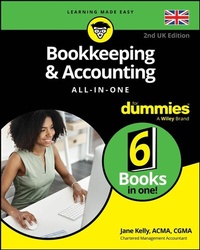
Bookkeeping & Accounting All-in-One For Dummies, UK Edition
Beschreibung

All the essential financial skills you need to grow a small business
Bookkeeping & Accounting All-in-One For Dummies, UK Edition, 2nd Edition simplifies every aspect of financial record keeping so you can manage your business expertly. You'll receive comprehensive guidance on balancing your books, speeding up data entry, and boosting performance by eliminating costly clerical errors.
Using popular accounting software Sage 50 as a guide, learn how to quickly run financial reports, manage payroll, track and analyse both revenue and expenditure and manage the assets and liabilities of your business. As a business owner or as an accountant, you can set business targets that encourage expansion and growth-all with the help of this incredibly useful and comprehensive resource.
- Grasp must-know concepts and skills of bookkeeping and accounting for small business.
- Learn from relatable example scenarios and access online bookkeeping forms and resources.
- Get up-to-date guidance on VAT reporting and end of year reporting including references to UK accounting standards.
This is a valuable resource for small-business employees tasked with bookkeeping and accounting, small business owners, and anyone who works with the money side of small enterprises. Understand it all with Bookkeeping & Accounting All-in-One For Dummies, UK Edition, 2nd Edition!
Weitere Details
Weitere Ausgaben
Andere Ausgaben
Person
Jane Kelly, ACMA, CGMA, is a chartered management accountant who helps small business owners and employees with accounting, bookkeeping, and accounting software. She's also the author of Sage 50 Accounts For Dummies, Bookkeeping For Dummies UK Edition, and Accounting Workbook For Dummies UK Edition.
Inhalt
- Intro
- Title Page
- Copyright Page
- Table of Contents
- Introduction
- About This Book
- Foolish Assumptions
- Icons Used in This Book
- Beyond the Book
- Where to Go from Here
- Book 1 Basic Bookkeeping
- Chapter 1 So You Want to Do the Books
- Delving into Bookkeeping Basics
- Looking at basic accounting methods
- Understanding assets, liabilities, and capital
- Introducing debits and credits
- Charting your bookkeeping course
- Discovering different business types
- Planning and controlling your activities
- Instituting internal controls
- Keeping an accurate paper trail
- Defining and Maintaining a Ledger
- Using Bookkeeping Tools to Manage Daily Finances
- Tracking sales
- Keeping stock
- Running Tests for Accuracy
- Checking the cash and bank
- Testing your balance
- Understanding your VAT
- Doing bookkeeping corrections
- Preparing financial reports
- Handling payroll
- Working with your accountant
- Chapter 2 Getting Down to Bookkeeping Basics
- Bookkeeping: The Record-Keeping of the Business World
- Wading through Basic Bookkeeping Lingo
- Accounts for the Balance Sheet
- Accounts for the Profit and Loss account
- Other common terms
- Pedalling through the Accounting Cycle
- Understanding Accounting Methods
- Keeping things simple with cash-basis accounting
- Recording right away with accrual accounting
- Seeing Double with Double-Entry Bookkeeping
- Golden rules of bookkeeping
- Practising with an example
- Have a Go
- Answering the Have a Go Questions
- Chapter 3 Outlining Your Financial Roadmap with a Chart of Accounts
- Getting to Know the Chart of Accounts
- Starting with the Balance Sheet Accounts
- Tackling assets
- Fixed assets (also known as Non-Current Assets)
- Current assets
- Laying out your liabilities
- Current liabilities
- Long-term liabilities
- Controlling the capital
- Keeping an Eye on the Profit and Loss Accounts
- Recording the profit you make
- Recording the cost of sales
- Acknowledging the other costs
- Setting Up Your Chart of Accounts
- Have a Go
- Answering the Have a Go Questions
- Chapter 4 Looking at Ledgers
- Developing Entries for the Ledger
- Posting Sales Invoices
- Posting Purchase Invoices
- There's an App for That!
- Entering Items into the Nominal Ledger
- Cashbook/Bank Transactions
- Bank payments
- Supplier payments
- Bank receipts
- Customer receipts
- Introducing Control Accounts
- Debtors Control account
- Creditors Control account
- Understanding How the Ledgers Impact the Accounts
- Adjusting for Nominal Ledger Errors
- Have a Go
- Answering the Have a Go Questions
- Book 2 Bookkeeping Day to Day
- Chapter 1 Planning and Controlling Your Workload
- Introducing Checklists
- Sorting Out Your Sales Invoices
- Entering Your Purchases Invoices
- Sequential numbering and coding - the old-fashioned way
- Scanning your invoices in the modern age!
- Paying your suppliers
- Checking Cash Payments and Receipts
- Cash payments
- Cash receipts
- Using a Bank Feed to Reconcile Your Bank Account
- Entering Your Journals
- Controlling Your Books, Records, and Money
- Dividing staff responsibilities
- Balancing control costs
- Have a Go
- Answering the Have a Go Questions
- Chapter 2 Counting Your Sales
- Reviewing Your Sales
- Collecting on cash sales
- Monitoring retail sales
- Checking your online sales
- Keeping your eye on credit sales
- Dealing with other sales
- Recording Your Sales in the Books
- Recording and automating cash sales
- Recording retail sales
- Updating online sales
- Recording credit sales in the books
- Adjusting Your Sales
- Monitoring sales discounts
- Recording sales returns and allowances
- Monitoring Trade Debtors
- Accepting Your Losses
- Have a Go
- Answering the Have a Go Questions
- Chapter 3 Buying and Tracking Your Purchases
- Identifying Different Types of Purchases
- Making Capital Purchases
- Buying stock
- Overhead and operating expenses
- Keeping Track of Stock
- Entering initial cost
- Managing stock and its value
- Figuring out the best method for you
- Comparing the methods
- Buying and Monitoring Supplies
- Staying on Top of Your Bills
- Have a Go
- Answering the Have a Go Questions
- Chapter 4 Doing Your Banking
- Making Sure that the Closing Cash Is Right
- Producing a snapshot in time
- Checking all your cash balances
- Reconciling Bank Accounts
- Reconciling your bank account without using a bank feed
- Automating your bank reconciliation using bank feeds
- Considering credit card sales
- Tracking down errors
- Have a Go
- Answering the Have a Go Questions
- Book 3 Undertaking Monthly and Quarterly Tasks
- Chapter 1 Adding the Cost of Value-Added Tax (VAT)
- Looking into VAT
- Knowing what to charge
- Knowing how much to charge
- When you can't charge VAT
- Understanding what to claim on purchases
- Registering for VAT
- VAT Returns in the Digital Age
- Digital records that you must keep
- Other records that you must keep
- Submitting VAT online
- Paying VAT online
- Getting help for small businesses
- Glancing at problem areas
- Using fuel for private motoring
- Leasing a motor car
- Filing under special circumstances
- Correcting mistakes
- Chapter 2 Employee Payroll and Benefits
- Staffing Your Business
- Running Your Payroll
- Obtaining an employer's PAYE reference
- Starting a new employee
- Recording pay
- Picking pay periods
- Calculating weekly pay
- Calculating monthly pay
- Totalling up for commission payments
- Calculating commission with and without a base salary
- Levelling up with graduated commission
- Serving up a salary with tips
- Paying staff fairly
- Making statutory payments
- Calculating deductions
- Accounting for NICs
- Figuring out PAYE tax
- Preparing payslips
- Reporting to HMRC
- Making a Full Payment Submission (FPS)
- Sending an Employer Payment Summary (EPS)
- Verifying National Insurance numbers
- Correcting reporting mistakes
- Taxing Benefits
- Posting Your Payroll Entries
- Settling Up with HM Revenue & Customs
- Handling Payroll Year-End
- Have a Go
- Answering the Have a Go Questions
- Chapter 3 Adjusting Your Books
- Adjusting All the Right Areas
- Depreciating assets
- Accruing the costs
- Allocating prepaid expenses
- Counting stock
- Allowing for bad debts
- Checking Your Trial Balance
- Changing Your Chart of Accounts
- Have a Go
- Answering the Have a Go Questions
- Book 4 Working to Prepare Financial Statements
- Chapter 1 Producing a Profit and Loss Account
- Lining Up the Profit and Loss account
- Formatting the Profit and Loss Account
- Preparing the Profit and Loss Account
- Finding Net Sales
- Finding Cost of Goods Sold
- Drawing remaining amounts from your Trial Balance
- Deciphering Gross Profit
- Monitoring Expenses
- Using the Profit and Loss Account to Make Business Decisions
- Testing Profits
- Return on Sales
- Return on Assets
- Return on Shareholders' Capital
- Branching Out with Profit and Loss Account Data
- Have a Go
- Answering the Have a Go Questions
- Chapter 2 Developing a Balance Sheet
- Breaking Down the Balance Sheet
- Gathering Balance Sheet Ingredients
- Dividing and listing your assets
- Current assets
- Fixed assets
- Acknowledging your debts
- Naming your investments
- Presenting Your Balance Sheet
- Horizontal format
- Vertical format
- Putting Your Balance Sheet to Work
- Testing your cash
- Current ratio
- Acid test (quick) ratio
- Assessing your debt
- Have a Go
- Answering the Have a Go Questions
- Chapter 3 Cash Flows and the Cash Flow Statement
- The Three Types of Cash Flow
- Setting the Scene: Changes in Balance Sheet Accounts
- Using the Indirect or Direct Method?
- Looking at Cash Flow from Operating Activities
- Computing cash flow from profit (also known as cash flow from operating activities)
- Considering changes in working capital
- Debtors increase
- Stock increase
- Prepaid expenses increase
- Adjusting for non-cash expenses
- Operating liabilities increases
- Presenting the Cash Flow Statement
- Sailing through the Rest of the Cash Flow Statement
- Investing activities
- Financing activities
- Direct method - another alternative for reporting cash flow
- Free Cash Flow: What on Earth Does That Mean?
- Scrutinising the Cash Flow Statement
- Book 5 Accountants: Managing the Business
- Chapter 1 Discovering Different Business Types
- Finding the Right Business Type
- Sole trader
- Partnership
- Limited Liability Partnerships (LLPs)
- Limited companies
- Tax Reporting for Sole Traders
- Making Tax Digital - Income Tax Self-Assessment
- Expanding to the supplementary pages
- Filling out the self-employment supplementary pages
- Filing Tax Forms for Partnerships
- Filing Returns for Limited Companies
- Introducing Software-Only Filing
- Have a Go
- Answering the Have a Go Questions
- Chapter 2 Choosing Accounting Methods
- Decision-Making behind the Scenes in Profit and Loss Accounts
- Calculating Cost of Goods Sold and Cost of Stock
- The FIFO method
- The average cost method
- Identifying Stock Losses: Net Realisable Value (NRV)
- Managing Your Stock Position
- Appreciating Depreciation Methods
- Straight-Line depreciation
- Reducing-Balance depreciation
- Comparing the methods
- Collecting or Writing Off Bad Debts
- Reconciling Corporation Tax
- Dealing with Foreign Exchange
- Transaction exposure
- Translation exposure
- Comparing performance
- Two Final Issues to Consider
- Have a Go
- Answering the Have a Go Questions
- Chapter 3 Managing Profit Performance
- Redesigning the External Profit and Loss Account
- Basic Model for Management Profit and Loss Account
- Variable versus fixed operating expenses
- From operating profit (EBIT) to the bottom line
- Travelling Two Trails to Profit
- First path to profit: Contribution margin minus fixed expenses
- Second path to profit: Excess over break-even volume × contribution margin per unit
- Calculating the margin of safety
- Doing what-if analysis
- Lower profit from lower sales - but that much lower?
- Violent profit swings due to operating leverage
- Cutting sales price, even a little, can gut profit
- Improving profit
- Cutting prices to increase sales volume: A very tricky game to play!
- Cash flow from improving profit margin versus improving sales volume
- A Final Word or Two
- Have a Go
- Answering the Have a Go Questions
- Chapter 4 Cost Conundrums
- Previewing What's Coming Down the Road
- What Makes Cost So Important?
- Sharpening Your Sensitivity to Costs
- Direct versus indirect costs
- Fixed versus variable costs
- Breaking even
- Relevant versus irrelevant (sunk) costs
- Separating between actual, budgeted, and standard costs
- Product versus period costs
- Putting Together the Pieces of Product Cost for Manufacturers
- Minding manufacturing costs
- Allocating costs properly: Not easy!
- Allocating Indirect Costs Is as Simple as ABC - Not!
- Calculating product cost
- Fixed manufacturing costs and production capacity
- Excessive production output for beefing up profit
- Have a Go
- Answering the Have a Go Questions
- Chapter 5 Business Budgeting
- The Reasons for Budgeting
- The modelling reasons for budgeting
- Planning reasons for budgeting
- Management control reasons for budgeting
- Other benefits of budgeting
- Budgeting and Management Accounting
- Budgeting in Action
- Developing your profit strategy and budgeted Profit and Loss account
- Budgeting cash flow from profit for the coming year
- Capital Budgeting
- Calculating payback
- Discounting cash flow
- Calculating the internal rate of return
- Arriving at the cost of capital
- Reporting on Variances
- Staying Flexible with Budgets
- Have a Go
- Answering the Have a Go Questions
- Book 6 Accountants: Working with the Outside World
- Chapter 1 Getting a Financial Report Ready for Prime Time
- Considering the Purpose of Annual Reporting
- Identifying the stakeholders
- Complying with legal and regularity requirements
- Building transparency and trust
- Looking at the Contents of an Annual Report
- Preparing the Strategic Report
- Writing the Governance Report
- Gathering together the Financial Statements
- Statement of Changes in Equity
- The purpose of a Statement of Changes in Equity
- Making Sure that Disclosure Is Adequate
- Footnotes versus notes versus disclosures
- What you'll find in the notes to the accounts
- Why the notes are important
- Keeping it private versus going public
- Nudging the Numbers
- Adjusting the cash balance by "window dressing"
- Smoothing the rough edges off profit
- Sticking to the accounting conventions
- Conservatism
- Materiality
- Consistency
- Browsing versus Reading Financial Reports
- Chapter 2 How Investors Read a Financial Report
- Financial Reporting by Private versus Public Businesses
- Private company reporting requirements
- Public company reporting requirements
- Analysing Financial Reports
- Gross profit margin
- Net profit margin
- Earnings per share, basic and diluted
- Price/earnings (P/E) ratio
- Dividend yield
- Book value per share
- Return on equity (ROE)
- Gearing or leverage
- Current ratio
- Acid test ratio
- Keeping track of stock and debtors
- Debtor days
- Return on assets (ROA)
- Using combined ratios
- Appreciating the limits of ratios
- Navigating the Notes
- Checking for Warning Signs in the Audit Report
- Finding Financial Facts
- Public company accounts
- Private company accounts
- Using FAME (Financial Analysis Made Easy)
- Have a Go
- Answering the Have a Go Questions
- Chapter 3 Professional Auditors and Advisers
- Why Audit?
- Who Can Audit Company Accounts?
- What Happens during an Audit?
- What's in an Auditor's Report
- True and fair: An unqualified ("clean") opinion
- Other kinds of audit opinions
- How can the reader be sure of the modified opinion?
- Do Audits Always Catch Fraud?
- Looking for errors and fraud
- What happens when auditors spot fraud
- Auditors and the Rules
- From Audits to Advising
- Index
- EULA
