

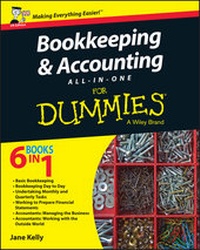
Bookkeeping and Accounting All-in-One For Dummies - UK, UK Edition
Beschreibung

Unless you're one of those rare "numbers people," the thought of accounting and bookkeeping probably make your head spin. While these pragmatic and confusing practices may not be fun for the rest of us, mastering them is absolutely essential in order to run and maintain a successful business. Thankfully, Bookkeeping & Accounting All-in-One For Dummies, UK Edition, is here to take the intimidation out of crunching numbers and offers easy-to-follow, step-by-step instruction on keeping your business' finances in order with information specific to a business in the United Kingdom.
Written in plain English and packed with loads of helpful instruction, this approachable and all-encompassing guide arms you with everything you need to get up and running on all the latest accounting practices and bookkeeping software. Inside, you'll find out how to prepare financial statements, balance your books, keep the tax inspector off your back, and so much more.
* Gives you access to supplemental online samples of bookkeeping forms, accounting templates, and spreadsheets
* Includes many practical bookkeeping and accounting exercises and templates
* Simplifies every aspect of accounting and record-keeping
* Shows you how to run your business "by the books"
If you're a small business owner or employee who is confused and intimidated by managing your accounts and books, this comprehensive guide empowers you to take charge of those pesky figures to keep your business afloat.
Weitere Details
Weitere Ausgaben
Andere Ausgaben
Person
Inhalt
Book I: Basic Bookkeeping 5
Chapter 1: So You Want to Do the Books 7
Chapter 2: Getting Down to Bookkeeping Basics 19
Chapter 3: Outlining Your Financial Roadmap with a Chart of Accounts 39
Chapter 4: Looking at Ledgers 57
Book II: Bookkeeping Day to Day 83
Chapter 1: Planning and Controlling Your Workload 85
Chapter 2: Counting Your Sales 99
Chapter 3: Buying and Tracking Your Purchases 125
Chapter 4: Doing Your Banking 141
Book III: Undertaking Monthly and Quarterly Tasks 155
Chapter 1: Adding the Cost of Value-Added Tax (VAT) 157
Chapter 2: Employee Payroll and Benefits 171
Chapter 3: Adjusting Your Books 191
Book IV: Working to Prepare Financial Statements 209
Chapter 1: Producing a Profit and Loss Statement 211
Chapter 2: Developing a Balance Sheet 227
Chapter 3: Cash Flows and the Cash Flow Statement 245
Book V: Accountants: Managing the Business 269
Chapter 1: Discovering Different Business Types 271
Chapter 2: Choosing Accounting Methods 281
Chapter 3: Managing Profit Performance 307
Chapter 4: Cost Conundrums 331
Chapter 5: Business Budgeting: 355
Book VI: Accountants: Working with the Outside World 379
Chapter 1: Getting a Financial Report Ready for Prime Time 381
Chapter 2: How Investors Read a Financial Report 401
Chapter 3: Professional Auditors and Advisers 431
Index 445
Chapter 1
So You Want to Do the Books
In This Chapter
Introducing bookkeeping and its basic purpose
Maintaining a paper trail
Managing daily business finances
Making sure that everything's accurate
For many small business owners, while they love working in their chosen field using the skills they know and love, they don't always like to perform 'bookkeeping' duties. Most company owners prefer to employ the skills of a qualified bookkeeper. Some may, perhaps, prefer to give their bag-full of receipts to their accountant and simply hope that a useful set of accounts comes out of the end of the accounting sausage machine!
In this chapter we help to demystify the role of a bookkeeper. It may be that you're just starting off in business and, as a result, can't afford the services of a bookkeeper just yet! Think of this chapter as a checklist of jobs that need to be done.
Throughout the book, we introduce Have a Go sections, which are practical exercises aimed at helping you understand the bookkeeping principles we discuss. Feel free to draw all over these sections of the book; we want it to be as useful for you as possible.
Delving into Bookkeeping Basics
Like most businesspeople, you probably have great ideas for running your own business and just want to get started. You don't want to be distracted by the small stuff, like keeping detailed records of every penny you spend; you just want to build a business with which you can make lots of money.
Well, slow down there - you're not in a race! If you don't carefully plan your bookkeeping system and figure out exactly how and what financial details you want to track, you've absolutely no way to measure the success (or failure, unfortunately) of your business efforts.
Bookkeeping, when done properly, gives you an excellent measure of how well you're doing and also provides lots of information throughout the year. This information allows you to test the financial success of your business strategies and make any necessary course corrections early in the year to ensure that you reach your year-end profit goals.
Looking at basic accounting methods
You can't keep books unless you know how to go about doing so. The two basic accounting methods are cash-based accounting and accrual accounting. The key difference between the two methods is the point at which you record sales and purchases in your books. If you choose cash-based accounting, you only record transactions when cash changes hands. If you use accrual accounting, you record a transaction on its completion, even if cash doesn't change hands.
For example, suppose that your business buys products to sell from a supplier but doesn't actually pay for those products for 30 days. If you're using cash-based accounting, you don't record the purchase until you actually lay out the cash to the supplier. If you're using accrual accounting, you record the purchase when you receive the products, and you also record the future debt in an account called Trade Creditors.
HM Revenue & Customs, who has an interest in every business in the UK, accept only the accrual accounting method. So, in reality you can't use cash-based accounting. However, a special concession for smaller businesses allows them to use a form of cash-based accounting for value-added tax (VAT) purposes (which is covered in Book III, Chapter 1). In essence, you can complete your VAT return on a cash-based accounting method, which HM Revenue & Customs refers to as cash accounting.
We talk about the pros and cons of each type of accounting method in Book I, Chapter 2.
Understanding assets, capital and liabilities
Every business has three key financial parts that must be kept in balance: assets, capital and liabilities. Of course, for some of you these may be alien concepts, so maybe a quick accounting primer is in order.
We use buying a house with a mortgage as an example. The house you're buying is an asset; that is, something of value that you own. In the first year of the mortgage, you don't own all of it, but by the end of the mortgage period (typically 25 years) you will. The mortgage is a liability, or a debt that you owe. As the years roll on and you reduce the mortgage (liability), your capital or ownership of the asset increases. That's it in a nutshell.
- Assets include everything the business owns, such as cash, stock, buildings, equipment and vehicles.
- Capital includes the claims that owners have on the assets based on their portion of ownership in the business.
- Liabilities include everything the business owes to others, such as supplier bills, credit card balances and bank loans.
The formula for keeping your books in balance involves these three elements:
- Assets = Capital + Liabilities
Because this equation is so important, we talk a lot about how to keep your books in balance throughout this book. You can find an initial introduction to this concept in Book I, Chapter 2.
Introducing debits and credits
To keep the books, you need to revise your thinking about two common financial terms: debits and credits. Most non-bookkeepers and non-accountants think of debits as subtractions from their bank accounts. The opposite is true with credits - people usually see credits as additions to their accounts, in most cases in the form of refunds or corrections in favour of the account holders.
Well, forget all you think that you know about debits and credits. Debits and credits are totally different animals in the world of bookkeeping. Because keeping the books involves a method called double-entry bookkeeping, you have to make at least two entries - a debit and a credit - into your bookkeeping system for every transaction. Whether that debit or credit adds or subtracts from an account depends solely upon the type of account.
We know all this debit, credit and double-entry stuff sounds confusing, but we promise that this system is going to become much clearer as you work through this book. We start explaining this important concept in Book I, Chapter 2.
Charting your bookkeeping course
You can't just enter transactions in the books willy-nilly. You need to know exactly where those transactions fit into the larger bookkeeping system. To know where everything goes, you use your Chart of Accounts, which is essentially a list of all the accounts that your business has and the types of transactions that go into each one. (We talk more about the Chart of Accounts in Book I, Chapter 3.)
Discovering different business types
Before you start up in business, you're wise to sit down and have a think about the structure of your business.
For example, if you're a window cleaner, and only ever see yourself doing your own rounds and not working with anyone else, then sole trader status would be more than adequate. However, if you're planning to be much bigger and take on staff, then you need to read Book V, Chapter 1 to see how you should structure your business and what sort of advice you may need.
Planning and controlling your activities
Many businesses just start up and trade from day to day, without any real planning or control of the activities they undertake. Often, businesspeople become so busy that they're fire-fighting continually and lack any real direction. We like using checklists, because they help to organise your bookkeeping activities in a methodical and orderly manner. This level of organisation means that you can pick up and put down the accounts from day to day or even week to week. You can always start from where you left off, quickly and easily, by simply adopting some of the hints and tips contained within Book II, Chapter 1.
Instituting internal controls
Every business owner needs to be concerned with keeping tight controls on business cash and how that cash is used. One way to institute this control is by placing internal restrictions on who can enter information into your books and who has the necessary access to use that information.
You also need to control carefully who has the ability to accept cash receipts and spend your business's cash. Separating duties appropriately helps you to protect your business's assets from error, theft and fraud. We talk more about controlling your cash and protecting your financial records in Book II, Chapter 1.
Keeping an accurate paper trail
Keeping the books is all about creating an accurate paper trail. A computerised accounting system would refer to this trail as the Audit Trail. You want to keep track of all your business's financial transactions so that if a question comes up at a later date, you can turn to the books to figure out what went wrong. We're big fans of using checklists, so you know exactly where you are in the monthly accounting cycle. We introduce our monthly checklist in Book II, Chapter 1.
All your business's financial transactions are summarised in the Nominal Ledger, and journals keep track of the tiniest details of each transaction. Information can be gathered quickly by using a computerised accounting system, which gives you access to your financial...
