

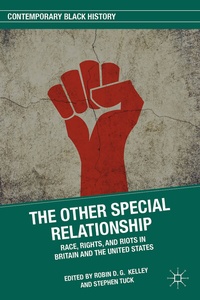
The Other Special Relationship
Beschreibung

The close diplomatic, economic, and military ties that comprising the "special relationship" between the United States and Great Britain have received plenty of attention from historians over the years. Less frequently noted are the countries' shared experiences of empire, white supremacy, racial inequality, and neoliberalism - and the attendant struggles for civil rights and political reform that have marked their recent history. This state-of-the-field collection traces the contours of this other "special relationship," exploring its implications for our understanding of the development of an internationally interconnected civil rights movement. Here, scholars from a range of research fields contribute essays on a wide variety of themes, from solidarity protests to calypso culture to white supremacy.
Weitere Details
Weitere Ausgaben
Andere Ausgaben
Personen
Robin D. G. Kelley is Professor of American Studies and Ethnicity at the University of Southern California, USA. He is the author of the prize-winning books Thelonious Monk: The Life and Times of an American Original (Free Press, 2009)and Freedom Dreams: The Black Radical Imagination (Beacon Press, 2002). Stephen Tuck is University Lecturer in American History and a tutor and fellow at Pembroke College, Oxford University, UK. He is the author of the prize-winning books We Ain't What We Ought To Be: The Black Freedom Struggle from Emancipation to Obama (Harvard University Press, 2010) and Beyond Atlanta: The Struggle for Racial Equality in Georgia, 1940-1980 (University of Georgia Press, 2003).
Inhalt
1. "U.S. Negroes, Your Fight is Our Fight": Black Britons and the 1963 March on Washington; Kennetta Hammond Perry
2. "Black Was the Colour of our Fight": The Transnational Roots of British Black Power; Rosie Wild
Individual Life: A Black Englishman in the Heart of the Confederacy: The Transnational Life of Paul Stephenson; Nick Juravich
3. Caribbean Left: Diasporic Circulations; Carole Boyce Davies
4. Scholar-Activist St. Clair Drake and the Transatlantic World of Black Radicalism; Kevin Gaines
Individual Life: "We all became black": Tony Soares, African-American internationalists, and anti-imperialism; Anne-Marie Angelo
5. A Heavy Load: The American Civil Rights Movement and the Northern Ireland Civil Rights Movement; Marc Mulholland
6. Containing Racism?: The London Experience, 1957-1968; John Davis
Individual Life: From Manchester to Monroe: The unexpected journey of Constance Lever; Stephen Tuck and Imaobong Umoren7. "Nobody in This World Is Better Than Us":Calypso in the Age of Decolonization and Civil Rights; Joshua B. Guild
8. Stax, Subcultures, and Civil Rights: Young Britain and the Politics of Soul Music in the 1960s; Joe Street
Individual Life: From Guy Warren to Kofi Ghanaba: A Life of Trans-Atlantic (Dis)Connections; Robin Kelley
9. Violence at Desmond's Hip City: Gender and Soul Power in London; Tanisha C. Ford
10. Brotherhood, Betrayal, and Rivers of Blood: Southern Segregationists and British Race Relations; Clive Webb
