

Antimicrobial Resistance in Wastewater Treatment Processes
Beschreibung

Weitere Details
Weitere Ausgaben
Andere Ausgaben
Personen
Patricia Keen is a researcher and instructor in the Department of Civil Engineering at the University of British Columbia. She has more than 30 years of extensive experience in environmental chemistry, toxicology, ecosystem health, environmental risk assessment, resource management and environmental impacts of contaminants. The principle focus of her research is related to antimicrobial resistance in environment and together with Dr. Mark Montforts, she is the co-editor of the book published in 2012 by Wiley Blackwell entitled Antimicrobial Resistance in the Environment. Patricia is actively engaged in water and wastewater research at UBC and maintains a consulting role in projects related to environmental health and integrated resource management.
Raphaël Fugère is a biologist and environmental engineer with more than seven years of experience in designing, building, optimizing, operating and troubleshooting drinking water and wastewater treatment plants, from small to very large-scale. He has experience in process related research as well as on the practical side associated with industrial and municipal plants. He has actively participated in roles involving water management governance for small and mid-sized cities, ensuring coordination between agricultural needs, municipal needs, industrial needs and the need for resource conservation. Some of those efforts date back to 2006 where, even at the time, the need for fracturing "fracking" fluid was putting pressure on the scarce water resources in northern British Columbia. Raphaël maintains a support role on various research projects at conducted at UBC.
Inhalt
Preface
Antimicrobial resistance is arguably the greatest threat to worldwide human health. This book evaluates the roles of human water use, treatment, and conservation in the development and spread of antimicrobial resistance.
The collection of wastewater dates back to the Roman Empire when sewage, surface runoff, and drainage water were received in the Cloaca Maxima and flushed into the Tiber River by water transported from a vast network of aqueducts. By the Middle Ages, several major urban centers developed throughout Europe that included systems of open ditches and wooden, lead, or clay pipes designed for the disposal of sewage. Rapid increases in population densities in major European cities since that time demanded considerable improvements in water distribution systems and wastewater management in order to protect the public health of citizens. However, it was not until the mid-nineteenth century that many of these improvements were, in fact, realized. Canals dedicated to the transport of wastewater for direct discharge into rivers were constructed, although frequently, drinking water pumps were installed in close proximity to the wastewater removal systems. In essentially all situations, wastewater was ultimately returned to the environment in an untreated form.
Since 1850, the increased frequency of disease outbreaks, such as cholera and typhus, has required dedicated engineering efforts for the treatment of wastewater. Early examples of sewage treatment were simply the application of lime to cesspools, intended to reduce foul odors. During the same period, infectious disease epidemics were still believed to be transmitted through the human population by exposure to filth and foul smells and via person-to-person contact. While major advancements in the disciplines of sanitary engineering and health sciences were being made, it became increasingly clear that water played a critical role in the spread of infectious disease among the human population and that the safety of drinking water was compromised by any possibility of exposure to sewage. Water flushed waste through vast networks of ditches and underground sewers, then discharged in major rivers such as the Thames, the Seine, and the Danube. This rapid growth of urban centers was associated with persistent objectionable smells emanating from water courses that bisected large cities. This, in turn, reinforced political will to improve environmental conditions and led to pioneering technologies in sanitary engineering.
The engineering of technologies specific to the treatment of wastewater experienced a period of unprecedented growth beginning in the mid-nineteenth century. Coincidentally, regulations intended to protect the environment from the impacts of discharge of sewage into receiving waters began to appear more frequently in many major urban centers throughout Europe (Cooper, 2001). The goal of wastewater treatment was to ensure that effluent was sufficiently free of disease-causing entities that it could be released without impacting the safety of drinking water that was being employed for the human population. The secondary objective for improvement in wastewater treatment was driven by the economic incentive linked to the production of artificial guano (Cooper, 2001). Fertility of agricultural lands was declining to such an extent that crop yields were diminishing while the human population in urban centers was constantly growing. To counter this threat to food security, bird droppings were being imported from South America to the United Kingdom for use as agricultural fertilizer. Although land application of domestic waste had been practiced since Roman times, large areas of land adjacent to major urban centers were purchased and designated as "sewage farms." These farms for the land treatment of sewage needed increasing allotments of valuable land. They were subject to a number of weather-related complications and failed to achieve adequate hygiene standards that would ensure the protection of the health of farm workers and citizens at large. In this way, the intimate link between engineered systems for wastewater treatment, agricultural food production, and public health was firmly rooted throughout history.
Antimicrobial resistance in pathogenic organisms is a health risk that has been increasing for the last half century. Domestic sewage contains microbes originating from microbiomes of the human population resident in any community. Wastewater treatment plants receive influent composed largely by domestic sewage and therefore concentrate a vast and diverse collection of microbes in one location. Discharge of effluent from wastewater treatment plants represents the most important source of environmental contaminants, including those that are associated with development of antimicrobial resistance in bacteria.
For some time, antibiotic compounds have been identified as emerging contaminants and included in the category of pharmaceuticals and personal care products. Antibiotics can retain their activity after excretion from human patients such that bacterial communities in biological wastewater treatment systems are impacted by exposure to such contaminants and this antibiotic activity could potentially persist if their removal is incomplete following wastewater treatment. Improvements in instrumentation and tools for the analyses of genes in complex environmental samples have enhanced the ability to track mobile genetic elements of antimicrobial resistance through the wastewater treatment process. Increasing evidence is being gathered to suggest that the dynamic chemical, biological, and ecological conditions of operations in wastewater treatment processes influence the abundance of antimicrobial resistance genes in the effluents discharged to the environment after treatment. Because wastewater treatment plants receive sewage composed of contributions from gut flora of healthy and sick individuals, bacteria that are highly resistant to antibiotic therapy are increasingly detected in wastewater treatment systems.
More than 50% of the world's populations live in cities. Developing nations are witnessing a trend of accelerated urbanization that, in some cases, is accompanied by increased health risks. Clean water, in terms of availability and safe quality, remains a key concern in urban centers. Urban water cycles are now recognized as subsystems where patterns of water use, wastewater treatment, and water reuse play major roles in protection of public health.
Designed as a companion volume to Antimicrobial Resistance in the Environment (Wiley-Blackwell, 2012), this book is a multidisciplinary synthesis of topics related to antimicrobial resistance and wastewater treatment processes. Building on the increasing understanding of the central role of the environment in the development and spread of antimicrobial resistance, the book begins with five chapters that describe key issues from a more general perspective before focusing specifically on issues related to wastewater treatment processes. Detailed discussions concerning chemical analyses of antibiotics are included as well as comprehensive examinations of the features of experimental design that are particularly important in studies related to antimicrobial resistance. Advanced treatment strategies for mitigating the effects of factors that influence development and dissemination of antimicrobial resistance in the receiving environment are examined in detail. Several chapters discuss the ever-growing improvements in metagenomics, molecular methods, culture-based analyses, and gene sequencing capabilities, which are becoming popular for the examination of antimicrobial resistance in environmental samples, including those derived from wastewater.
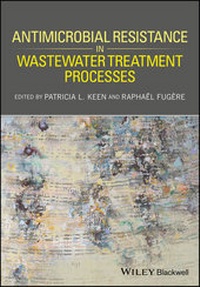
We thank our fantastic team of contributing authors whom we are extremely pleased to regard as both our professional colleagues and our friends. Each chapter of this book has been crafted by some of the world's leading authorities on the topic, in many cases together with early career researchers who continue to explore unanswered questions about risks linked to the development and spread of antimicrobial resistance. We thank the team at Wiley-Blackwell led by Mindy Okura-Marszycki and Kshitija Iyer for guiding us through the entire process of assembling this book from concept to completion. We extend our sincere gratitude to Philippe Raphanel for the use of the image from his wonderful painting on the cover of this book.
Patricia offers her thanks to colleagues from the Department of Civil Engineering at the University of British Columbia and also to her colleagues at the New York Institute of Technology, especially those individuals in the Energy Management Program at the Vancouver Campus, for their roles in making the development of this book a fun and rewarding experience. As well, she would like to express her sincere appreciation to Steve Clark for kindness, patience, and technical support throughout the book preparation process. Raphaël offers his thanks to René Fugère for his encouragement and support throughout all the phases that have led to the completion of this book. This book owes its existence to the inspiration of Julian Davies' letter in Nature published in 2012. Patricia and Raphaël are deeply grateful to Julian for his willingness to share his inspiration, knowledge, friendship, and scholarly guidance, which have enabled us to complete this work.
Reference
- Cooper PF (2001). Historical aspects of wastewater treatment. In: Decentralised Sanitation and Reuse: Concepts, Systems and Implementation, P Lens, G Zeeman, and G Lettinga...
