

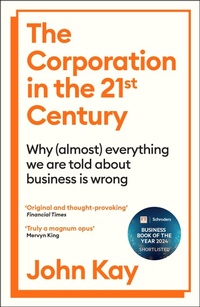
The Corporation in the Twenty-First Century
Why (almost) everything we are told about business is wrong
Erschienen am 22. August 2024
978-1-80522-173-9 (ISBN)
Beschreibung
SHORTLISTED FOR THE FINANCIAL TIMES AND SCHRODERS BUSINESS BOOK OF THE YEAR 2024
A NEW STATESMAN BOOK OF THE YEAR 2024
A FINANCIAL TIMES BEST BUSINESS BOOK OF THE YEAR 2024
'Original and thought-provoking... A brilliantly erudite account of the major waves in the theory and practice of management' Financial Times
'Instead of theory it has wisdom... an excellent book' New Statesman
For generations, we have defined a corporation as a business that uses its accumulated wealth to own the means of production and exercise economic power.
That is no longer the reality. Corporations no longer control their own industries, and our most desired goods and services aren't stacked in container ships: they appear on your screen, fit in your pocket or occupy your head.
But even as we consume more than ever before, big business faces a crisis of legitimacy. The pharmaceutical industry creates life-saving vaccines but has lost the trust of the public. The widening pay gap between executives and employees is destabilising our societies. Facebook and Google have more customers than any companies in history but are widely reviled.
In incisive, provocative prose, economist John Kay describes how the pursuit of shareholder value has destroyed mammoth companies, redefines successful commercial activity, and looks to the future of what the corporation might be.
A NEW STATESMAN BOOK OF THE YEAR 2024
A FINANCIAL TIMES BEST BUSINESS BOOK OF THE YEAR 2024
'Original and thought-provoking... A brilliantly erudite account of the major waves in the theory and practice of management' Financial Times
'Instead of theory it has wisdom... an excellent book' New Statesman
For generations, we have defined a corporation as a business that uses its accumulated wealth to own the means of production and exercise economic power.
That is no longer the reality. Corporations no longer control their own industries, and our most desired goods and services aren't stacked in container ships: they appear on your screen, fit in your pocket or occupy your head.
But even as we consume more than ever before, big business faces a crisis of legitimacy. The pharmaceutical industry creates life-saving vaccines but has lost the trust of the public. The widening pay gap between executives and employees is destabilising our societies. Facebook and Google have more customers than any companies in history but are widely reviled.
In incisive, provocative prose, economist John Kay describes how the pursuit of shareholder value has destroyed mammoth companies, redefines successful commercial activity, and looks to the future of what the corporation might be.
Rezensionen / Stimmen
Original and thought-provoking... A brilliantly erudite account of the major waves in the theory and practice of management * Financial Times * Informative, funny, and full of deep insights. Truly a magnum opus -- Mervyn King, former Governor of the Bank of England A characteristically acerbic analysis of the archetypal organisational unit of capitalism and what has become of it as the production of material goods has given way to immaterial and intangible services -- 'Best Business Books of 2024' * Financial Times * The doyen of British thinkers on the evolution of business * Literary Review * A very entertaining read for specialists and non-specialists alike. Few writers come close to matching Kay's analysis of what makes good businesses succeed and bad businesses fail -- Evan Davis, broadcaster This thoughtful critique of the modern corporation weaves history, psychology, economics, and good humor into a persuasive argument that business is fundamentally social and human -- Frank Partnoy, author of The Match King: Ivar Kreuger, The Financial Genius Behind a Century of Wall Street Scandals Praise for John Kay * - * An unparalleled communicator of economics to a non-specialist audience * New Statesman * Kay is both a first-class economist and an excellent writer * Financial Times * An admirable debunker of myths and false beliefs - Kay can see substantial things others don't -- Nassim N Taleb, author * The Black Swan * Kay is a brilliant writer * Wall Street Journal * By exploring ambiguity without lapsing into vagueness, Kay achieves what he advocastes: resisting thinking reductively and rushing to the bottom line. His writing is always clear but never closed. [it is] history written with a sustained moral outlook and world-view... instead of theory it has wisdom... brilliant * New Statesman *Weitere Details
Sprache
Englisch
Verlagsort
London
Großbritannien
Zielgruppe
Für höhere Schule und Studium
Für Beruf und Forschung
Produkt-Hinweis
Reflowable
ISBN-13
978-1-80522-173-9 (9781805221739)
Copyright in bibliographic data and cover images is held by Nielsen Book Services Limited or by the publishers or by their respective licensors: all rights reserved.
Schweitzer Klassifikation
Weitere Ausgaben
Person
Sir John Kay is one of Britain's leading economists. He has been awarded the Saltire Prize for Other People's Money, which was also shortlisted for the Orwell Prize. Previous titles include Obiquity, The Long and Short of It, Greed is Dead, and Radical Uncertainty. He lives in Oxford.
