

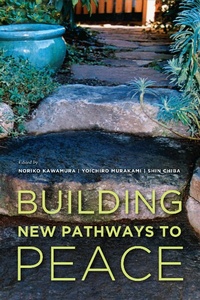
Building New Pathways to Peace
Beschreibung

In the post-Cold War era, problems of war and peace have become complicated and ambiguous, involving such nonmilitary issues as the north-south dichotomy of power, resource depletion, and globalization of capitalism. To create a twenty-first-century intellectual and theoretical foundation for peace studies, Building New Pathways to Peace considers both the old concepts of tolerance, shalom, and wa, and the relatively new concepts of human security, decent peace, credibility, accountability, plurality, multiculturalism, and transnationalism. It also elucidates impediments to and necessary conditions for actualizing peace.
Weitere Details
Weitere Ausgaben
Andere Ausgaben
Personen
Noriko Kawamura is associate professor of history, Washington State University. Yoichiro Murakami and Shin Chiba teach at the International Christian University in Tokyo. Other contributors are Martha Cottam, Gregory Hooks, Takashi Kibe, Otwin Marenin, Anri Morimoto, T. V. Reed, Susan Ross, Raymond Sun, and Kano Yamamoto.
Inhalt
Foreword by Johan Galtung
Acknowledgments
Introduction
1. On Tolerance, Yoichiro Murakami
2. To Forgive is Human: A Theological Reflection on the Politics of Reconciliation, Anri Morimoto
3. On Perspectives of Peace: The Hebraic Idea of Shalom and Prince Shotoku's Idea of Wa Shin Chiba
4. Decency, Equality, and Peace: A Perspective on a Peaceful Multicultural Society, Takashi Kabe
5. Globalization, Culture and the Strategic Use of the Arts for Peacebuilding, T.V. Reed
6. Impediments to Human Security: Social Categories, Privilege, and Violence, Martha Cottam
7. The Lessons of Peacebuilding for Kyosei, Otwin Marenin
8. Media Discourses of Peace: An Imperfect but Important Tool of Peace, Security, and Kyosei, Susan Dente Ross
9. Establishing Credibility under Globalization: The Role of Higher Education in Promoting Peace, Security, and Kyosei,
Kano Yamamoto
10. Can Grand Theories of the State Help Us Envision a Grand Theory of Peace?, Gregory Hooks
11. ?Remembering Is Not an Innocent Act?: Reflections on Postwar German War Memory and Peace Studies, Raymond C. Sun
12. To Transnationalize War Memory for Peace and Kyosei: Reconciliation of Pearl Harbor and Hiroshima, Noriko Kawamura
Bibliography
Contributors
Index
