

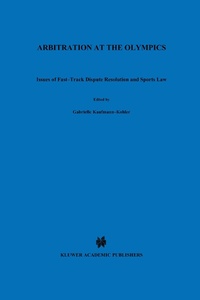
Arbitration at the Olympics
Issues of Fast-Track Dispute Resolution and Sports Law
Erschienen am 1. Dezember 2001
174 Seiten
978-90-411-7983-8 (ISBN)
Beschreibung
What does an athlete do when she is not allowed to take the start of the Olympic finals because of a positive doping test or he is not allowed to compete at the Games for reasons of nationality?
He or she brings the case before the ad hoc Division of the Court of Arbitration for Sport, an arbitral body first created on the occasion of the 1996 Games in Atlanta, which is present on site and resolves all disputes within 24 hours.
Written by its former President, who teaches and practices international dispute resolution in Geneva, Switzerland, this book tells the story of the ad hoc Division from Atlanta to Sydney over Nagano. It gives an account of the cases resolved, discusses the Arbitration Rules, and explains the practical operation of the Division.
It also reviews all the main arbitration law issues which the Division faces, including jurisdiction, arbitrability, due process, the choice and proof of the applicable substantive rules, the remedies against the award, as well as some sports law issues, such as field of play rules or strict liability for doping offenses.
The wealth of information it contains makes this book an indispensable tool for all involved or interested in sports law and dispute resolution. Many of its developments go beyond the sports context and are of general interest to all arbitration practitioners.
He or she brings the case before the ad hoc Division of the Court of Arbitration for Sport, an arbitral body first created on the occasion of the 1996 Games in Atlanta, which is present on site and resolves all disputes within 24 hours.
Written by its former President, who teaches and practices international dispute resolution in Geneva, Switzerland, this book tells the story of the ad hoc Division from Atlanta to Sydney over Nagano. It gives an account of the cases resolved, discusses the Arbitration Rules, and explains the practical operation of the Division.
It also reviews all the main arbitration law issues which the Division faces, including jurisdiction, arbitrability, due process, the choice and proof of the applicable substantive rules, the remedies against the award, as well as some sports law issues, such as field of play rules or strict liability for doping offenses.
The wealth of information it contains makes this book an indispensable tool for all involved or interested in sports law and dispute resolution. Many of its developments go beyond the sports context and are of general interest to all arbitration practitioners.
Weitere Details
Weitere Ausgaben
Inhalt
- Cover
- Half Title Page
- Title Page
- Copyright Page
- Table of Contents
- ACKNOWLEDGMENTS
- I. INTRODUCTION: FROM ATLANTA TO SYDNEY
- ATLANTA OR THE FIRST DAYS
- NAGANO OR ADOLESCENCE
- SYDNEY OR THE AGE OF MATURITY
- AND WHAT ABOUT THE COURTS?
- HOW TO USE THIS BOOK?
- BROADER PERSPECTIVE ON CONTEMPORARY DISPUTE RESOLUTION
- II. ARBITRATION AT THE SYDNEY OLYMPIC GAMES
- 1. Sydney and arbitration - or how fast can arbitrators go?
- 1. THE AD HOC DIVISION AND ITS ARBITRATION RULES
- 2. THE SYDNEY CASES
- 2.1 OVERVIEW
- 2.2 PEREZ
- 2.2.1 Facts
- 2.2.2 Act 1: Rule 46 Olympic Charter
- 2.2.3 Act 2: Statelessness under international standards
- 2.2.4 Act 3: Due process and speed
- 2.2.5 Addendum: Miranda, another Cuban eligibility dispute
- 2.3 BAUMANN
- 2.3.1 Facts
- 2.3.2 Jurisdiction
- 2.3.3 Res judicata
- 2.3.4 Merits
- 2.4 MELINTE
- 2.4.1 Facts and procedure
- 2.4.2 Jurisdiction
- 2.4.3 Merits in expedited form
- 2.5 SEGURA
- 2.5.1 Facts and argument
- 2.5.2 Arbitrability
- 2.5.3 Merits
- 3. SELECTED ISSUES
- 3.1 PLACE OF ARBITRATION
- 3.2 JURISDICTION
- 3.2.1 Raguz and multiparty arbitration scheme
- 3.2.2 Jurisdiction of the ad hoc Division
- a) Athletes
- b) IFs
- c) NOCs
- d) National federations
- e) Organising Committee of the Olympic Games
- f) Manufacturers of sports equipment
- 3.3 ARBITRABILITY
- 3.4 LAW APPLICABLE TO THE MERITS
- 3.4.1 General principles of law
- 3.4.2 Ascertaining the law - or do you need to prove the law?
- 4. HOW FAST CAN ARBITRATORS GO?
- 4.1 THE NEED FOR SPEED
- 4.2 ACHIEVING SPEED
- 4.3 HURDLES AND HOW TO OVERCOME THEM
- 4.3.1 Anti-arbitration injunction, parallel proceedings, and lis pendens
- 4.3.2 Identifying and joining the parties
- 4.3.3 Due process: notice and evidence taking - or how fast can parties go?
- a) Notice
- b) Evidence taking
- 2. Memorandum on the CAS ad hoc Division
- 1. PARTIES AND DISPUTES
- 2. STRUCTURE OF THE CAS AD HOC DIVISION
- 3. ARBITRATION RULES
- 3.1 INTEGRAL PART OF CODE
- 3.2 COURSE OF ARBITRATION
- - Application
- - Formation of the arbitral tribunal
- - Interim Relief
- - Hearing and evidence
- - Full power to establish the facts
- - Law governing the merits
- - Award
- - Referral to usual CAS arbitration
- - Publication
- 3.3 COMPLIANCE WITH FUNDAMENTAL PRINCIPLES OF NATURAL JUSTICE
- 4. JURISDICTION OF THE CAS AD HOC DIVISION
- 5. PLACE OR "SEAT" OF ARBITRATION
- 5.1 SEAT IN LAUSANNE
- 5.2 REASONS FOR CHOICE OF SEAT
- 5.3 THE SEAT: A LEGAL CONNECTION
- 6. MUNICIPAL LAW GOVERNING THE ARBITRATION
- 3. Raguz v. Sullivan
- The Supreme Court of New South Wales Court of Appeal
- 4. Raducan v. International Olympic Committee
- 4.1. English translation
- 4.2. Original French version
- III. ARBITRATION AT THE NAGANO OLYMPIC GAMES Nagano and arbitration - or towards proximate justice
- 1. INTRODUCTION
- 2. THE CAS IN NAGANO
- 2.1 REBAGLIATI V. IOC
- 2.2 SAMUELSSON V. INTERNATIONAL ICE HOCKEY FEDERATION
- 2.3 OTHER PROCEEDINGS
- 3. THREE TOPICS FOR CONSIDERATION
- 3.1 THE LAW GOVERNING THE MERITS: GLOBALIZATION BY THE APPLICATION OF GENERAL PRINCIPLES OF LAW
- 3.2 THE LAW GOVERNING THE ARBITRATION PROCEDURE: (DE)LOCALIZATION BY FIXING THE SEAT AT LAUSANNE
- 3.3 RESOLVING DISPUTES: A PROXIMATE SYSTEM OF JUSTICE
- IV. ARBITRATION AT THE ATLANTA GAMES Arbitration and the Games or the first experience of the Olympic Division of the Court of Arbitration for Sport
- 1. GOAL: FAIR, FAST AND FREE
- 2. STRUCTURE
- 3. LEGAL FRAMEWORK
- 3.1 JURISDICTION
- 3.2 APPLICABLE PROCEDURAL RULES AND SEAT OF THE ARBITRATION
- 3.3 RULES APPLICABLE TO MERITS OF THE DISPUTE
- 4. COURSE OF THE ARBITRATION
- 5. PRACTICAL ORGANIZATION
- 6. CASES SUBMITTED TO THE OLYMPIC DIVISION
- 6.1 US SWIMMING V. FINA
- 6.2 ANDRADE, WHITE AND LITTLE V. NOC CAPE VERDE
- 6.3 ANDRADE 2
- 6.4 MENDY V. AIBA
- 6.5 KORNEEV AND RUSSIAN NOC V. IOC
- GOULIEV AND RUSSIAN NOC V. IOC
- 7. CONCLUSIONS: WHAT LESSONS ARE TO BE LEARNED?
- V. CAS ARBITRATION RULES FOR THE OLYMPIC GAMES
- 1. ARBITRATION RULES FOR THE GAMES OF THE XXVII OLYMPIAD IN SYDNEY
- 2. RÈGLEMENT D'ARBITRAGE POUR LES JEUX DE LA XXVII ÈME OLYMPIADE À SYDNEY
- VI. STANDARD FORMS USED BY THE CAS AD HOC DIVISION
- 1. Standard request for arbitration
- 2. Summons to appear
- INDEX
- SELECTED BIBLIOGRAPHY
- LIST OF CITED AWARDS AND CASES
- CAS AD HOC DIVISION AWARDS
- OTHER CAS AWARDS
- COURT CASES
- ABREVIATIONS
- Back Cover
