

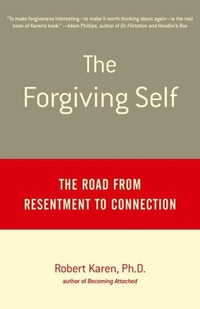
The Forgiving Self
The Road from Resentment to Connection
Erschienen am 23. März 2011
304 Seiten
978-0-307-76515-4 (ISBN)
Beschreibung

In this fascinating book about our struggle to forgive, psychologist and award-winning author Robert Karen uses movies, people in the news, and sessions from his practice to illuminate the conflict between our wish to repair our relationships on one side and our tendency to see ourselves as victims who want revenge on the other.
Why do we harden our hearts, even against those we want to love? Why do we find it so hard to admit being wrong? Why are the worst grudges the ones we hold against ourselves? When we nurse our resentments, Karen says, we are acting from an insecure aspect of the self that harbors unresolved pain from childhood. But we also have a forgiving self which is not compliant or fake, but rather the strongest, most loving part of who we are. Through it, we are able to voice anger without doing damage, to acknowledge our own part in what has gone wrong, to see the flaws in ourselves and others as part of our humanity.
Karen demonstrates how we can move beyond our feelings of being wronged without betraying our legitimate anger and need for repair. The forgiving self, when we are able to locate it, brings relief from compulsive self-hatred and bitterness, and allows for a re-emergence of love.
Why do we harden our hearts, even against those we want to love? Why do we find it so hard to admit being wrong? Why are the worst grudges the ones we hold against ourselves? When we nurse our resentments, Karen says, we are acting from an insecure aspect of the self that harbors unresolved pain from childhood. But we also have a forgiving self which is not compliant or fake, but rather the strongest, most loving part of who we are. Through it, we are able to voice anger without doing damage, to acknowledge our own part in what has gone wrong, to see the flaws in ourselves and others as part of our humanity.
Karen demonstrates how we can move beyond our feelings of being wronged without betraying our legitimate anger and need for repair. The forgiving self, when we are able to locate it, brings relief from compulsive self-hatred and bitterness, and allows for a re-emergence of love.
Weitere Details
Weitere Ausgaben
Andere Ausgaben
Buch
07/2003
Random House Inc
18,30 €
Artikel ist vergriffen; siehe andere Ausgabe

Buch
01/2001
Bantam Books
42,04 €
Artikel ist vergriffen; siehe andere Ausgabe
Person
ROBERT KAREN, PH.D., is an award-winning author and clinical psychologist in private practice as well as an associate clinical professor at the Derner Institute of Advanced Psychology Studies at Adelphi University. The author of Becoming Attached and The Forgiving Self, he lives in New York City.
Inhalt
- Intro
- About the Author
- Other Books by This Author
- Title Page
- Dedication
- Contents
- Author's Note
- Introduction - Psychology in Forgiving and Not Forgiving
- Part I - The Landscape of Loss
- Chapter One - Saints and Monsters
- Chapter Two - The Flight from Mourning
- Chapter Three - Holding Out for Heaven
- Chapter Four - The Failure of Protest and Repair
- Chapter Five - The Birth of the Inner Drama
- Part II - The Landscape of Resentment
- Chapter Six - The More We Blame the Further We Get from Ourselves
- Chapter Seven - Revenge of the Wounded
- Part III - The Landscape of Connection
- Chapter Eight - The Redeployment of Love
- Chapter Nine - Extraordinary Forgiveness
- Chapter Ten - The Renewal of Protest
- Chapter Eleven - Anger Without Bitterness
- Chapter Twelve - Owning Up
- Chapter Thirteen - Can We Forgive Our Parents?
- Chapter Fourteen - Letting Go
- Acknowledgments
- Copyright
