

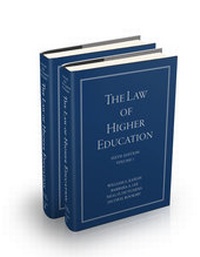
The Law of Higher Education
6. Auflage
Erschienen am 4. April 2019
2336 Seiten
978-1-119-55120-1 (ISBN)
Beschreibung

Your must-have resource on the law of higher education
Written by recognized experts in the field, the latest edition of The Law of Higher Education offers college administrators, legal counsel, and researchers with the most up-to-date, comprehensive coverage of the legal implications of administrative decision making.
In the increasingly litigious environment of higher education, William A. Kaplin and Barbara A. Lee's clear, cogent, and contextualized legal guide proves more and more indispensable every year. Two new authors, Neal H. Hutchens and Jacob H Rooksby, have joined the Kaplin and Lee team to provide additional coverage of important developments in higher education law. From hate speech to student suicide, from intellectual property developments to issues involving FERPA, this comprehensive resource helps ensure you're ready for anything that may come your way.
* Includes new material since publication of the previous edition
* Covers Title IX developments and intellectual property
* Explores new protections for gay and transgender students and employees
* Delves into free speech rights of faculty and students in public universities
* Expands the discussion of faculty academic freedom, student academic freedom, and institutional academic freedom
If this book isn't on your shelf, it needs to be.
Written by recognized experts in the field, the latest edition of The Law of Higher Education offers college administrators, legal counsel, and researchers with the most up-to-date, comprehensive coverage of the legal implications of administrative decision making.
In the increasingly litigious environment of higher education, William A. Kaplin and Barbara A. Lee's clear, cogent, and contextualized legal guide proves more and more indispensable every year. Two new authors, Neal H. Hutchens and Jacob H Rooksby, have joined the Kaplin and Lee team to provide additional coverage of important developments in higher education law. From hate speech to student suicide, from intellectual property developments to issues involving FERPA, this comprehensive resource helps ensure you're ready for anything that may come your way.
* Includes new material since publication of the previous edition
* Covers Title IX developments and intellectual property
* Explores new protections for gay and transgender students and employees
* Delves into free speech rights of faculty and students in public universities
* Expands the discussion of faculty academic freedom, student academic freedom, and institutional academic freedom
If this book isn't on your shelf, it needs to be.
Weitere Details
Weitere Ausgaben
Nachauflagen
William A. Kaplin | Barbara A. Lee | Neal H. Hutchens
The Law of Higher Education
Essentials for Legal and Administrative Practice
E-Book
08/2024
1. Auflage
Wiley-Scrivener
89,99 €
Als Download verfügbar
Andere Ausgaben
William A. Kaplin | Barbara A. Lee | Neal H. Hutchens
The Law of Higher Education, 2 Volume Set
2 Volume Set
Buch
04/2019
6. Auflage
Jossey-Bass
322,50 €
Versand in 15-20 Tagen
Personen
William A. Kaplin is Professor of Law Emeritus at the Catholic University of America in Washington, DC, where he also served for many years as Special Counsel to the Office of General Counsel. He is the former editor of the Journal of College and University Law. Professor Kaplin received the American Council on Education's Borden Award, in recognition of the First Edition of The Law of Higher Education. He has also been honored through Stetson University's establishment of the William A. Kaplin Award for Excellence in Higher Education Law and Policy Scholarship, a national award presented annually to a leading scholar in the field.
Barbara A. Lee is Senior Vice President for Academic Affairs at Rutgers, The State University of New Jersey, and Distinguished Professor of Human Resource Management. She is a former Dean of the School of Management and Labor Relations, and also served as associate provost, department chair, and Director of the Center for Women and Work at Rutgers. She chaired the editorial board of the Journal of College and University Law and is a Fellow of the National Association of College and University Attorneys. She received the Daniel Gorenstein Award from Rutgers University in 2009 for distinguished contributions to scholarship and service. In addition to co-authoring multiple editions of The Law of Higher Education, The Law of Higher Education-Student Version, and A Legal Guide for Student Affairs Professionals, she co-authored, with George LaNoue, Academics in Court. She has published over 100 books and articles on higher education legal topics, and serves as an expert witness in tenure, discharge, and discrimination cases, as well as a frequent lecturer and trainer for academic and corporate audiences.
Barbara Lee received her B.A. degree, summa cum laude, from the University of Vermont, her M.A. in English and Ph.D. in higher education administration, and her J.D., cum laude, from the Georgetown University Law Center.
Neal H. Hutchens serves as Professor and Chair in the University of Mississippi School of Education's Department of Higher Education. He previously held a faculty appointment at Penn State University. A key strand of his scholarship is centered on free speech and academic freedom issues in higher education. Hutchens was the 2015 recipient of the William A. Kaplin Award from the Center for Excellence in Higher Education Law and Policy at Stetson University College of Law. He is on the editorial board for The Review of Higher Education and for Education Law & Policy Review and is a member of the authors' committee for West's Education Law Reporter. He also serves on the Litigation Committee for the American Association of University Professors and is a past board member of the Education Law Association.
Jacob H. Rooksby is Dean and Professor in the School of Law at Gonzaga University, where he also holds a joint appointment in the School of Education. Prior to joining Gonzaga, Rooksby was Associate Dean and Associate Professor at Duquesne University School of Law. Rooksby's scholarship lies in two fields: intellectual property law and higher education law. Johns Hopkins University Press published his book, The Branding of the American Mind: How Universities Capture, Manage, and Monetize Intellectual Property and Why It Matters, in 2016. Rooksby writes a regular column for Campus Legal Advisor and has published his work in Harvard Journal of Law & Technology, Yale Journal of Law & Technology, and the Chronicle of Higher Education, among other outlets. Rooksby holds J.D., M.Ed., and Ph.D. degrees from the University of Virginia and an undergraduate degree, summa cum laude, from the College of William & Mary. He formerly practiced law with McGuireWoods LLP and Cohen & Grigsby, P.C.
Barbara A. Lee is Senior Vice President for Academic Affairs at Rutgers, The State University of New Jersey, and Distinguished Professor of Human Resource Management. She is a former Dean of the School of Management and Labor Relations, and also served as associate provost, department chair, and Director of the Center for Women and Work at Rutgers. She chaired the editorial board of the Journal of College and University Law and is a Fellow of the National Association of College and University Attorneys. She received the Daniel Gorenstein Award from Rutgers University in 2009 for distinguished contributions to scholarship and service. In addition to co-authoring multiple editions of The Law of Higher Education, The Law of Higher Education-Student Version, and A Legal Guide for Student Affairs Professionals, she co-authored, with George LaNoue, Academics in Court. She has published over 100 books and articles on higher education legal topics, and serves as an expert witness in tenure, discharge, and discrimination cases, as well as a frequent lecturer and trainer for academic and corporate audiences.
Barbara Lee received her B.A. degree, summa cum laude, from the University of Vermont, her M.A. in English and Ph.D. in higher education administration, and her J.D., cum laude, from the Georgetown University Law Center.
Neal H. Hutchens serves as Professor and Chair in the University of Mississippi School of Education's Department of Higher Education. He previously held a faculty appointment at Penn State University. A key strand of his scholarship is centered on free speech and academic freedom issues in higher education. Hutchens was the 2015 recipient of the William A. Kaplin Award from the Center for Excellence in Higher Education Law and Policy at Stetson University College of Law. He is on the editorial board for The Review of Higher Education and for Education Law & Policy Review and is a member of the authors' committee for West's Education Law Reporter. He also serves on the Litigation Committee for the American Association of University Professors and is a past board member of the Education Law Association.
Jacob H. Rooksby is Dean and Professor in the School of Law at Gonzaga University, where he also holds a joint appointment in the School of Education. Prior to joining Gonzaga, Rooksby was Associate Dean and Associate Professor at Duquesne University School of Law. Rooksby's scholarship lies in two fields: intellectual property law and higher education law. Johns Hopkins University Press published his book, The Branding of the American Mind: How Universities Capture, Manage, and Monetize Intellectual Property and Why It Matters, in 2016. Rooksby writes a regular column for Campus Legal Advisor and has published his work in Harvard Journal of Law & Technology, Yale Journal of Law & Technology, and the Chronicle of Higher Education, among other outlets. Rooksby holds J.D., M.Ed., and Ph.D. degrees from the University of Virginia and an undergraduate degree, summa cum laude, from the College of William & Mary. He formerly practiced law with McGuireWoods LLP and Cohen & Grigsby, P.C.
Inhalt
- Volume 1
- Title Page
- Copyright
- Notice to Instructors
- Notice of Website and PeriodicUpdates for the Sixth Edition
- Contents
- Preface
- Overview of the Sixth Edition
- Relationship Between the Sixth Edition and Earlier Editions
- Audience
- Organization
- What Is New in This Edition
- Citations and References
- A Note on Nomenclature
- Recommendations for Using the Bookand Keeping Up to Date
- Acknowledgments
- The Authors
- Part One Perspectives and Foundations
- Chapter 1. Overview of Higher Education Law
- Section 1.1. How Far the Law Reaches and How Loudly It Speaks
- Section 1.2. Evolution of Higher Education Law
- Section 1.3. The Governance of Higher Education
- 1.3.1. Basic concepts and distinctions
- 1.3.2. Internal governance
- 1.3.3. External governance
- Section 1.4. Sources of Higher Education Law
- 1.4.1. Overview
- 1.4.2. External sources of law
- 1.4.2.1. Federal and state constitutions
- 1.4.2.2. Statutes
- 1.4.2.3. Administrative rules and regulations
- 1.4.2.4. State common law
- 1.4.2.5. Foreign and international law
- 1.4.3. Internal sources of law
- 1.4.3.1. Institutional rules and regulations
- 1.4.3.2. Institutional contracts
- 1.4.3.3. Academic custom and usage
- 1.4.4. The role of case law
- Section 1.5. The Public-Private Dichotomy
- 1.5.1. Overview
- 1.5.2. The state action doctrine
- 1.5.2.1. When private postsecondary institutions may be engaged in state action
- 1.5.2.2. When students, employees, and others may be engaged in state action
- 1.5.3. Other bases for legal rights in private institutions
- Section 1.6. Religion and the Public-Private Dichotomy
- 1.6.1. Overview
- 1.6.2. Religious autonomy rights of religious institutions and their personnel
- 1.6.3. Government support for religious institutions and their students and faculty members
- 1.6.4. Religious autonomy rights of individuals in public postsecondary institutions
- Section 1.7. The Relationship Between Law and Policy
- Selected Annotated Bibliography
- Chapter 2. Legal Planning and Dispute Resolution
- Section 2.1. Legal Liability
- 2.1.1. Overview
- 2.1.2. Types of liability
- 2.1.3. Agency law
- 2.1.4. Enforcement mechanisms
- 2.1.5. Remedies for legal violations
- 2.1.6. Avoiding legal liability
- Section 2.2. Litigation in the Courts
- 2.2.1. Overview
- 2.2.2. Access to court
- 2.2.2.1. Jurisdiction
- 2.2.2.2. Other technical doctrines
- 2.2.2.3. Statutes of limitations
- 2.2.2.4. Exhaustion of remedies
- 2.2.3. Pretrial and trial issues
- 2.2.3.1. Class action suits
- 2.2.3.2. Pretrial discovery
- 2.2.3.3. Issues regarding evidence
- 2.2.3.4. Summary judgments and motions to dismiss
- 2.2.3.5. Standards of judicial review and burdens of proof
- 2.2.3.6. Final judgments.
- 2.2.4. Judicial remedies
- 2.2.4.1. Overview
- 2.2.4.2. Money damages
- 2.2.4.3. Injunctions
- 2.2.4.4. Attorney's fees
- 2.2.4.5. Contempt of court
- 2.2.5. Judicial (academic) deference
- 2.2.6. Managing litigation and the threat of litigation
- Section 2.3. Alternative Dispute Resolution
- 2.3.1. Overview
- 2.3.2. Types of ADR
- 2.3.3. Applications to colleges and universities
- Section 2.4. Legal Services
- 2.4.1. Organizational arrangements for delivery of legal services
- 2.4.2. Treatment law and preventive law
- 2.4.3. Ethical issues
- Section 2.5. Institutional Management of Liability Risk
- 2.5.1. Overview and suggestions
- 2.5.2. Risk avoidance and risk control
- 2.5.3. Risk transfer
- 2.5.3.1. Liability insurance
- 2.5.3.2. Hold-harmless and indemnification agreements
- 2.5.3.3. Releases and waivers
- 2.5.4. Risk retention
- 2.5.5. Enterprise risk management
- 2.5.6. Legal limits on authority to transfer risk
- Selected Annotated Bibliography
- Part Two The College and Its Governing Board, Personnel, and Agents
- Chapter 3. The College and Its Trustees and Officers
- Section 3.1. The Question of Authority
- Section 3.2. Sources and Scope of Authority and Liability
- 3.2.1. Trustees
- 3.2.1.1. Overview
- 3.2.1.2. Trustees of public colleges
- 3.2.1.3. Trustees of private colleges
- 3.2.2. Other officers and administrators
- 3.2.3. Campus organizations
- 3.2.4. Trustee liability
- Section 3.3. Institutional Tort Liability
- 3.3.1. Overview
- 3.3.2. Negligence
- 3.3.2.1. Overview
- 3.3.2.2. Premises liability
- 3.3.2.3. Liability for injuries related to on-campus instruction
- 3.3.2.4. Liability for injuries in off-campus courses
- 3.3.2.5. Liability for cocurricular and social activities
- 3.3.2.6. Student suicide
- 3.3.2.7. Liability for injuries related to outreach programs
- 3.3.3. Educational malpractice and related claims
- 3.3.4. Defamation
- 3.3.5. Other sources of tort liability
- Section 3.4. Institutional Contract Liability
- Section 3.5. Institutional Liability for Violating Federal Constitutional Rights (Section 1983 Liability)
- 3.5.1. Overview
- 3.5.2. Eleventh Amendment immunity
- 3.5.3. Other limits on Section 1983 liability and alternative sources of liability
- Section 3.6. Captive and Affiliated Organizations
- 3.6.1. Overview
- 3.6.2. Structural problems
- 3.6.3. Taxation issues
- 3.6.4. Application of regulatory laws
- 3.6.5. "State action" issues
- 3.6.6. Liability issues
- Selected Annotated Bibliography
- Chapter 4. The College and Its Employees
- Section 4.1. Overview of Employment Relationships
- Section 4.2. Pre-hire Considerations
- 4.2.1. Employees versus independent contractors
- 4.2.2. Where is the workplace?
- 4.2.3. Applicant screening
- Section 4.3. Employment Contracts
- 4.3.1. Defining the contract
- 4.3.2. The at-will doctrine
- 4.3.3. Sources, scope, and terms of the contract
- 4.3.3.1. Sources of the contract
- 4.3.3.2. Contract interpretation
- 4.3.3.3. Employee handbooks as contracts
- 4.3.3.4. Other contract claims
- 4.3.3.5. Contract rescission
- 4.3.3.6. Investigating employees
- 4.3.3.7. Executive contracts
- 4.3.3.8. Coaches' contracts
- 4.3.4. Amendment of the contract
- 4.3.5. Waiver of contract rights
- 4.3.6. Legal planning with contracts
- Section 4.4. Civil Service Rules
- Section 4.5. Collective Bargaining
- 4.5.1. Overview
- 4.5.2. The public-private dichotomy in collective bargaining
- 4.5.2.1. Overview
- 4.5.2.2. Bargaining at private colleges
- 4.5.2.3. Collective bargaining in religiously affiliated institutions
- 4.5.2.4. Bargaining at public colleges
- 4.5.3. Organization, recognition, and certification
- 4.5.4. Bargainable subjects
- 4.5.5. Collective bargaining and antidiscrimination laws
- 4.5.6. Students and collective bargaining
- Section 4.6. Other Employee Protections
- 4.6.1. Occupational Safety and Health Act
- 4.6.2. Fair Labor Standards Act
- 4.6.3. Employee Retirement Income Security Act
- 4.6.4. Family and Medical Leave Act
- 4.6.5. Immigration laws
- 4.6.6. Workers' compensation laws
- 4.6.7. Unemployment compensation laws
- 4.6.8. Whistleblower protections
- 4.6.9. Uniformed Services Employment and Reemployment Rights Act
- 4.6.10. Free speech claims by staff
- 4.6.11. Social media and email privacy
- Section 4.7. Personal Liability of Employees
- 4.7.1. Overview
- 4.7.2. Tort liability
- 4.7.2.1. Overview
- 4.7.2.2. Negligence
- 4.7.2.3. Defamation
- 4.7.2.4. Other tort claims
- 4.7.3. Contract liability
- 4.7.4. Constitutional liability (personal liability under Section 1983)
- 4.7.4.1. Qualified immunity
- 4.7.4.2. Issues on the merits: State-created dangers
- Section 4.8. Performance Management Issues
- 4.8.1. Pre-hire issues
- 4.8.2. Evaluation
- 4.8.3. Discipline
- 4.8.4. Promotion
- 4.8.5. Termination
- Selected Annotated Bibliography
- Chapter 5. Nondiscrimination and Affirmative Action in Employment
- Section 5.1. The Interplay of Statutes, Regulations, and Constitutional Protections
- Section 5.2. Sources of Law
- 5.2.1. Title VII
- 5.2.2. Equal Pay Act
- 5.2.3. Title IX
- 5.2.4. Section 1981
- 5.2.5. Americans with Disabilities Act and Rehabilitation Act of 1973
- 5.2.6. Age Discrimination in Employment Act
- 5.2.7. Genetic Information Nondiscrimination Act (GINA)
- 5.2.8. Constitutional prohibitions against employment discrimination
- 5.2.9. Executive Orders 11246 and 11375
- 5.2.10. Laws prohibiting sexual orientation discrimination
- 5.2.11. Laws prohibiting transgender discrimination
- Section 5.3. The Protected Classes
- 5.3.1. Race
- 5.3.2. National origin and alienage
- 5.3.3. Sex
- 5.3.3.1. Overview
- 5.3.3.2. Pregnancy and health benefits discrimination
- 5.3.3.3. Sexual harassment
- 5.3.3.4. Discrimination claims by athletics coaches
- 5.3.4. Disability
- Is the employee disabled for ADA purposes?
- Is the employee qualified?
- Is the requested accommodation reasonable?
- 5.3.4.0. The "nondiscrimination" defense
- 5.3.5. Age
- 5.3.6. Religion
- 5.3.7. Sexual orientation
- 5.3.8. Transgender/gender identity or expression
- Section 5.4. Affirmative Action
- 5.4.1. Overview
- 5.4.2. Affirmative action under Title VII
- 5.4.3. Affirmative action under the equal protection clause
- 5.4.4. State regulation of affirmative action
- 5.4.5. Conclusion
- Section 5.5. Application of Nondiscrimination Laws to Religious Institutions
- Selected Annotated Bibliography
- Part Three The College and its Faculty
- Chapter 6. Faculty Employment Issues
- Section 6.1. Overview
- Section 6.2. Faculty Contracts
- 6.2.1. Overview
- 6.2.2. Statutory versus contract rights in public institutions
- 6.2.3. Academic custom and usage
- 6.2.4. Part-time faculty
- 6.2.5. Contracts in religious institutions
- Section 6.3. Faculty Collective Bargaining
- 6.3.1. Bargaining unit eligibility of faculty
- 6.3.2. Coexistence of collective bargaining and traditional academic practices
- Section 6.4. Application of Nondiscrimination Laws to Faculty Employment Decisions
- 6.4.1. Overview
- 6.4.2. Challenges to employment decisions
- 6.4.2.1. Race and national origin discrimination claims
- 6.4.2.2. Sex discrimination
- 6.4.2.3. Disability discrimination
- 6.4.2.4. Age discrimination
- 6.4.2.5. Religious discrimination
- 6.4.3. Judicial deference and remedies for tenure denial
- 6.4.4. Challenges to salary decisions
- 6.4.5. Other workplace issues
- Section 6.5. Affirmative Action in Faculty Employment Decisions
- Section 6.6. Standards and Criteria for Faculty Personnel Decisions
- 6.6.1. General principles
- 6.6.2. Terminations of tenure for cause
- 6.6.3. Denial of tenure
- 6.6.4. Post-tenure review
- Section 6.7. Procedures for Faculty Employment Decisions
- 6.7.1. General principles
- 6.7.2. The public faculty member's right to constitutional due process
- 6.7.2.1. Overview
- 6.7.2.2. Nonrenewal of contracts
- 6.7.2.3. Denial of tenure
- 6.7.2.4. Termination of tenure
- 6.7.2.5. Other personnel decisions
- 6.7.3. The private faculty member's procedural rights
- 6.7.4. Implementing procedural requirements
- Section 6.8. Closure, Merger, and Reduction in Force
- 6.8.1. Overview
- 6.8.2. Contractual considerations
- 6.8.3. Constitutional considerations
- 6.8.4. Statutory considerations
- 6.8.5. Preparing for closures and reductions in force
- Selected Annotated Bibliography
- Chapter 7. Faculty Academic Freedom and Freedom of Expression
- Section 7.1. General Concepts and Principles
- 7.1.1. Faculty freedom of expression in general
- 7.1.2. Other constitutional rights supporting faculty freedom of expression
- 7.1.3. Academic freedom: Basic concepts and distinctions
- 7.1.4. Professional versus legal concepts of academic freedom
- 7.1.5. The foundational constitutional law cases
- 7.1.6. External versus internal restraints on academic freedom
- 7.1.7. "Institutional" academic freedom
- 7.1.8. "International" academic freedom
- Section 7.2. Academic Freedom in Teaching
- 7.2.1. In general
- 7.2.2. The classroom
- 7.2.3. Grading
- 7.2.4. Methods of analyzing academic freedom in teaching claims
- 7.2.5. Private institutions
- Section 7.3. Academic Freedom in Research and Publication
- Section 7.4. Academic Freedom in Institutional Affairs
- 7.4.1. In general
- 7.4.2. Speech on governance matters
- 7.4.3. Intramural speech on extramural public affairs
- Section 7.5. Academic Freedom in Private Life
- 7.5.1. In general
- 7.5.2. Extramural speech
- Section 7.6. Administrators' Authority Regarding Faculty Academic Freedom and Freedom of Expression
- Section 7.7. Protection of Confidential Academic Information: The "Academic Freedom Privilege"
- 7.7.1. Overview
- 7.7.2. Personnel issues
- 7.7.3. Research findings
- Section 7.8. Academic Freedom in Religious Colleges and Universities
- Selected Annotated Bibliography
- Part Four The College and Its Students
- Chapter 8. The Student-Institution Relationship
- Section 8.1. The Legal Status of Students
- 8.1.1. Overview
- 8.1.2. The age of majority
- 8.1.3. The contractual rights of students
- 8.1.4. Student academic freedom
- 8.1.5. Students' legal relationships with other students
- Section 8.2. Admissions
- 8.2.1. Basic legal requirements
- 8.2.2. Arbitrariness
- 8.2.3. The contract theory
- 8.2.4. The principle of nondiscrimination
- 8.2.4.1. Race
- 8.2.4.2. Sex
- 8.2.4.3. Disability
- 8.2.4.4. Age
- 8.2.4.5. Residence
- 8.2.4.6. Immigration status
- 8.2.5. Affirmative action programs
- 8.2.6. Readmission
- Section 8.3. Financial Aid
- 8.3.1. General principles
- 8.3.2. Federal programs
- 8.3.3. Nondiscrimination
- 8.3.4. Affirmative action in financial aid programs
- 8.3.5. Discrimination against nonresidents
- 8.3.6. Discrimination against noncitizens
- 8.3.6.1. Documented (immigrant and nonimmigrant) students
- 8.3.6.2. Undocumented students
- 8.3.7. Using government student aid funds at religious institutions
- 8.3.8. Collection of student debts
- 8.3.8.1. Overview of federal bankruptcy law
- 8.3.8.2. Student loans and bankruptcy law
- 8.3.8.3. Withholding certified transcripts
- 8.3.8.4. Debt collection requirements in federal student loan programs.
- Section 8.4. Student Housing
- 8.4.1. Overview
- 8.4.2. Discrimination claims
- 8.4.3. Searches and seizures
- Section 8.5. Campus Computer Networks
- 8.5.1. Freedom of speech
- 8.5.2. Right to privacy
- 8.5.3. Liability issues
- Section 8.6. Campus Security
- 8.6.1. Security officers
- 8.6.2. Protecting students against violent crime
- 8.6.3. Federal statutes and campus security
- Section 8.7. Other Support Services
- 8.7.1. Overview
- 8.7.2. Health services
- 8.7.3. Services for students with disabilities
- 8.7.4. Services for international students
- 8.7.5. Child care services
- 8.7.6. Legal services
- Section 8.8. Student Records
- 8.8.1. Family Educational Rights and Privacy Act (FERPA)
- 8.8.2. State law
- 8.8.3. The Federal Privacy Act
- Selected Annotated Bibliography
- Volume 2
- Contents
- Part Four The College and its Students
- Chapter 9. Student Academic Issues
- Section 9.1. Overview
- Section 9.2. Grading and Academic Standards
- Section 9.3. Online Programs
- 9.3.1. Overview
- 9.3.2. Ownership of online course materials
- 9.3.3. Student legal claims about online programs
- Section 9.4. Academic Accommodations for Students with Disabilities
- 9.4.1. Overview
- 9.4.2. Requests for programmatic or other accommodations
- 9.4.2.1. Domestic programs
- 9.4.2.2. Study abroad programs
- 9.4.2.3. Online programs
- Section 9.5. Sexual Harassment of Students by Faculty Members
- Section 9.6. Academic Dismissals and Other Academic Sanctions
- 9.6.1. Overview
- 9.6.2. Contract issues and fiduciary duty issues
- 9.6.3. Constitutional issues
- 9.6.4. Discrimination issues
- 9.6.5. Procedures for academic sanctions
- 9.6.5.1. Public institutions
- 9.6.5.2. Private institutions
- Section 9.7. Degree Revocation
- Selected Annotated Bibliography
- Chapter 10. Student Disciplinary Issues
- Section 10.1. Disciplinary and Grievance Systems
- 10.1.1. Overview
- 10.1.2. Establishment of systems
- 10.1.3. Codes of student conduct
- 10.1.4. Judicial systems
- Section 10.2. Disciplinary Rules and Regulations
- 10.2.1. Overview
- 10.2.2. Public institutions
- 10.2.3. Private institutions
- 10.2.4. Disciplining students with mental disorders
- Section 10.3. Procedures for Suspension, Dismissal, and Other Sanctions
- 10.3.1. Overview
- 10.3.2. Public institutions
- 10.3.2.1. Overview
- 10.3.2.2. Notice
- 10.3.2.3. Hearing
- 10.3.3. Private institutions
- Section 10.4. Student Protests and Freedom of Speech
- 10.4.1. Student free speech in general
- 10.4.2. The "public forum" concept
- 10.4.3. Regulation of student protest
- 10.4.4. Prior approval of protest activities
- 10.4.5. Court injunctions and criminal prosecutions
- 10.4.6. Posters and leaflets
- 10.4.7. Protests in the classroom
- Section 10.5. Speech Codes and the Problem of Hate Speech
- 10.5.1. Hate speech and the campus
- 10.5.2. The case law on hate speech and speech codes
- 10.5.3. Guidelines for dealing with hate speech on campus
- Selected Annotated Bibliography
- Chapter 11. Rights and Responsibilities of Student Organizations and Their Members
- Section 11.1. Student Organizations
- 11.1.1. The right to organize
- 11.1.2. The right not to join, or associate, or subsidize
- 11.1.3. Mandatory student activities fees
- 11.1.4. Principle of nondiscrimination
- 11.1.5. Religious activities
- Section 11.2. Fraternities and Sororities
- 11.2.1. Overview
- 11.2.2. Institutional recognition and regulation of fraternal organizations
- 11.2.3. Institutional liability for the acts of fraternal organizations
- 11.2.4. Liability of fraternal organizations or their members
- Section 11.3. The Student Press
- 11.3.1. General principles
- 11.3.2. Mandatory student fee allocations to student publications
- 11.3.3. Permissible scope of institutional regulation
- 11.3.4. Advertising in student publications
- 11.3.5. Obscenity
- 11.3.6. Libel
- 11.3.7. Obscenity and libel in private institutions
- Section 11.4. Athletic Teams and Clubs
- 11.4.1. General principles
- 11.4.2. Athletes' due process rights
- 11.4.3. Athletes' freedom of speech
- 11.4.4. Pertinent statutory law
- 11.4.5. Athletic scholarships
- 11.4.6. Sex discrimination
- 11.4.7. Discrimination on the basis of disability
- 11.4.8. Drug testing
- 11.4.9. Tort liability for athletic injuries
- Selected Annotated Bibliography
- Part Five The College and Local, State, and Federal Governments
- Chapter 12. Local Governments and the Local Community
- Section 12.1. General Principles
- Section 12.2. Zoning and Land Use Regulation
- 12.2.1. Overview
- 12.2.2. Public institutions and zoning regulations
- 12.2.3. Private institutions and zoning regulations
- 12.2.4. Special exceptions and variances
- 12.2.5. Amendment of zoning ordinances
- 12.2.6. Rights of other property owners
- 12.2.7. Zoning off-campus housing
- Section 12.3. Local Government Taxation
- 12.3.1. General tax concepts
- 12.3.2. Property taxes
- 12.3.3. Sales, admission, and amusement taxes
- Section 12.4. Student Voting in the Community
- 12.4.1. Registering to vote
- 12.4.2. Scheduling elections
- 12.4.3. Canvassing and registration on campus
- 12.4.4. Reapportionment
- Section 12.5. Relations with Local Police
- Section 12.6. Community Access to the College's Campus
- 12.6.1. Public versus private institutions
- 12.6.2. Exclusion of speakers and events
- 12.6.3. Trespass statutes and ordinances, and related campus regulations
- 12.6.4. Soliciting and canvassing
- 12.6.4.1. Overview
- 12.6.4.2. Commercial solicitation
- 12.6.4.3. Noncommercial solicitation
- Section 12.7. Community Activities of Faculty Members and Students
- Selected Annotated Bibliography
- Chapter 13. The College and State Government
- Section 13.1. Overview
- Section 13.2. State Provision of Public Postsecondary Education
- 13.2.1. Overview
- 13.2.2. Statutorily based institutions
- 13.2.3. Constitutionally based institutions
- Section 13.3. State Chartering and Licensure of Private Postsecondary Institutions
- 13.3.1. Scope of state authority
- 13.3.2. Chartering and licensure of religious institutions
- Section 13.4. State Regulation of Out-of-State Institutions and Programs
- Section 13.5. Other State Regulatory Laws Affecting Postsecondary Education Programs
- 13.5.1. Overview
- 13.5.2. Open meetings and public disclosure
- 13.5.3. Open records laws
- 13.5.4. State administrative procedure laws
- 13.5.5. Laws regulating medical services and medical research
- 13.5.6. Laws on gun possession
- Selected Annotated Bibliography
- Chapter 14. The College and the Federal Government
- Section 14.1. Federal Constitutional Powers over Education
- 14.1.1. Overview
- 14.1.2. Spending power
- 14.1.3. Taxing power
- 14.1.4. Commerce power
- 14.1.5. Civil rights enforcement powers
- 14.1.6. State sovereign immunity from suit
- Section 14.2. Federal Regulation of Postsecondary Education
- 14.2.1. Overview
- 14.2.2. Immigration laws
- 14.2.3. Regulation of research
- 14.2.3.1. Overview
- 14.2.3.2. Laws governing research on human subjects
- 14.2.3.3. Laws governing animal research
- 14.2.3.4. Research misconduct
- 14.2.4. USA PATRIOT Act and related laws
- 14.2.5. Copyright law
- 14.2.5.1. Overview
- 14.2.5.2. Rights of copyright
- 14.2.5.3. Copyright term and scope of protection
- 14.2.5.4. The fair use doctrine
- 14.2.5.5. Copyright ownership and management in the academy
- 14.2.5.6. The Digital Millennium Copyright Act (DMCA)
- 14.2.5.7. Copyright liability
- 14.2.6. Patent law
- 14.2.6.1. Overview
- 14.2.6.2. Patent-eligible subject matter
- 14.2.6.3. Policy issues involving university patents
- 14.2.6.4. Ownership of patents and ownership disputes
- 14.2.6.5. Infringement lawsuits
- 14.2.6.6. Patent reform and the America Invents Act (AIA)
- 14.2.7. Trademark law
- 14.2.8. Antitrust law
- 14.2.9. Federal Trade Commission Act
- 14.2.10. Environmental laws
- 14.2.11. Americans with Disabilities Act
- 14.2.12. Laws regulating computer network communications
- 14.2.12.1. Overview
- 14.2.12.2. Computer statutes
- 14.2.12.3. General statutes
- 14.2.13. Medicare
- 14.2.14. Health Insurance Portability and Accountability Act
- 14.2.15. False Claims Act and other fraud statutes
- Section 14.3. Federal Taxation of Postsecondary Education
- 14.3.1. Introduction and overview
- 14.3.2. Tax-exempt status
- 14.3.3. Tax-exempt status and intermediate sanctions
- 14.3.4. Tax rules regarding students
- 14.3.5. Gifts and contributions
- 14.3.6. The unrelated business income tax
- 14.3.7. Excise taxes on colleges and universities
- 14.3.8. Related entities and commercialization
- 14.3.9. Foreign programs and campuses
- 14.3.10. IRS audit guidelines
- Section 14.4. Federal Aid-to-Education Programs
- 14.4.1. Functions and history
- 14.4.2. Distinction between federal aid and federal procurement
- 14.4.3. Legal structure of aid programs
- 14.4.4. "Cross-cutting" aid conditions
- 14.4.4.1. Overview
- 14.4.4.2. Drug-Free Workplace Act of 1988
- 14.4.4.3. Safe and Drug-Free Schools and Communities Act Amendments
- 14.4.4.4. Student Right-to-Know Act
- 14.4.4.5. Other cross-cutting aid conditions
- 14.4.5. Enforcing compliance with aid conditions
- 14.4.6. Protecting institutional interests in disputes with funding agencies
- Section 14.5. Civil Rights Compliance
- 14.5.1. General considerations
- 14.5.2. Title VI
- 14.5.3. Title IX
- 14.5.3.1. Overview
- 14.5.3.2. Title IX and peer sexual harassment
- 14.5.3.3. Claims by accusing students
- 14.5.3.4. Claims by accused students
- 14.5.4. Section 504 of the Rehabilitation Act
- 14.5.5. Age Discrimination Act
- 14.5.6. Affirmative action
- 14.5.7. Scope and coverage problems
- 14.5.7.1. Coverage of employment discrimination
- 14.5.7.2. Coverage of unintentional discriminatory acts
- 14.5.7.3. Scope of the phrase "receiving federal financial assistance."
- 14.5.7.4. Scope of the phrase "program or activity."
- 14.5.7.5. Coverage of retaliatory acts
- 14.5.7.6. Coverage of extraterritorial acts of discrimination
- 14.5.8. Administrative enforcement
- 14.5.9. Other enforcement remedies
- Section 14.6. Dealing with the Federal Government
- 14.6.1. Handling federal rule making and regulations
- 14.6.2. Obtaining information
- Selected Annotated Bibliography
- Part Six The College and External Private Entities
- Chapter 15. The College and the Education Associations
- Section 15.1. Overview of the Education Associations
- Section 15.2. Applicable Legal Principles
- Section 15.3. The College and the Accrediting Agencies
- 15.3.1. Overview of accrediting agencies
- 15.3.2. Accreditation and the courts
- 15.3.2.1. Formative developments
- 15.3.2.2. State common law and "federal common law."
- 15.3.2.3. The U.S. Constitution
- 15.3.2.4. Antitrust law
- 15.3.2.5. Defamation law and other tort theories
- 15.3.2.6. Bankruptcy law
- 15.3.3. Accreditation and the U.S. Department of Education
- 15.3.4. Dealing with accrediting agencies
- Section 15.4. Athletic Associations and Conferences
- 15.4.1. Overview
- 15.4.2. Federal constitutional constraints
- 15.4.3. State statutes regulating athletic associations' enforcement activities
- 15.4.4. Antitrust laws
- 15.4.5. Common law principles
- 15.4.6. Federal civil rights statutes
- 15.4.6.1. The civil rights spending statutes
- 15.4.6.2. The Americans with Disabilities Act
- Section 15.5. The American Association of University Professors
- Section 15.6. Dealing with the Education Associations
- Selected Annotated Bibliography
- Chapter 16. The College and the Business and Industrial Community
- Section 16.1. The Contract Context for College Business Transactions
- 16.1.1. Overview
- 16.1.2. Types of contracts and contract terms
- 16.1.3. Elements of the contract
- 16.1.4. Breach of contract and remedies for breach
- 16.1.5. Arbitration
- Section 16.2. The College as Purchaser
- 16.2.1. Purchase of goods
- 16.2.2. Purchase of services
- 16.2.3. Purchase of real estate
- 16.2.4. The special case of design and construction contracts
- 16.2.4.1. General principles
- 16.2.4.2. Construction contracts in public institutions
- 16.2.4.3. Liability problems
- Section 16.3. The College as Seller and Competitor
- 16.3.1. Auxiliary enterprises
- 16.3.1.1. Overview
- 16.3.1.2. Institutional authority to operate auxiliary enterprises
- 16.3.2. State noncompetition statutes
- 16.3.3. Federal antitrust law
- 16.3.4. Taxation of income from entrepreneurial activities
- 16.3.4.1. Overview
- 16.3.4.2. Federal unrelated business income tax
- 16.3.4.3. State and local taxation
- 16.3.5. Administering auxiliary enterprises
- Section 16.4. The College as Research Collaborator and Partner
- 16.4.1. Potential and problems
- 16.4.2. The research agreement
- 16.4.3. Application of patent law
- 16.4.4. Federal tax exemptions for research
- 16.4.5. Application of antitrust law
- 16.4.6. Conflicts of interest
- Selected Annotated Bibliography
- Statute Index
- Case Index
- Subject Index
- EULA
