

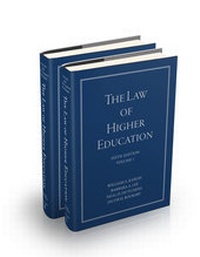
The Law of Higher Education
Beschreibung

Written by recognized experts in the field, the latest edition of The Law of Higher Education offers college administrators, legal counsel, and researchers with the most up-to-date, comprehensive coverage of the legal implications of administrative decision making.
In the increasingly litigious environment of higher education, William A. Kaplin and Barbara A. Lee's clear, cogent, and contextualized legal guide proves more and more indispensable every year. Two new authors, Neal H. Hutchens and Jacob H Rooksby, have joined the Kaplin and Lee team to provide additional coverage of important developments in higher education law. From hate speech to student suicide, from intellectual property developments to issues involving FERPA, this comprehensive resource helps ensure you're ready for anything that may come your way.
* Includes new material since publication of the previous edition
* Covers Title IX developments and intellectual property
* Explores new protections for gay and transgender students and employees
* Delves into free speech rights of faculty and students in public universities
* Expands the discussion of faculty academic freedom, student academic freedom, and institutional academic freedom
If this book isn't on your shelf, it needs to be.
Weitere Details
Weitere Ausgaben
Andere Ausgaben
Personen
Barbara A. Lee is Senior Vice President for Academic Affairs at Rutgers, The State University of New Jersey, and Distinguished Professor of Human Resource Management. She is a former Dean of the School of Management and Labor Relations, and also served as associate provost, department chair, and Director of the Center for Women and Work at Rutgers. She chaired the editorial board of the Journal of College and University Law and is a Fellow of the National Association of College and University Attorneys. She received the Daniel Gorenstein Award from Rutgers University in 2009 for distinguished contributions to scholarship and service. In addition to co-authoring multiple editions of The Law of Higher Education, The Law of Higher Education-Student Version, and A Legal Guide for Student Affairs Professionals, she co-authored, with George LaNoue, Academics in Court. She has published over 100 books and articles on higher education legal topics, and serves as an expert witness in tenure, discharge, and discrimination cases, as well as a frequent lecturer and trainer for academic and corporate audiences.
Barbara Lee received her B.A. degree, summa cum laude, from the University of Vermont, her M.A. in English and Ph.D. in higher education administration, and her J.D., cum laude, from the Georgetown University Law Center.
Neal H. Hutchens serves as Professor and Chair in the University of Mississippi School of Education's Department of Higher Education. He previously held a faculty appointment at Penn State University. A key strand of his scholarship is centered on free speech and academic freedom issues in higher education. Hutchens was the 2015 recipient of the William A. Kaplin Award from the Center for Excellence in Higher Education Law and Policy at Stetson University College of Law. He is on the editorial board for The Review of Higher Education and for Education Law & Policy Review and is a member of the authors' committee for West's Education Law Reporter. He also serves on the Litigation Committee for the American Association of University Professors and is a past board member of the Education Law Association.
Jacob H. Rooksby is Dean and Professor in the School of Law at Gonzaga University, where he also holds a joint appointment in the School of Education. Prior to joining Gonzaga, Rooksby was Associate Dean and Associate Professor at Duquesne University School of Law. Rooksby's scholarship lies in two fields: intellectual property law and higher education law. Johns Hopkins University Press published his book, The Branding of the American Mind: How Universities Capture, Manage, and Monetize Intellectual Property and Why It Matters, in 2016. Rooksby writes a regular column for Campus Legal Advisor and has published his work in Harvard Journal of Law & Technology, Yale Journal of Law & Technology, and the Chronicle of Higher Education, among other outlets. Rooksby holds J.D., M.Ed., and Ph.D. degrees from the University of Virginia and an undergraduate degree, summa cum laude, from the College of William & Mary. He formerly practiced law with McGuireWoods LLP and Cohen & Grigsby, P.C.
Inhalt
Preface
Overview of the Sixth Edition
Operating the colleges and universities of today presents a multitude of challenges for their leaders and personnel. Often the issues they face involve institutional policy, but with continually increasing frequency these issues have legal implications as well. Examples abound. A student enrolled in an online course may commit plagiarism or violate the code of student conduct in some other way. In what ways may the college discipline the student, and what process should be followed? A staff member may become a "whistleblower" and allege that the college is violating the law. Suppose the college was preparing to dismiss the complaining staff member for poor performance just before he "blew the whistle". May the college still dismiss the staff member? A student religious organization may approach the dean of students seeking recognition or an allocation from the fund for student activities. If membership is limited to students of a particular faith, or if the student organization does not admit gays or lesbians, how should the administration respond? A faculty member may challenge a negative promotion or tenure decision on the ground that her performance was negatively affected by a disability. Is the college required to modify the tenure criteria it applies to the faculty member, or might the faculty member have other rights to assert? A faculty member is disciplined by the school's dean for having made various comments to high-level administrators and the press about the importance of racially and ethnically diverse faculty and the school's failure to work toward this goal. The faculty member claims a violation of free speech and academic freedom. Is this a viable claim? A wealthy alumna may call the vice president for student affairs and offer to make a multimillion-dollar donation for scholarships on the condition that the scholarships be awarded only to African-American students from disadvantaged families. Can and should the vice president accept the donation and follow the potential donor's wishes?
We have designed this book as a resource for college and university attorneys, officers and administrators, trustees, faculty, and staff who may face issues such as these or innumerable others. The book provides foundational information and conceptual building blocks, in-depth analysis of key developments, and practical suggestions on a wide array of legal and policy issues faced by public and private institutions; the book also recommends and describes numerous additional resources to aid research, analysis, and legal planning. In particular, the book identifies trends and tracks their implications for academic institutions-often pointing out how particular legal developments may clash with, or support, important academic practices or values. In addition, the book explores relationships between law and policy, suggests preventive law measures for institutions to consider, and includes other suggestions and perspectives that serve to facilitate effective working relationships between counsel and administrators who grapple with law's impact on their campuses.
The discussions draw upon pertinent court opinions, constitutional provisions, statutes, and administrative regulations, as well as selected secondary sources such as journal articles, books, reports, and websites. In selecting topics and cases for discussion, we have primarily considered their significance for higher education policy making or legal risk management, their currency or timelessness, and their usefulness as illustrative examples of particular problems or as practical applications of particular legal principles.
Relationship Between the Sixth Edition and Earlier Editions
This sixth edition of The Law of Higher Education is the successor to the fifth edition, published in 2013, and the updates posted on the website of the National Association of College and University Attorneys periodically after the publication of the fifth edition. The sixth edition features a thoroughly revised, updated, and expanded text. This edition is current to approximately June 2018, but also occasionally references developments from later in that year.
In the years since publication of the fifth edition and then its updates, many new and newly complex legal concerns have arisen on U.S. campuses-from the use (and abuse) of the internet in student life, teaching and learning, and communications generally. Conflict about affirmative action in admissions continues, despite guidance from the U.S. Supreme Court. Arguments over "hate speech" and the boundaries of free speech and academic freedom have intensified on campus, and U.S. immigration policy has affected many current and prospective students. Indeed, it is difficult to identify any other entities-including large corporations and government agencies-that are subject to as great an array of legal requirements as are colleges and universities.
To serve the needs occasioned by this continual growth of the law, the sixth edition retains all material of continuing legal currency from the fifth edition and the updates, reorganized and reedited (and often reanalyzed) to accommodate the deletion and addition of materials and to maximize clarity and accessibility. To this base, we have added considerable new material that did not appear in earlier editions or updates. Specifically, we have extended the discussion of matters that appeared (in hindsight) to have been given insufficient attention in earlier editions or that have since acquired greater significance; integrated pertinent new developments and insights regarding topics in the earlier editions; and introduced numerous new topics and issues not covered in earlier editions. (See the listing of new sections below under the heading "What Is New in This Edition.")
Although considerable material from earlier editions has lost its legal currency as a result of later developments, we have nevertheless retained some of this material for its continuing historical significance. What has been retained, however, is often presented in a more compressed format than in earlier editions. Thus, readers desiring additional historical context for particular issues may wish to consult earlier editions. Moreover, we have sometimes deleted or compressed material that still has legal currency, because later cases or developments provide more instructive illustrations. Thus, readers seeking additional examples of particular legal issues may also wish to consult previous editions.
Like the earlier editions, the sixth edition covers all of nonprofit postsecondary education-from the large state university to the small private liberal arts college, from the graduate and professional school to the community college and vocational and technical institution, and from the traditional campus-based program to the innovative off-campus or multistate program, and now to distance learning as well. The sixth edition also covers proprietary (for-profit) institutions in situations where they are treated differently from nonprofits (e.g., state licensure of postsecondary institutions and programs), and in other areas of particular interest to proprietary institutions (e.g., distance learning).
The sixth edition also reflects the same perspective on the intersection of law and education as described in the preface to the first edition:
The law has arrived on the campus. Sometimes it has been a beacon, at other times a blanket of ground fog. But even in its murkiness, the law has not come "on little cat feet," like Carl Sandburg's "Fog"; nor has it sat silently on its haunches; nor will it soon move on. It has come noisily and sometimes has stumbled. And even in its imperfections, the law has spoken forcefully and meaningfully to the higher education community and will continue to do so.
Audience
The Law of Higher Education was originally written for administrative officers, trustees, and legal counsel who dealt with the many challenges and complexities that arise from the law's presence on campus, and for students and observers of higher education and law who desired to explore the intersection of these two disciplines. Beginning with the third edition, and continuing through this sixth edition, we have expanded the book's materials and scope to serve additional groups who regularly encounter legal conflicts and challenges in their professional lives: for example, directors of student judicial affairs offices; directors of equal opportunity offices; directors of offices for disabled students and for international students; and directors of resident life; deans and department chairs; risk managers; business managers and managers of grants and contracts; technology transfer, intellectual property, and sponsored research administrators; athletic directors; and directors of campus security. In addition, others outside the colleges and universities may find this sixth edition useful: for example, officers and staff at higher education associations, executives and project officers of foundations serving academia, education policy makers in state and federal governments, and attorneys representing clients who enter into transactions with or have disputes with postsecondary institutions.1
To be equally usable by administrators and legal counsel, the text avoids legal jargon and technicalities whenever possible and explains them when they are used. Footnotes throughout the book are designed primarily to provide additional technical analysis and research resources for legal...
