

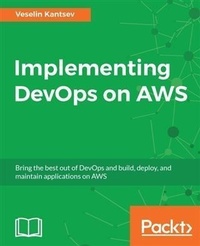
Implementing DevOps on AWS
Engineering DevOps for modern businesses
1. Auflage
Erschienen am 13. Januar 2025
258 Seiten
978-1-78646-997-7 (ISBN)
Beschreibung

Bring the best out of DevOps and build, deploy, and maintain applications on AWSKey Features - Work through practical examples and gain DevOps best practices to successfully deploy applications on AWS
- Successfully provision and operate distributed application systems and your AWS infrastructure using DevOps
- Perform Continuous Integration and deployment and fine-tune the way you deliver on AWS
Book DescriptionKnowing how to adopt DevOps in your organization is becoming an increasingly important skill for developers, whether you work for a start-up, an SMB, or an enterprise. This book will help you to drastically reduce the amount of time spent on development and increase the reliability of your software deployments on AWS using popular DevOps methods of automation. To start, you will get familiar with the concept of IaC and will learn to design, deploy, and maintain AWS infrastructure. Further on, you'll see how to design and deploy a Continuous Integration platform on AWS using either open source or AWS provided tools/services. Following on from the delivery part of the process, you will learn how to deploy a newly created, tested, and verified artefact to the AWS infrastructure without manual intervention. You will then find out what to consider in order to make the implementation of Configuration Management easier and more effective. Toward the end of the book, you will learn some tricks and tips to optimize and secure your AWS environment. By the end of the book, you will have mastered the art of implementing DevOps practices onto AWS.What you will learn - Design and deploy infrastructure as code within your AWS Virtual Private Cloud
- Implement Continuous Integration using AWS Services
- Configure EC2 instances using SaltStack
- Implement Continuous Deployment using Jenkins and the AWS CLI
- Collect important metrics and log data to gain more insight into infrastructure and applications
- Troubleshooting popular issues with some less known techniques using the AWS platform
Who this book is forThis book is for system administrators and developers who manage AWS infrastructure and environments and are planning to implement DevOps in their organizations. Those aiming for the AWS Certified DevOps Engineer certification will also find this book useful. Prior experience of operating and managing AWS environments is expected.
- Successfully provision and operate distributed application systems and your AWS infrastructure using DevOps
- Perform Continuous Integration and deployment and fine-tune the way you deliver on AWS
Book DescriptionKnowing how to adopt DevOps in your organization is becoming an increasingly important skill for developers, whether you work for a start-up, an SMB, or an enterprise. This book will help you to drastically reduce the amount of time spent on development and increase the reliability of your software deployments on AWS using popular DevOps methods of automation. To start, you will get familiar with the concept of IaC and will learn to design, deploy, and maintain AWS infrastructure. Further on, you'll see how to design and deploy a Continuous Integration platform on AWS using either open source or AWS provided tools/services. Following on from the delivery part of the process, you will learn how to deploy a newly created, tested, and verified artefact to the AWS infrastructure without manual intervention. You will then find out what to consider in order to make the implementation of Configuration Management easier and more effective. Toward the end of the book, you will learn some tricks and tips to optimize and secure your AWS environment. By the end of the book, you will have mastered the art of implementing DevOps practices onto AWS.What you will learn - Design and deploy infrastructure as code within your AWS Virtual Private Cloud
- Implement Continuous Integration using AWS Services
- Configure EC2 instances using SaltStack
- Implement Continuous Deployment using Jenkins and the AWS CLI
- Collect important metrics and log data to gain more insight into infrastructure and applications
- Troubleshooting popular issues with some less known techniques using the AWS platform
Who this book is forThis book is for system administrators and developers who manage AWS infrastructure and environments and are planning to implement DevOps in their organizations. Those aiming for the AWS Certified DevOps Engineer certification will also find this book useful. Prior experience of operating and managing AWS environments is expected.
Weitere Details
Weitere Ausgaben
Andere Ausgaben
Inhalt
- Cover
- Copyright
- Credits
- About the Author
- About the Reviewer
- www.PacktPub.com
- Customer Feedback
- Table of Contents
- Preface
- Chapter 1: What is DevOps and Should You Care?
- What is DevOps?
- A common goal
- Shared knowledge (no silos)
- Trust and shared responsibility
- Respect
- Automation
- Reproducible infrastructure
- Metrics and monitoring
- Continuous Integration, Delivery, and Deployment
- Embracing failure
- Should you care
- Is this the right time?
- Will it work?
- Is it worth it?
- Do you need it?
- Summary
- Chapter 2: Start Treating Your Infrastructure as Code
- IaC using Terraform
- Configuration
- Template design
- Resources
- Variables
- Outputs
- Operations
- Validation
- Dry-run
- Deployment
- Updates
- Removal
- IaC using CloudFormation
- Configuration
- Template design
- Parameters
- Resources
- Outputs
- Operations
- Template validation
- Deploying a Stack
- Updating a stack
- Deleting a stack
- Summary
- Chapter 3: Bringing Your Infrastructure Under Configuration Management
- Introduction to SaltStack
- Preparation
- Writing Configuration Management code
- States
- Pillars
- Grains
- Top files
- Bootstrapping nodes under Configuration Management (end-to-end IaC)
- Summary
- Chapter 4: Build, Test, and Release Faster with Continuous Integration
- Prepare IaC
- Terraform templates
- Variables
- Variables (values)
- Resources
- Create the VPC
- Add networking components
- Add EC2 node and related resources
- Outputs
- SaltStack code
- States
- Pillars
- Minion configuration
- Deploy IaC
- Setup CI
- Jenkins initialization
- Writing a demo app
- Defining the pipeline
- Setting up the pipeline
- Summary
- Chapter 5: Ever-Ready to Deploy Using Continuous Delivery
- Preparing Terraform templates
- Resources
- Variables
- Variables (values)
- Outputs
- Prepareing Salt code
- States
- top.sls
- jenkins
- nginx
- Pillars
- Minion configuration
- Preparing Jenkins code
- Packer
- demo-app.json
- demo-app_vars.json
- demo-app_userdata.sh
- Serverspec
- spec/localhost/demo-app_spec.rb
- demo-app
- demo-app-cdelivery
- Preparing CodeCommit repositories
- Deploy Terraform templates
- Initializing Jenkins
- Configuring Jenkins jobs
- demo-app pipeline
- demo-app-cdelivery pipeline
- Summary
- Chapter 6: Continuous Deployment - A Fully Automated Workflow
- Terraform code (resources.tf)
- outputs.tf
- Deployment
- Jenkins pipelines
- Continuous Deployment pipeline
- cdeployment.sh
- Summary
- Chapter 7: Metrics, Log Collection, and Monitoring
- Centralized logging
- Ingesting and storing logs with Logstash and Elasticsearch
- Collecting logs with Elasticsearch Filebeat
- Visualizing logs with Kibana
- Metrics
- Ingesting and storing metrics with Prometheus
- Gathering OS and application metrics with Telegraf
- Visualizing metrics with Grafana
- Monitoring
- Alerting with Prometheus
- Self-remediation with Prometheus and Jenkins
- Summary
- Chapter 8: Optimize for Scale and Cost
- Architectural considerations
- The VPC
- CIDR
- Subnets and Availability Zones
- VPC limits
- The frontend layer
- The backend layer
- The object storage layer
- The load balancing layer
- Cross-zone load balancing
- ELB pre-warming
- The CDN layer
- Spot instances
- AWS Calculators
- Summary
- Chapter 9: Secure Your AWS Environment
- Managing access using IAM
- Securing the root account
- VPC security
- Security Groups
- Network ACLs
- VPN gateway
- VPC peering
- EC2 security
- IAM Roles
- SSH access
- Individual keys
- Entrypoint
- ELBs everywhere
- HTTPS by default
- Encrypted storage
- EBS volumes
- S3 objects
- OS updates
- Security auditing
- VPC Flow Logs
- CloudTrail
- Trusted Advisor
- AWS Config
- Self pen testing
- Summary
- Chapter 10: AWS Tips and Tricks
- Using VPCs
- Keep the Main route table as a fallback
- Staying within the VPC
- Creating IAM roles in advance
- Groups over users
- Knowing the AWS service limits
- Pre-warm ELBs if needed
- Using termination protection
- Tagging what you can
- Deploying across multiple zones
- Enhancing your ELB health-checks
- Offloading SSL onto the ELB
- EIP versus public IP
- Mind the full-hour billing
- Using Route53 ALIAS records
- The S3 bucket namespace is global
- - versus . in the S3 bucket name
- Randomizing S3 filenames
- Initializing (pre-warm) EBS volumes
- Summary
- Index
