

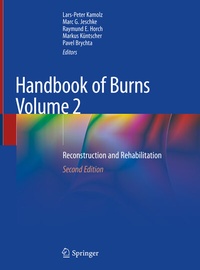
Handbook of Burns Volume 2
Beschreibung

The second edition of this volume has been updated with chapters on scar treatment using laser, microneedling, tissue engineering, adipose tissue and lipofilling. It compiles the perspectives of a multi-author team, examining the entire spectrum of burn reconstruction and long-term treatment. Individual updated chapters cover basic aspects of wound healing and scarring, and plastic surgery relating to tissue rearrangement and the use of flaps, as well as the long-term use of skin and skin substitutes. Furthermore, it addresses topics such as rehabilitation and scar management in detail. It provides comprehensive reconstruction guidelines organized by anatomic region (e.g. face, hands, ...) as well as future trends and prospects in burn reconstruction, such as allotransplantation and bionics.
Please also have a look at the volume "Handbook of Burns Volume 1 - Acute Burn Care 2nd edition"
Weitere Details
Weitere Ausgaben
Andere Ausgaben
Personen
Univ. Professor Dr. med. Lars-Peter Kamolz is a professor and director of the Division of Plastic, Aesthetic and Reconstructive Surgery, Department of Surgery, LKH- University Hospital Graz- Medical University Graz, Austria. He is also head of the Research Unit for Safety in health at the Medical University Graz, Austria and Director of COREMED-Centre for Regenerative Medicine, Joanneum Research Forschungsgesellschaft, Austria.
Professor Dr. Marc Jeschke received his MD from the Eberhard-Karls-University, Tübingen, Germany, in 1994 and is PhD in experimental surgery (molecular biology) from the University of Regensburg, Germany, in 2002. Dr. Jeschke was appointed director of the Ross Tilley Burn Centre (Sunnybrook Health Science Centre) in 2010. Currently, he holds appointments in the department of surgery, Division of Plastic Surgery, department of Immunology. He holds the chair of burn research and is a professor of surgery at the University of Toronto, Canada.
Raymund E. Horch is a professor and director of the department of Plastic and Hand Surgery and of the Laboratory for Tissue Engineering and Regenerative Medicine, at the University Hospital Erlangen, Germany.
Markus Küntscher received his medical degree from the Ruprecht-Karls-University Heidelberg, Germany, in 1998. Since 2010, he has been the head of the Department Plastic and Hand Surgery and head of the Reconstructive Breast Center at the Evangelische Elisabeth Klinik, Berlin, Germany. He has authored more than 50 scientific articles in national and international journals and given more than 100 talks at medical conferences.
Professor MUDr. Pavel Brychta graduated from the University J.E. Purkyne, Brünn, Czech Republic. He is the head of the Department of Burns and Reconstructive Surgery, University Hospital Brno, Czech Republic.
Inhalt
Acute stress disorder and post traumatic stress disorder in individuals suffering from burn injury.- Long term consequences of burn injuries.- Skin architecture and function.- Burn wound healing: Pathophysiology.- Scar assessment.- Burn Scar treatment.- The future of wound documentation: three-dimensional, evidence-based, intuitive and thorough.- Evaluation of mimic function in patients with facial burns by use of the three-dimensional video-analysis.- Rehabilitation and scar management.- Scar treatment and Scar modelling by use of laser.- Percutaneous collagen induction therapy (microneedling): am alternative treatment for burn scars.- Medical Tattooing.- Generation of adipose tissue based in tissue engineering: An overview.- Burn scar lipofilling.- Exercise .- Principles of burn reconstruction.- Tissue expanders in burn surgery.- Burn reconstruction: Skin substitutes and tissue engineering.- Twelve year follow-up: a clinical study on dermal regeneration.- Generation of adipose tissue based in tissue engineering: An overview .- Burn reconstuction: Neck region.- Burn reconstruction: Eye region .- Reconstruction of the post burn ear.- Reconstruction of the perioral region after Burn reconstruction: Breast.- Reconstruction of burn deformities of the lower extremity.- Thermal injuries to the foot.- Burn reconstruction: Hand and upper extremity.- Facial transplantation .- Modern myoprostheses in electric burn injuries.- Simulation and Training.
