

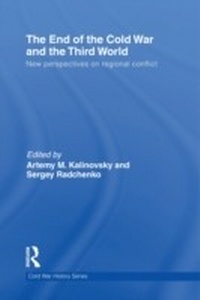
The End of the Cold War and The Third World
New Perspectives on Regional Conflict
1. Auflage
Erschienen am 19. April 2011
328 Seiten
978-1-136-72430-5 (ISBN)
Beschreibung

This book brings together recent research on the end of the Cold War in the Third World and engages with ongoing debates about regional conflicts, the role of great powers in the developing world, and the role of international actors in conflict resolution.
Most of the recent scholarship on the end of the Cold War has focused on Europe or bilateral US-Soviet relations. By contrast, relatively little has been written on the end of the Cold War in the Third World: in Asia, Africa, and Latin America. How did the great transformation of the world in the late 1980s affect regional conflicts and client relationships? Who "won" and who "lost" in the Third World and why do so many Cold War-era problems remain unresolved? This book brings to light for the first time evidence from newly declassified archives in Russia, the United States, Eastern Europe, as well as from private collections, recent memoirs and interviews with key participants. It goes further than anything published so far in systematically explaining, both from the perspectives of the superpowers and the Third World countries, what the end of bipolarity meant not only for the underdeveloped periphery so long enmeshed in ideological, socio-political and military conflicts sponsored by Washington, Moscow or Beijing, but also for the broader patterns of international relations.
This book will be of much interest to students of the Cold War, war and conflict studies, third world and development studies, international history, and IR in general.
Most of the recent scholarship on the end of the Cold War has focused on Europe or bilateral US-Soviet relations. By contrast, relatively little has been written on the end of the Cold War in the Third World: in Asia, Africa, and Latin America. How did the great transformation of the world in the late 1980s affect regional conflicts and client relationships? Who "won" and who "lost" in the Third World and why do so many Cold War-era problems remain unresolved? This book brings to light for the first time evidence from newly declassified archives in Russia, the United States, Eastern Europe, as well as from private collections, recent memoirs and interviews with key participants. It goes further than anything published so far in systematically explaining, both from the perspectives of the superpowers and the Third World countries, what the end of bipolarity meant not only for the underdeveloped periphery so long enmeshed in ideological, socio-political and military conflicts sponsored by Washington, Moscow or Beijing, but also for the broader patterns of international relations.
This book will be of much interest to students of the Cold War, war and conflict studies, third world and development studies, international history, and IR in general.
Rezensionen / Stimmen
'This book is an extremely useful collection of works by the top scholars in the field, using new archival materials, and the scope of the book and choices of topics are original and interesting. [...]This book provides a good overview of the current state of field on the chronological frontier of Cold War scholarship, and excellent starting point for those who will push beyond it.' -- Jeremy Friedman, Yale University, H-Diplo Roundtable Review'Kalinovsky and Radchenko have edited a very useful book - with essays chock full of important material' -- Vijay Prashad, Trinity College, Hartford, CT, H-Diplo Roundtable Review
'Artemy Kalinovsky and Sergey Radchenko's The End of the Cold War and the Third World comes as a timely, insightful volume that takes a major step in recognizing and correcting the problematic analytical relationship between the Cold War and the Third World. Its contribution to modern world history is especially valuable insofar as it aims to be as much a work of contemporary history as about the past century.' -- Heonik Kwon, Trinity College, Cambridge University, H-Diplo Roundtable Review
'The End of the Cold War and the Third World provides a wealth of stimulating insights, all presented within a conception of the subject matter that in its scope, depth, and nuance will serve as a beacon for other scholars. The volume provides both a mass of original primary research for regional specialists interested in just one or two chapters, and a complex, diverse, and rich conception of the end of the Cold War that will attract scholars from a number of fields interested in the subject as a whole. For both reasons, The End of the Cold War and the Third World ... will doubtless become an enduring staple of Cold War libraries.' -- Jamie Miller, University of Cambridge, H-Diplo Roundtable Review
'Artemy M. Kalinovsky and Sergey Radchenko have assembled a valuable and insightful collection of essays... By providing a volume seeking to explore the impact of the Cold War's end across a broad range of Third World cases, the editors have taken an important step toward deepening our understanding of the period's lasting significance and continuing effects...This is an outstanding work, and one that will be of great use to historians and students. Kalinovsky and Radchenko have accomplished a great deal by pushing our interest in the end of the Cold War beyond its typical Euro-American boundaries.' -- Michael E. Latham, Fordham University, H-Diplo Roundtable Review
Weitere Details
Reihe
Sprache
Englisch
Verlagsort
London
Großbritannien
Verlagsgruppe
Taylor & Francis Ltd
Zielgruppe
Für höhere Schule und Studium
Für Beruf und Forschung
Dateigröße
1,96 MB
ISBN-13
978-1-136-72430-5 (9781136724305)
Copyright in bibliographic data and cover images is held by Nielsen Book Services Limited or by the publishers or by their respective licensors: all rights reserved.
Schweitzer Klassifikation
Weitere Ausgaben
Andere Ausgaben
Artemy Kalinovsky | Sergey Radchenko
The End of the Cold War and The Third World
New Perspectives on Regional Conflict
Buch
03/2013
1. Auflage
Routledge
84,10 €
Versand in 15-20 Tagen
Artemy Kalinovsky | Sergey Radchenko
The End of the Cold War and The Third World
New Perspectives on Regional Conflict
Buch
04/2011
1. Auflage
Routledge
233,80 €
Versand in 15-20 Tagen
Personen
Artemy M. Kalinovsky is Assistant Professor of East European Studies at the University of Amsterdam and a Research Associate at the London School of Economics IDEAS.
Sergey Radchenko is Lecturer at the University of Nottingham, China Campus, Ningbo, China.
Sergey Radchenko is Lecturer at the University of Nottingham, China Campus, Ningbo, China.
Inhalt
Introduction: The End of the Cold War and the Third World Artemy Kalinovsky and Sergey Radchenko 1. Gorbachev and the Third World Svetlana Savranskaya 2. The Decline of Soviet Arms Transfers to the Third World Mark Kramer 3. China's Changing Policies toward the Third World and the End of the Global Cold War Chen Jian 4. The Impact of the Cold War's End on the Arab-Israeli Conflict: A View from Israel Dima Adamsky 5. The Failure to Resolve the Afghan Conflict, 1989-1992 Artemy Kalinovsky 6. From Battlefield into Marketplace Balazs Szalontai 7. India and the End of the Cold War Sergey Radchenko 8. Nicaragua, Chile and the End of the Cold War in Latin America Victor Fueroa-Clark 9. The 'Missing Cold War:' Reflections on the Latin American Debt Crisis, 1979-89 Duccio Basosi 10. Brazilian Assessments of the End of the Cold War Matias Spektor 11. Were the Soviets "Selling out?" Vladimir Shubin 12. The Ending of the Cold War and Southern Africa Chris Saunders 13. 'The Battle of Cuito Cuanavale': Media space and the End of the Cold War in Southern Africa Sue Onslow, with Simon Bright
