

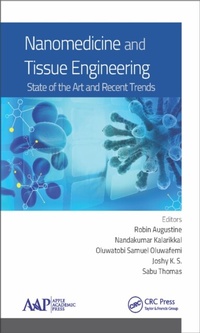
Nanomedicine and Tissue Engineering
State of the Art and Recent Trends
1. Auflage
Erschienen am 30. März 2016
562 Seiten
978-1-4987-2642-9 (ISBN)
Beschreibung

This book focuses on the recent advances in nanomedicine and tissue engineering. It outlines the basic tools and novel approaches that are becoming available in nanomedicine and tissue engineering and considers the full range of nanomedical applications which employ molecular nanotechnology inside the human body, from the perspective of a future pr
Rezensionen / Stimmen
"Provides a clear and thorough insight into the current applications of nanotechnology in medicine. With its broad scope, this book reaches topics like the use of magnetic hyperthermia for the selective destruction of cancer cells, as well as green synthesis of metal nanoparticles and the surface functionalization of nanoparticles. Equally significant, it delves into the current trends of drug delivery techniques, including various nanocarriers, a self-nanoemulsifying drug delivery system, and scaffolding techniques. It features several chapters related to tissue engineering, focusing on scaffold fabrication techniques like electrospinning, the materials used, and their applications, especially in wound dressings. Ideal for professionals in the field, the chapters contained here give an in-depth look at the current state of nanomedicine and tissue engineering, and present this information in an easily comprehensible manner."-Wenguo Cui, Professor, Orthopedic Institute, Soochow University, China
Weitere Details
Sprache
Englisch
Verlagsort
London
Großbritannien
Verlagsgruppe
Taylor & Francis Ltd
Zielgruppe
Für höhere Schule und Studium
Für Beruf und Forschung
Dateigröße
19,61 MB
ISBN-13
978-1-4987-2642-9 (9781498726429)
Copyright in bibliographic data and cover images is held by Nielsen Book Services Limited or by the publishers or by their respective licensors: all rights reserved.
Schweitzer Klassifikation
Weitere Ausgaben
Andere Ausgaben
Nandakumar Kalarikkal | Robin Augustine | Oluwatobi Samuel Oluwafemi
Nanomedicine and Tissue Engineering
State of the Art and Recent Trends
Buch
03/2021
1. Auflage
Apple Academic Press Inc.
111,30 €
Versand in 3-4 Wochen
Nandakumar Kalarikkal | Robin Augustine | Oluwatobi Samuel Oluwafemi
Nanomedicine and Tissue Engineering
State of the Art and Recent Trends
Buch
03/2016
1. Auflage
Apple Academic Press Inc.
218,50 €
Versand in 3-4 Wochen
Personen
Robin Augustine is a research fellow working in the area of biomaterial fabrication for various medical applications. He has research experience in molecular mechanism of cancer, cytotoxicity studies and pathways that regulate the mechanism of glucose metabolism, cancer, and diabetes during his research at Rajive Gandhi Centre for Biotechnology, India. He is currently working in the area of nanobiotechnology in the lab of Professor Sabu Thomas at the International and Inter University Centre for Nanoscience and Nanotechnology, Mahatma Gandhi University, Kottayam, Kerala, India.
Dr. Nandakumar Kalarikkal obtained his master's degree in physics with a specialization in industrial physics and his PhD in semiconductor physics from Cochin University of Science and Technology, Kerala, India. He was a postdoctoral fellow at NIIST, Trivandrum, and later joined with Mahatma Gandhi University. Currently he is the joint director of the Centre for Nanoscience and Nanotechnology as well as assistant professor in the School of Pure and Applied Physics at Mahatma Gandhi University. His current research interests include synthesis, characterization, and applications of nanophosphors, nanoferrites, nanoferroelctrics, nanomultiferroics, nanocomposites, and phase transitions.
Oluwatobi Samuel Oluwafemi, PhD, is a senior lecturer at the Department of Chemistry and Chemical Technology, Walter Sisulu University, Mthatha Campus, Eastern Cape, South Africa. He has published many papers in internationally reviewed journals and has presented at several professional meetings. He is a fellow of many professional bodies, a reviewer for many international journals, and has received many awards for his excellent work in material research. His current research interests include application of nanoparticles in medicine, water treatment, polymer, LEDs, and sensors.
Joshy K. S. is a research schol
Dr. Nandakumar Kalarikkal obtained his master's degree in physics with a specialization in industrial physics and his PhD in semiconductor physics from Cochin University of Science and Technology, Kerala, India. He was a postdoctoral fellow at NIIST, Trivandrum, and later joined with Mahatma Gandhi University. Currently he is the joint director of the Centre for Nanoscience and Nanotechnology as well as assistant professor in the School of Pure and Applied Physics at Mahatma Gandhi University. His current research interests include synthesis, characterization, and applications of nanophosphors, nanoferrites, nanoferroelctrics, nanomultiferroics, nanocomposites, and phase transitions.
Oluwatobi Samuel Oluwafemi, PhD, is a senior lecturer at the Department of Chemistry and Chemical Technology, Walter Sisulu University, Mthatha Campus, Eastern Cape, South Africa. He has published many papers in internationally reviewed journals and has presented at several professional meetings. He is a fellow of many professional bodies, a reviewer for many international journals, and has received many awards for his excellent work in material research. His current research interests include application of nanoparticles in medicine, water treatment, polymer, LEDs, and sensors.
Joshy K. S. is a research schol
Herausgeber*in
Assoc Prof & Head, Advanced Materials Laboratory, School of Pure and Applied Physics, International & Inter University Centre for Nanoscience & Nanotechnology, Mahatma Gandhi University, Kerala, India
Mahatma Gandhi University, Kottayam, India
University of Johannesburg, South Africa
Mahatma Gandhi University, Kottayam, Kerala, India
Professor of Polymer Science and Technology and Honorary Director of the Centre for Nanoscience and Nanotechnology, Mahatma Gandhi University, Kottayam, India
Inhalt
Preface. Nanomedicine: From Concept to Reality. Tissue Engineering: Principles, Recent Trends and the Future. Tailored Heating Superparamagnetic Nanoparticles for Hyperthermia Applications. Silver Nanoparticles: Newly Emerging Antimicrobials in the 21st Century. Tailoring Plasmon Resonances in Metal Nanospheres for Optical Diagnostics of Molecules and Cells. Recent Advances in Nanoparticulate Drug Delivery System for Antiviral Drugs. Triggerable Liposomes: Newer Approach in Cytoplasmic Drug Delivery. P-gp Inhibitors: A Potential Tool to Overcome Drug Resistance in Cancer Chemotherapy. Formulation and Evaluation of Self-Nanoemulsifying Drug Delivery System (SNEDDS) for Oral Delivery of Ketoconazole. Recent Advances in the Application of Biopolymer Scaffolds for 3D Culture Of Cells. Electrospun Matrices for Biomedical Applications: Recent Advances. Functionalization of Scaffolds with Biomolecules for Various Types of Tissue Engineering Applications. Anti Microbial Nano Materials for Wound Dressings. Cutaneous Wound Care: Grafts to Tissue Engineered Skin Substitutes. Index.
