

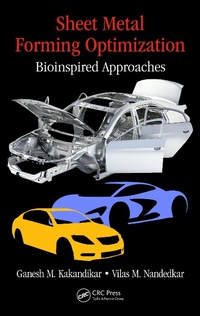
Sheet Metal Forming Optimization
Bioinspired Approaches
Erschienen am 16. Oktober 2017
248 Seiten
978-1-4987-9615-6 (ISBN)
Beschreibung
Automotive and aerospace components, utensils, and many other products are manufactured by a forming/drawing process on press machines of very thin sheet metal, 0.8 to 1.2 mm. It is imperative to study the effect of all involved parameters on output of this type of manufacturing process. This book offers the readers with application and suitability of various evolutionary, swarm, and bio-inspired optimization algorithms for sheet metal forming processes. Book initiates by presenting basics of metal forming, formability followed by discussion of process parameters in detail, prominent modes of failure, basics of optimization and various bioinspired approaches followed by optimization studies on various industrial components applying bioinspired optimization algorithms.
Key Features:
* Focus on description of basic investigation of metal forming, as well as evolutionary optimization
* Presentation of innovative optimization methodologies to close the gap between those formulations and industrial problems, aimed at industrial professionals
* Includes mathematical modeling of drawing/forming process
* Discusses key performance parameters, such as Thinning, Fracture, and Wrinkling
* Includes both numerical and experimental analysis
Key Features:
* Focus on description of basic investigation of metal forming, as well as evolutionary optimization
* Presentation of innovative optimization methodologies to close the gap between those formulations and industrial problems, aimed at industrial professionals
* Includes mathematical modeling of drawing/forming process
* Discusses key performance parameters, such as Thinning, Fracture, and Wrinkling
* Includes both numerical and experimental analysis
Weitere Details
Sprache
Englisch
Verlagsort
London
Großbritannien
Verlagsgruppe
Taylor & Francis Ltd
Zielgruppe
Für höhere Schule und Studium
Illustrationen
62 Tables, black and white; 50 Illustrations, color; 65 Illustrations, black and white
Dateigröße
19,85 MB
ISBN-13
978-1-4987-9615-6 (9781498796156)
Copyright in bibliographic data and cover images is held by Nielsen Book Services Limited or by the publishers or by their respective licensors: all rights reserved.
Schweitzer Klassifikation
Weitere Ausgaben
Personen
Dr. Ganesh M. Kakandikar
Dr. Ganesh Kakandikar is presently working as Associate Professor in Department of Mechanical Engineering at MAEER's Maharashtra Institute of Technology, Kothrud, Pune. He has completed his Ph.D. from Swami Ramanand Teerth Marathwada University, Nanded. He has total 19 years of teaching experience. His area of expertise are Sheet Metal Forming, Optimization Technique and CAD/CAM/CAE. He has 55 National and International publications. He has Authored three International books.
Dr. Vilas M. Nandedkar
Dr. Vilas M. Nandedkar is presently working as Professor in Department of Production Engineering at S.G.G.S. Institute of Engineering & Technology, Nanded, India. He has completed his Ph.D. from Indian Institute of Technology, Powai, Bombay. His areas of interest are Robotics, Sheet Metal Forming and Technology Management. He has authored two International books. He has 150 National and International publications.
Dr. Ganesh Kakandikar is presently working as Associate Professor in Department of Mechanical Engineering at MAEER's Maharashtra Institute of Technology, Kothrud, Pune. He has completed his Ph.D. from Swami Ramanand Teerth Marathwada University, Nanded. He has total 19 years of teaching experience. His area of expertise are Sheet Metal Forming, Optimization Technique and CAD/CAM/CAE. He has 55 National and International publications. He has Authored three International books.
Dr. Vilas M. Nandedkar
Dr. Vilas M. Nandedkar is presently working as Professor in Department of Production Engineering at S.G.G.S. Institute of Engineering & Technology, Nanded, India. He has completed his Ph.D. from Indian Institute of Technology, Powai, Bombay. His areas of interest are Robotics, Sheet Metal Forming and Technology Management. He has authored two International books. He has 150 National and International publications.
Inhalt
1. Introduction to Metal Forming
2. Process Parameters in Drawing
3. Failures in Drawing
4. Engineering Optimization
5. Thinning Optimization: Cohort Intelligence
6. Springback Optimization: Flower Pollination
7. Fracture Optimization: Genetic Algorithm Approach
8. Thinning Optimization of Punch Plate: Gray Wolf Optimizer
9. Wrinkling Optimization: Firefly Algorithm
10. Thickness Gradient Optimization: Ant Lion
11. Springback Optimization: Cuckoo Search
2. Process Parameters in Drawing
3. Failures in Drawing
4. Engineering Optimization
5. Thinning Optimization: Cohort Intelligence
6. Springback Optimization: Flower Pollination
7. Fracture Optimization: Genetic Algorithm Approach
8. Thinning Optimization of Punch Plate: Gray Wolf Optimizer
9. Wrinkling Optimization: Firefly Algorithm
10. Thickness Gradient Optimization: Ant Lion
11. Springback Optimization: Cuckoo Search
