

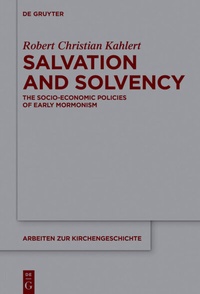
Salvation and Solvency
The Socio-Economic Policies of Early Mormonism
1. Auflage
Erschienen am 24. Mai 2016
XX, 452 Seiten
978-3-11-047347-6 (ISBN)
Beschreibung

This monograph tracks the development of the socio-economic stance of early Mormonism, an American Millenarian Restorationist movement, through the first fourteen years of the church's existence, from its incorporation in the spring of 1830 in New York, through Ohio and Missouri and Illinois, up to the lynching of its prophet Joseph Smith Jr in the summer of 1844. Mormonism used a new revelation, the Book of Mormon, and a new apostolically inspired church organization to connect American antiquities to covenant-theological salvation history. The innovative religious strategy was coupled with a conservative socio-economic stance that was supportive of technological innovation.
This analysis of the early Mormon church uses case studies focused on socio-economic problems, such as wealth distribution, the financing of publication projects, land trade and banking, and caring for the poor. In order to correct for the agentive overtones of standard Mormon historiography, both in its supportive and in its detractive stance, the explanatory models of social time from Fernand Braudel's classic work on the Mediterranean are transferred to and applied in the nineteenth-century American context.
This analysis of the early Mormon church uses case studies focused on socio-economic problems, such as wealth distribution, the financing of publication projects, land trade and banking, and caring for the poor. In order to correct for the agentive overtones of standard Mormon historiography, both in its supportive and in its detractive stance, the explanatory models of social time from Fernand Braudel's classic work on the Mediterranean are transferred to and applied in the nineteenth-century American context.
Weitere Details
Weitere Ausgaben
Andere Ausgaben
Buch
05/2016
1. Auflage
De Gruyter
149,95 €
Versand in 7-9 Tagen
E-Book
05/2016
1. Auflage
De Gruyter
149,95 €
Als Download verfügbar
Person
Robert Christian Kahlert
, Korneuburg, Austria.
Inhalt
- Intro
- Contents
- Acknowledgements
- List of Figures
- List of Tables
- Abbreviations
- 1. Introduction
- 1.1 Nineteenth-Century American Restorationism
- 1.2 Historiographical Intention
- 1.3 Overall Process
- 1.3.1 Pilot Study and Initial Hypothesis
- 1.3.2 Archival Research
- 1.3.3 Case Analysis
- 1.3.4 Constraint Identification and Application
- 1.4 Monograph Organzation and Findings
- 1.4.1 Groundwork
- 1.4.2 Case Studies
- 1.4.3 Models and Narratives
- Part I: Groundwork
- 2. Methodology
- 2.1 Research Thesis
- 2.2 Event Interpretation
- 2.2.1 Scripts and Events
- 2.2.2 Enculturation
- 2.2.3 Events in the Historical Record
- 2.2.4 Linearization Strategies
- 2.2.5 Narrative Strategy
- 2.3 Braudel's Historiographical Method
- 2.3.1 Braudel's Trifurcated Historical Time
- 2.3.2 Analysis
- 2.4 Inspiration and Biases
- 2.5 Organization
- 3. Nineteenth-Century Economic Life
- 3.1 Introduction
- 3.2 Settlement
- 3.3 Pioneer and Farm Life
- 3.4 Settled Life
- 3.5 Mobility and Trade
- 3.5.1 Using Person Power
- 3.5.2 Using Animal Power
- 3.5.3 Water Transportation
- 3.5.4 Transportation Infrastructure
- 3.6 Manufacturing and Industry
- 3.6.1 Bootstrapping the Process
- 3.6.2 Refining and Processing
- 3.6.3 Goods and Transportation Services
- 3.7 The Gentleman Farmer
- 3.7.1 Some Famous Exemplars
- 3.7.2 The Projected Image
- 3.8 Outlook
- 4. Joseph Smith Jr's Socio-Economic Baseline
- 4.1 Introduction
- 4.1.1 Methodological Considerations
- 4.1.2 On Extended Family Influences
- 4.1.3 On Geographic Influences
- 4.1.4 On Business Influences
- 4.2 Socio-Economic Family Influences
- 4.2.1 The Nuclear Family
- 4.2.2 The Extended Family
- 4.2.3 Summary
- 4.3 Influences of the Local Economy
- 4.3.1 Palmyra
- 4.3.2 Manchester
- 4.3.3 Canandaigua
- 4.3.4 Summary
- 4.4 Joseph Smith Jr, Supernatural Consultant
- 4.4.1 Defusing the Treasure-Hunter Stigma
- 4.4.2 Searching for the Silver Mine
- 4.4.3 The Articles of the Agreement
- 4.4.4 Evaluating Joseph Smith Jr's Consultancy
- 4.5 Summary
- 5. A New Scripture
- 5.1 The Unexpected Openness of the Canon
- 5.1.1 Which Bible
- 5.1.2 The Textual Incompleteness of the Canon
- 5.1.3 The Conceptual Insufficiency of the Canon
- 5.1.4 The Lost Tribes
- 5.2 Recognizing a New Revelation
- 5.2.1 The Process of Revelation
- 5.3 The Impeccable Translation
- 5.4 The Socio-Economic Stance of the Book of Mormon
- 5.4.1 The Role of Trade in the Book of Mormon
- 5.4.2 The Socio-Economic Optimum and its Loss
- 5.4.3 Discussion
- 5.5 Outlook
- Part II: Socio-Economic Case Studies
- 6. Funding the Book of Mormon
- 6.1 Introduction to the Case Studies
- 6.1.1 Apologetics
- 6.1.2 Dominating through Details
- 6.1.3 Argumentative Focus
- 6.2 Scribes and Sponsors
- 6.2.1 The Knight Family
- 6.2.2 The Whitmer Family
- 6.2.3 Martin Harris
- 6.3 Presses, Proofs and Book Publishing
- 6.4 Conclusions
- 6.4.1 Supported by Gentlemen Farmers
- 6.4.2 Outlook
- 7. Raiding the Campbellites
- 7.1 Introduction
- 7.1.1 The Split between the Baptists and the Disciples
- 7.1.2 The Spaulding-Rigdon Thesis
- 7.1.3 Outlook
- 7.2 The Campbellite Movement
- 7.2.1 Alexander Campbell
- 7.2.2 Adamson Bentley
- 7.2.4 The Mahoning Baptist Association
- 7.2.5 Pittsburgh
- 7.2.6 The Christian Baptist
- 7.2.7 The McCalla Debate
- 7.2.8 Rigdon as a Campbellite
- 7.2.9 Walter Scott's Evangelizing
- 7.2.10 Spreading the Restoration
- 7.2.11 Debating Robert Owen
- 7.2.12 Disagreeement at Austintown
- 7.2.13 Rigdon and the Rigdonites Become Mormons
- 7.2.14 Rigdon's Conversion
- 7.2.15 Differences Explored
- 7.3 Excursion: The Problem of Compensating Religious Work
- 7.3.1 Salaries
- 7.3.2 Collections
- 7.3.3 Patronage
- 7.3.4 Independence
- 7.3.5 Bishops are not Preachers
- 7.3.6 The Mormon Stance
- 7.4 Outlook: Transition in Kirtland
- 8. Consecration and Stewardship
- 8.1 Edward Partridge
- 8.2 The Economics of Moving the Fayette Saints
- 8.3 Newel Kimball Whitney
- 8.3.1 Early Life
- 8.3.2 Doing Business in Kirtland
- 8.3.3 Newel K. Whitney and Company
- 8.3.4 The Fullness of the Gospel
- 8.4 The First Bishop
- 8.5 Phase I: The Beginning
- 8.5.1 Revelation D&C 42
- 8.5.2 Discussion
- 8.5.3 Early Implementation in Ohio
- 8.6 Phase II: Independence, MS
- 8.6.1 Bringing the Partridge Family
- 8.6.2 Consecration upon Arrival
- 8.6.3 The Problem of Atomization
- 8.7 Phase III: Donations Replace Consecration in Ohio
- 8.7.1 Enforcing Donations
- 8.7.2 Relief from other Branches
- 8.8 Phase IV: The Move to Far West, Missouri
- 8.9 Outlook
- 9. The United Firm
- 9.1 Introduction
- 9.2 Initial Founding
- 9.3 Shifts and Realignments
- 9.3.1 Independence and Connectedness
- 9.3.2 Dr Frederick G. Williams
- 9.3.3 The Johnson Family
- 9.4 The United Firm at Work
- 9.4.1 Businesses in Kirtland
- 9.4.2 Properties in Missouri
- 9.4.3 Missouri Operations Disrupted
- 9.4.4 The Literary Firm Moves to Ohio
- 9.4.5 Disagreements in the United Firm
- 9.4.6 The Introduction of High Councils
- 9.5 Separation and Obfuscation
- 9.5.1 Publishing an Indemnifying Revelation
- 9.6 Reorganization and Debt
- 9.6.1 High Councils Replace the United Firm
- 9.6.2 Battling the Debt
- 10. The Kirtland Safety Society
- 10.1 Banking in Ohio
- 10.1.1 Chartered Banking in Ohio 1831-1836
- 10.1.2 The Infamous Owl Creek Bank of Mount Vernon
- 10.1.3 Excursion: The Old Bank of Michigan
- 10.1.4 Leverage in Ohio
- 10.2 The Short History of the Safety Society
- 10.2.1 Cash Flow and Cash Constriction
- 10.2.2 Unclear Origins of a Bad Idea
- 10.2.3 Founding a Bank Differently
- 10.2.4 Going it Alone
- 10.2.5 Leverage and Circulation
- 10.2.6 Further Attempts to Charter
- 10.2.7 Would the Charter have Helped?
- 10.2.8 The Banking Crisis
- 10.3 The Fall-Out
- 11. Settling Nauvoo
- 11.1 Aftermath of the Mormon War
- 11.1.1 Preventing the Scatter
- 11.1.2 Purchasing Commerce and Environs
- 11.1.3 The Church as Land Promoter
- 11.1.4 Containing Financial Troubles
- 11.2 Plats and Lots
- 11.3 Settling the Swamp
- 11.4 Experienced Hands
- 11.4.1 The Law Brothers
- 11.4.2 Edwin Woolley
- 11.4.3 Edward Hunter
- 12. Ruling Nauvoo
- 12.1 Social Engagement
- 12.1.1 Managing the Poverty Relief
- 12.1.2 The Female Relief Society of Nauvoo
- 12.2 New Ventures
- 12.2.1 The Red Brick Store
- 12.2.2 Joseph Smith Jr's Steamboats
- 12.3 Administrating the City
- 12.3.1 The Nauvoo City Charter
- 12.3.2 Funding Change-The Case of the Nauvoo House
- 12.4 The Interference from Polygamy
- 12.4.1 Ephraimite Roots
- 12.4.2 Excursion: Testing of Loyalties
- 12.4.3 Bonding and Proximity
- 12.4.4 Failure to Convince
- 12.4.5 Loyal Dissent
- 12.4.6 The Fight with the Law Brothers
- 12.5 Outlook
- 13. Nauvoo Loose Ends
- 13.1 The British Influence
- 13.2 Agricultural Association
- 13.3 Economic Bipolarism
- 13.4 Nauvoo-Periphery to Central St Louis
- 13.5 Epilogue: Superior Organization
- 13.5.1 Organizational Shortcomings of the Campbellites
- 13.5.2 Organizing the Restoration
- 14. The Evolution of Socio-Economic Policy
- 14.1 Joseph Smith Jr's Solution
- 14.1.1 Dynamic but Non-Agentive Processes
- 14.1.2 The Beginnings of Specialization
- 14.1.3 The Confluence of Problems
- 14.2 Research Findings
- 14.2.1 Research Hypothesis Reviewed
- 14.2.2 Concluding Theses
- Part III: Models and Narratives
- 15. Braudel's Mediterranean Models
- 15.1 Basic Topics
- 15.1.1 Sifting the Topics
- 15.2 The Economic Measure of Distance
- 15.2.1 Description
- 15.3 Specie and Inflation
- 15.4 The Grain Trade
- 15.5 The Imperial State
- 15.6 The Elite in Society
- 15.7 The Middle Class
- 15.8 The Poor and the Outlaws
- 15.9 On Model Transfers
- 16. Evaluating Mediterranean Models
- 16.1 The Economic Measure of Distance
- 16.2 Specie and Inflation
- 16.3 The Grain Trade
- 16.4 The Imperial State
- 16.5 Social Change
- 16.6 Model-Transfer Experiment
- 16.6.1 The Trope of Counterfeiting
- 16.6.2 A Culture of Violence
- 16.6.3 Policing Nauvoo
- 16.6.4 The Role of Drinking in Nauvoo
- 16.6.5 Detectives, Headhunters and Informers
- 16.6.6 Evaluation of Historical Models
- 16.7 Summary
- 17. Epilogue: Whence Salvation History?
- 17.1 Introduction
- 17.2 The Implausibility of Mormon Salvation History
- 17.3 Demythologizing Salvation History
- 17.3.1 Rudolf Bultmann's Program of Interpreting Mythology
- 17.3.2 Cullmann's Counter-proposal: History as Salvation
- 17.3.3 The Present State of Salvation History
- 17.4 A Farewell to "Big Men" Salvation History
- 17.5 Within Salvation History and yet Excluded
- 17.6 Conclusion
- 18. Appendix
- 18.1 The Role of Lucy Mack Smith's Remniscences
- 18.2 Colonel Stephen Mack
- 18.2.1 Stephen Mack in the Rough Draft
- 18.2.2 Stephen Mack in the Clean Draft
- 18.2.3 Stephen Mack and the Oakland County Historians
- 18.2.4 How the Bank of Michigan Made Colonel Mack Poor
- 18.3 The 1825 Defalcation of the Bank of Michigan
- 18.3.1 Case Number Mapping
- 18.3.2 Key Events in the McCloskey Trial
- 18.3.3 Key Events in Henry J. Hunt's Trial
- 18.3.4 Key Events in Gabriel Godfroy's Trial
- 18.3.5 Key Events in Stephen Mack's Trial
- 18.3.6 Key Events in Austin E. Wing's Trial
- 18.3.7 Key Events in John M. Mack's Petition
- 18.4 Ohio Banks and Capitalization
- 18.4.1 Notes
- 18.4.2 Skipped
- 18.5 Licenses
- 18.5.1 Software License for PAT Maps
- Bibliography
- Index
