

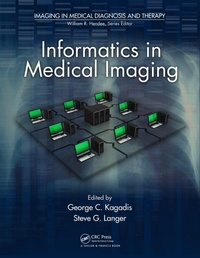
Informatics in Medical Imaging
Erschienen am 17. Oktober 2011
367 Seiten
978-1-4398-3136-6 (ISBN)
Beschreibung

Informatics in Medical Imaging provides a comprehensive survey of the field of medical imaging informatics. In addition to radiology, it also addresses other specialties such as pathology, cardiology, dermatology, and surgery, which have adopted the use of digital images. The book discusses basic imaging informatics protocols, picture archiving and
Rezensionen / Stimmen
Because of the comprehensive nature of this book with many topics in medical imaging informatics, the targeted readers include professionals in medical physics and biomedical imaging, as well as students and researchers. It may also be used as a helpful reference guide for medical physicists, radiologists, and administrative staff seeking additional information on medical imaging informatics. ...most chapters are well written and easy to read even for readers without much prior knowledge in medical imaging informatics. ... the book provides a comprehensive survey of the field of medical imaging informatics. Overall, this book is well written by experts in their respective fields and has good coverage. Readers may also obtain a wealth of information in medical imaging informatics from references listed at the end of each chapter ... .-Yu Liu, Medical Physics, March 2012
Weitere Details
Reihe
Sprache
Englisch
Verlagsort
Baton Rouge
USA
Verlagsgruppe
Taylor & Francis Inc
Zielgruppe
Für höhere Schule und Studium
Researchers, professionals, and students in medical physics and biomedical imaging interested in informatics; medical physicists and radiologists.
Illustrationen
131 s/w Abbildungen, 22 s/w Tabellen
131 b/w images, 22 tables and 94
Dateigröße
8,85 MB
ISBN-13
978-1-4398-3136-6 (9781439831366)
Copyright in bibliographic data and cover images is held by Nielsen Book Services Limited or by the publishers or by their respective licensors: all rights reserved.
Schweitzer Klassifikation
Weitere Ausgaben
Andere Ausgaben
George C. Kagadis | Steve G. Langer
Informatics in Medical Imaging
Buch
06/2020
1. Auflage
CRC Press
59,25 €
Versand in 15-20 Tagen
George C. Kagadis | Steve G. Langer
Informatics in Medical Imaging
Buch
10/2011
1. Auflage
CRC Press
272,20 €
Versand in 15-20 Tagen
Personen
George C. Kagadis, Ph.D. is currently an assistant professor of Medical Physics & Medical Informatics at the University of Patras, Greece. He received his Diploma in Physics from the University of Athens, Greece, in 1996 and both his MSc and Ph.D. in medical physics from the University of Patras in 1998 and 2002, respectively. He is a Greek State Scholarship Foundation grantee, a Fulbright Research Scholar, and a Full AAPM member. He has authored approximately 70 journal papers and had presented over 20 talks at international meetings. He has been involved in European and national projects, including e-health. His current research interests focus on IHE, CAD applications, medical image processing and analysis as well as studies in molecular imaging. Currently he is a member of the AAPM Molecular Imaging in Radiation Oncology Work Group, European Affairs Subcommittee, Work Group on Information Technology, and an associate editor of Medical Physics.
Steve G. Langer, Ph.D. is currently co-director of the radiology imaging informatics lab at the Mayo Clinic in Rochester, Minnesota, and formerly served on the faculty of the University of Washington, Seattle. His formal training in nuclear physics at the University of Wisconsin Madison and Michigan State has given way to a new mission: to design, enable, and guide into production high-performance computing solutions to implement next-generation imaging informatics analytics into the clinical practice. This includes algorithm design, validation, performance profiling, and deployment on vended or custom platforms as required. He also has extensive interests in validating the behavior and performance of human and machine-based (CAD) diagnostic agents.
Steve G. Langer, Ph.D. is currently co-director of the radiology imaging informatics lab at the Mayo Clinic in Rochester, Minnesota, and formerly served on the faculty of the University of Washington, Seattle. His formal training in nuclear physics at the University of Wisconsin Madison and Michigan State has given way to a new mission: to design, enable, and guide into production high-performance computing solutions to implement next-generation imaging informatics analytics into the clinical practice. This includes algorithm design, validation, performance profiling, and deployment on vended or custom platforms as required. He also has extensive interests in validating the behavior and performance of human and machine-based (CAD) diagnostic agents.
Inhalt
Introduction to Informatics in Healthcare. Standard Protocols in Imaging Informatics. Information Systems in Health Care Informatics. Key Technologies. Operational Issues. Medical Informatics beyond the Radiology Department.
