

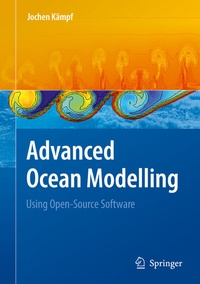
Advanced Ocean Modelling
Using Open-Source Software
1. Auflage
Erschienen am 30. April 2010
XIII, 181 Seiten
978-3-642-10610-1 (ISBN)
Beschreibung

This book focuses on motions of incompressible ?uids of a freely moving surface being in?uenced by both the Earth's rotation and density strati?cation. In contrast to traditional textbooks in the ?eld of geophysical ?uid dynamics, such as those by by Cushman-Roisin (1994) and Gill (1982), this book uses the method of proce- oriented hydrodynamic modelling to illustrate a rich variety of ?uid phenomena. To this end, the reader can adopt the model codes, found on the Springer server accompanying this book, to reproduce most graphs of this book and, even better, to create animation movies. The reader can also employ the codes as templates for own independent studies. This can be done by a lay person as a hobby activity, undergraduate or postgraduate students as part of their education, or professional scientists as part of research. Exercises of this book are run with open-source software that can be freely downloaded from the Internet. This includes the FORTRAN 95 compiler "G95" used for execution of model simulations, the data visualisation program "SciLab", and "ImageMagick" for the creation of graphs and GIF animations, which can be watched with most Internet browsers.
Rezensionen / Stimmen
From the reviews:
"Advanced Ocean Modelling is a combination of a textbook and a workbook including 25 computer-based exercises, written in Fortran 95. . The book is clearly written in an interesting manner, and is addressed to anyone wanting to learn what it takes to solve problems in ocean dynamics and needs to find effective methods to apply to them. This is an accessible textbook for undergraduate and graduate students in marine physics, physical oceanography and ocean modelling. Experienced researchers will welcome this book as a stimulating source." (Andrzej Icha, Pure and Applied Geophysics, Vol. 168, 2011)Weitere Details
Weitere Ausgaben
Andere Ausgaben
Buch
06/2010
Springer
128,39 €
Versand in 7-9 Tagen
Inhalt
1D Models of Ekman Layers.- Basics of Nonhydrostatic Modelling.- 2.5D Vertical Slice Modelling.- 3D Level Modelling.
"Preface (p. V-VI)
This book focuses on motions of incompressible fluids of a freely moving surface being influenced by both the Earth’s rotation and density stratification. In contrast to traditional textbooks in the field of geophysical fluid dynamics, such as those by by Cushman-Roisin (1994) and Gill (1982), this book uses the method of processoriented hydrodynamic modelling to illustrate a rich variety of fluid phenomena. To this end, the reader can adopt the model codes, found on the Springer server accompanying this book, to reproduce most graphs of this book and, even better, to create animation movies. The reader can also employ the codes as templates for own independent studies. This can be done by a lay person as a hobby activity, undergraduate or postgraduate students as part of their education, or professional scientists as part of research.
Exercises of this book are run with open-source software that can be freely downloaded from the Internet. This includes the FORTRAN 95 compiler “G95” used for execution of model simulations, the data visualisation program “SciLab”, and “ImageMagick” for the creation of graphs and GIF animations, which can be watched with most Internet browsers. Readers new to the subject are advised to read my book “Ocean Modelling for Beginners” (Kämpf, 2009), which gives descriptions, not replicated here, of the basics of geophysical fluid dynamics, finite-difference modelling, and the use of the above software suites.
The latter book deals with so-called layer models, predicting the motions of multiple layers of different densities and freely moving interfaces. Such models are used in practice as forecasting tools for tides and tsunamis. The latter book also contains a detailed description of the Coriolis force. This force contributes to the geostrophic balance that makes the larger-scale oceanic dynamics much more structured and predictable than turbulent motions in a tea cup.
The reader is advised to review the Coriolis force which plays a crucial role in many phenomena described here. This book focuses on so-called level models which, in contrast to layer models, are capable of simulating vertical mixing processes such as density-driven convection or breaking internal waves. I dedicate this book to my doctor father Professor Jan O. Backhaus for his creativity and overwhelming enthusiasm which have been the prime motivation for me to pursue a career in the field of physical oceanography. I particularly remember discussions with Jan on how to include a free sea surface in a nonhydrostatic convection model, a problem that neither of us could resolve at that time.
I have included such a model in this book. Other invaluable sources of motivation behind this work are the classical books of Henry Stommel, namely “An Introduction to the Coriolis Force” published in 1989 and co-authored by Dennis Moore, and “A View of the Sea”, published in 1987. Similar to the approach I take here, Stommel’s work underpins theory with computer programs, written in BASIC, that can be run by the reader for illustration of dynamical processes.
Adelaide, Australia, Jochen
Kämpf October 2009"
This book focuses on motions of incompressible fluids of a freely moving surface being influenced by both the Earth’s rotation and density stratification. In contrast to traditional textbooks in the field of geophysical fluid dynamics, such as those by by Cushman-Roisin (1994) and Gill (1982), this book uses the method of processoriented hydrodynamic modelling to illustrate a rich variety of fluid phenomena. To this end, the reader can adopt the model codes, found on the Springer server accompanying this book, to reproduce most graphs of this book and, even better, to create animation movies. The reader can also employ the codes as templates for own independent studies. This can be done by a lay person as a hobby activity, undergraduate or postgraduate students as part of their education, or professional scientists as part of research.
Exercises of this book are run with open-source software that can be freely downloaded from the Internet. This includes the FORTRAN 95 compiler “G95” used for execution of model simulations, the data visualisation program “SciLab”, and “ImageMagick” for the creation of graphs and GIF animations, which can be watched with most Internet browsers. Readers new to the subject are advised to read my book “Ocean Modelling for Beginners” (Kämpf, 2009), which gives descriptions, not replicated here, of the basics of geophysical fluid dynamics, finite-difference modelling, and the use of the above software suites.
The latter book deals with so-called layer models, predicting the motions of multiple layers of different densities and freely moving interfaces. Such models are used in practice as forecasting tools for tides and tsunamis. The latter book also contains a detailed description of the Coriolis force. This force contributes to the geostrophic balance that makes the larger-scale oceanic dynamics much more structured and predictable than turbulent motions in a tea cup.
The reader is advised to review the Coriolis force which plays a crucial role in many phenomena described here. This book focuses on so-called level models which, in contrast to layer models, are capable of simulating vertical mixing processes such as density-driven convection or breaking internal waves. I dedicate this book to my doctor father Professor Jan O. Backhaus for his creativity and overwhelming enthusiasm which have been the prime motivation for me to pursue a career in the field of physical oceanography. I particularly remember discussions with Jan on how to include a free sea surface in a nonhydrostatic convection model, a problem that neither of us could resolve at that time.
I have included such a model in this book. Other invaluable sources of motivation behind this work are the classical books of Henry Stommel, namely “An Introduction to the Coriolis Force” published in 1989 and co-authored by Dennis Moore, and “A View of the Sea”, published in 1987. Similar to the approach I take here, Stommel’s work underpins theory with computer programs, written in BASIC, that can be run by the reader for illustration of dynamical processes.
Adelaide, Australia, Jochen
Kämpf October 2009"
