

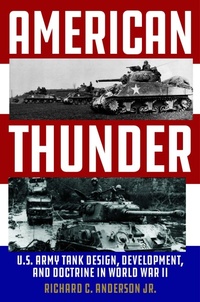
American Thunder
U.S. Army Tank Design, Development, and Doctrine in World War II
Erschienen am 14. Mai 2024
752 Seiten
978-0-8117-7382-9 (ISBN)
Beschreibung
If the machine gun changed the course of ground combat in the First World War, it was the tank that shaped ground combat in World War II. The tank was introduced in World War I in an effort to end the stalemate of the machine gun versus barbed-wire trenches, and by World War II, the tank's mobility and firepower became a rolling, thundering difference-maker on the battlefield. In this detailed, deeply researched, and heavily illustrated book, tank expert Richard Anderson tells the story of how the United States developed its armored force, turning it into a war-winning weapon in World War II that powered American ground forces and supplied armies around the world, including the British and Soviets.
For decades, American tanks of World War II have been undervalued in comparisons with German and Soviet tanks-and it's true that the best of American armor tended to underperform the best of German and Soviet armor during the war. That's because the U.S. had a different goal: not only to create battleworthy tanks like the Sherman, and to develop other tanks, but also to supply American allies with serviceable, combat-ready tanks. The United States did all this, but until now the complete story of American tanks in World War II has yet to be told.
Anderson's book is deeper and more thorough a chronicle of American tanks in World War II than has ever been done. This book is colorful, vivid, and thought-provokingly insightful on how the U.S. produced a tank force capable of conducting its own battlefield efforts and sustaining key allies around the world. This will be the go-to volume on American tanks for years to come.
For decades, American tanks of World War II have been undervalued in comparisons with German and Soviet tanks-and it's true that the best of American armor tended to underperform the best of German and Soviet armor during the war. That's because the U.S. had a different goal: not only to create battleworthy tanks like the Sherman, and to develop other tanks, but also to supply American allies with serviceable, combat-ready tanks. The United States did all this, but until now the complete story of American tanks in World War II has yet to be told.
Anderson's book is deeper and more thorough a chronicle of American tanks in World War II than has ever been done. This book is colorful, vivid, and thought-provokingly insightful on how the U.S. produced a tank force capable of conducting its own battlefield efforts and sustaining key allies around the world. This will be the go-to volume on American tanks for years to come.
Weitere Details
Sprache
Englisch
Verlagsort
PA
USA
Illustrationen
22 BW Illustrations, 365 BW Photos, 5 Maps, 118 Tables
Dateigröße
46,32 MB
ISBN-13
978-0-8117-7382-9 (9780811773829)
Copyright in bibliographic data and cover images is held by Nielsen Book Services Limited or by the publishers or by their respective licensors: all rights reserved.
Schweitzer Klassifikation
Weitere Ausgaben
Person
Richard C. Anderson Jr. is a historian with degrees from George Mason University and American Military University. He is the author of Artillery Hell (with Curt Johnson), Hitler's Last Gamble (with Trevor N. Dupuy and David Bongard), and Cracking Hitler's Atlantic Wall. After nearly thirty years as a military analyst for the U.S. government, he is now a full-time writer. He lives in Bremerton, Washington.
Inhalt
- Intro
- Contents
- List of Tables
- Acknowledgments
- Introduction
- U.S. Army World War II Procurement and Nomenclature
- Part I. ORGANIZATION, DEVELOPMENT, AND PRODUCTION FROM ARMISTICE DAY TO VJ DAY
- CHAPTER 1. Stagnation and Rebirth: THE LEAN YEARS FROM THE END OF THE GREAT WAR TO 1 SEPTEMBER 1939
- CHAPTER 2. State of the Art: THE VIEW LOOKING IN, SERENO BRETT AND ARTHUR HADSELL
- CHAPTER 3. Learning to Walk: 1 SEPTEMBER 1939-30 JUNE 1940
- CHAPTER 4. State of the Art: THE VIEW LOOKING OUT, THE SPANISH CIVIL WAR
- CHAPTER 5. The Sleeping Giant Stirs: 1 JULY-31 DECEMBER 1940
- CHAPTER 6. The Threat Perceived
- CHAPTER 7. Explosive Growth . . . and Growing Pains: 1 JANUARY-7 DECEMBER 1941
- CHAPTER 8. First Blood in the Pacific: THE FALL OF THE PHILIPPINES, 1941-1942
- CHAPTER 9. Giant Steps . . . and Stumbles: THE FIRST YEAR OF THE WAR, 1942
- CHAPTER 10. Hard Knocks: THE BATTLE OF HAPPY VALLEY
- CHAPTER 11. Learning Curve: THE SECOND YEAR OF THE WAR, 1943
- CHAPTER 12. More Hard Knocks: EARLY LESSONS LEARNED
- CHAPTER 13. Maturity: THE THIRD YEAR OF THE WAR, 1944
- CHAPTER 14. Europe: THE NORMANDY BREAKOUT
- CHAPTER 15. Endgame: THE LAST YEAR OF THE WAR, 1945
- CHAPTER 16. Europe: THE WINTER OF DISCONTENT
- CHAPTER 17. Firestorm in the Pacific
- Part II. CONTROVERSIES
- CHAPTER 18. Death Traps? MYTHS OF U.S. TANK DEVELOPMENT IN WORLD WAR II
- CHAPTER 19. The Great Tank Scandal?" IT IS SAID THAT IT TAKES THREE OF OUR SHERMANS TO KNOCK OUT A TIGER."
- CHAPTER 20. Bigger Guns?
- CHAPTER 21. Where Are the Tanks? THE REAL TANK SCANDAL
- CHAPTER 22. What's in a Name?
- Conclusion
- APPENDIX A. Other Ordnance Combat Vehicles
- APPENDIX B. Lend-Lease
- APPENDIX C. Tank "T" Numbers Assigned by Ordnance, 1926-1945
- APPENDIX D. Tank Model Year, "Mark," and "M" Numbers Assigned by Ordnance, 1928-1945
- APPENDIX E. The Cost of Ordnance
- APPENDIX F. The Cost of War: U.S. ARMY ARMORED PERSONNEL AND TANK LOSSES IN WORLD WAR II
- APPENDIX G. Firing Tests
- Notes
- Bibliography
- About the Author
