

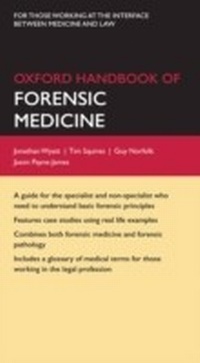
Oxford Handbook of Forensic Medicine
1. Auflage
Erschienen am 17. März 2011
604 Seiten
978-0-19-165323-0 (ISBN)
Beschreibung

Forensic medicine covers an amazing range of different subjects and no single individual can expect to be an expert in all of them. The Oxford Handbook of Forensic Medicine provides comprehensive coverage of all areas within this complex discipline. Written for specialists and non-specialists alike, it will appeal to practising forensic scientists, as well as lawyers, police officers, and forensic science students. It shows how forensic medicine has been used in specific casesenabling the reader to apply their knowledge in real life. A detailed glossary of medical terms helps those without medical training to understand medical reports and practices. This easily-portable guide is essential reading for the busy clinical forensic doctor or nurse, and others working at theinterface between medicine and law.
Weitere Details
Weitere Ausgaben
Andere Ausgaben
Jonathan P. Wyatt | Tim Squires | Guy Norfolk
Oxford Handbook of Forensic Medicine
Loseblatt
03/2011
1. Auflage
Oxford University Press
47,50 €
Versand in 15-20 Tagen
Inhalt
- Intro
- Detailed contents
- Symbols and abbreviations
- Anatomical terminology
- Prefixes
- Anatomical prefixes
- Suffixes
- Glossary of medical terms
- A
- B
- C
- D
- E
- F
- H
- I
- L
- M
- N
- O
- P
- R
- S
- T
- U
- V
- 1 Scope of forensic medicine
- Introduction to forensic medicine
- History of forensic medicine
- Developing clinical forensic medicine
- Forensic medicine around the world
- Professional bodies and discipline
- Forensic organizations
- Consent
- Mental capacity
- Confidentiality
- Preparing a witness statement
- Sample witness statement
- Appearing in court
- Professional and expert medical evidence
- Medical negligence
- 2 Forensic aspects of death
- Definition and diagnosis of death
- Changes after death: lividity
- Rigor mortis
- Changes after death: decomposition
- Time interval since death
- Death scene investigation
- The coroner system in England and Wales
- Coroner's inquest
- Fatal accident inquiry in Scotland
- Homicide
- Serial killers
- Suicide
- Dyadic death
- Sudden death from natural causes
- Accidents as a cause of death
- Environmental causes of death
- Deaths during sport
- Specific sport related deaths
- Cardiovascular collapse during exercise
- Trauma scoring
- 3 Forensic autopsy
- The autopsy: terminology and definitions
- Historical perspective
- Forensic or medicolegal autopsy
- Forensic autopsy procedure: summary
- The autopsy report
- External examination
- Forensic autopsy: evisceration
- Dissection: cardiovascular system
- Dissection: respiratory system
- Dissection: endocrine system
- Dissection: digestive system
- Dissection: lymphatic system
- Dissection: musculoskeletal system
- Dissection: cranium and nervous system
- Dissection: genitourinary system
- Autopsy samples: legal issues
- Autopsy samples: histology and toxicology
- The paediatric forensic autopsy
- Exhumation
- Mass graves and war crimes
- Health and safety issues
- High-risk autopsy
- Infection risks of autopsy
- Death certification
- 4 Asphyxia
- Definitions and historical perspective
- Clinical features of asphyxia
- Strangulation
- Hanging
- Compression asphyxia
- Smothering
- Choking
- Autoerotic asphyxia
- Drowning
- 5 Forensic pathology of physical injury
- Injury classification
- Terms used to describe injuries
- Describing injuries
- Body diagrams
- Bruising
- Progression of bruising with time
- Lacerations, abrasions, and scratches
- Incised wounds
- Stab wounds
- Slash wounds
- Skin wound healing
- Defence injuries
- Intimate partner violence and abuse
- Elder abuse and neglect
- Torture
- Scalp injury and skull fracture
- Primary brain injury
- Traumatic intracranial haemorrhage
- Further complications of brain injury
- Facial injury
- Spinal injury
- Chest injury
- Abdominal injury
- Fractures of the pelvis and extremities
- Burns
- Explosive injuries
- Investigations after an explosion
- Firearms
- Rifled gunshot injuries
- Shotgun injuries
- 6 The police custody unit
- The custody unit
- Purpose of detention
- Police and Criminal Evidence Act 1984
- The custody record
- Conditions of detention
- The forensic physician
- Vulnerable persons in custody
- Appropriate adults
- Solicitors and legal representatives
- Fingerprints and drug testing
- DNA and the national database
- Non-intimate and intimate samples
- Intimate searches
- Approach to custody work
- Personal safety
- The medical room
- Documentation
- Assessing fitness to detain
- Instructions to custody staff
- Levels of observation by custody staff
- Detainees requiring continuing healthcare
- Prescribing medication
- Deaths in custody
- 7 Life-threatening emergencies in custody
- Approach to life-threatening custody emergencies
- Airway obstruction 1
- Airway obstruction 2
- Choking
- Near hanging
- Tension pneumothorax
- Respiratory arrest
- The recovery position
- Cardiac arrest in custody
- Modified advanced life support
- Shock
- Epileptic fit
- The unconscious patient
- Suspected meningitis
- 8 Assessing and managing illness in custody
- Assessment of illness
- Management of chronic illness
- Diabetes
- Chest pain
- Palpitations
- Breathlessness
- Asthma
- Alcohol intoxication
- Alcohol withdrawal
- Other problems of alcoholics
- Detainees under the influence of drugs
- Drug withdrawal
- Body packers, pushers, and stuffers
- Other presentations and problems
- 9 Assessing and managing injury in custody
- Approach to assessment of injury
- Clinical assessment of injury
- Documenting injuries
- Restraint techniques and injuries
- Chemical restraint agents
- Handcuffs
- Injury from police weapons
- Taser
- Head injury from a custody perspective
- Head injury assessment
- Referral of head injury to hospital
- Custody management of head injury
- Facial injury
- Spinal injury
- Dermatomes
- Skin wounds
- Bite wounds
- Closed limb injury
- Upper limb injury
- Lower limb injury
- Blunt chest injury
- Abdominal injury
- 10 Traffic law and medicine
- Road traffic accidents in perspective
- Road traffic safety
- Investigating road traffic collisions
- Patterns of injury in fatal road trauma
- Patterns of fatal pedestrian injury
- Patterns of injury in fatal crashes: vehicle occupants
- Fatal injury patterns: motorcyclists and cyclists
- Medical conditions and fitness to drive
- Alcohol and driving performance
- Drink-driving legislation
- Provision of specimens for analysis
- Taking blood alcohol samples in a police station
- Hospital procedures
- Failure to provide samples under the Road Traffic Act
- Failure to provide blood and/or urine
- Failure to provide a breath sample
- Field impairment testing by police
- Medical examination of drug-impaired drivers
- Drugs and driving performance
- Drugs and driving: cannabis
- Drugs and driving: opioids
- Drugs and driving: benzodiazepines
- Drugs and driving: stimulants
- 11 Adult sexual assault
- Definitions and law
- Background to adult sexual assault
- Examination suites
- Principles of assessment
- Assessment procedure
- History of assault: the complainant
- Further medical history: complainant
- Examination for adult sexual assault
- Female genital examination
- Male genital examination
- Anal examination
- Examination of suspects
- Collecting forensic samples
- Persistence of forensic material
- Sexual assault examination kit
- Documentation of findings
- Interpretation of genital findings
- Interpretation of anal findings
- Treatment, counselling, and follow-up
- Appearance in court
- 12 Child abuse and neglect
- Background and historical perspective
- Types of child abuse
- Medical approach to child abuse
- Children Act 1989 and 2004 (England and Wales)
- Physical abuse: medical perspective
- Presentation of physical abuse
- Physical abuse: examination
- Physical abuse: interpreting findings
- Development of sexual characteristics
- Sexual abuse: presentation
- Sexual abuse: approach to examination
- Sexual abuse: examination procedure
- Sexual abuse: interpreting findings
- Recommended terminology
- Female child genital findings
- Anal findings in suspected child abuse
- Sexual abuse and infections
- Neglect and emotional abuse
- Fictitious illness by proxy
- Management of child abuse
- 13 Psychiatric aspects
- Introduction
- Definitions of some common terms
- Anxiety disorders
- Mood disorders
- Psychotic illness
- Learning disability
- Psychiatric illness, alcohol, and drugs
- Violent/disturbed behaviour
- Assessment of the mental state
- Assessment of suicide risk
- Fitness to interview
- Fitness to be charged/plead
- Mental capacity and the 2005 Act
- Mental health legislation
- Compulsory hospitalization
- Sections 136 and 135 (Mental Health Act 1983)
- Diversion from the criminal justice system
- Forensic psychiatry
- Forensic psychology
- 14 Forensic toxicology
- Introduction to forensic toxicology
- Arsenic poisoning
- Common drugs and poisons
- Toxicology and sudden death
- Signs of poisoning at autopsy
- Postmortem sample collection
- Interpretation of postmortem toxicology
- Controlled drugs legislation
- Alcohol overview
- Alcohol and sudden death
- Toxicological kinetics
- Diamorphine (heroin) and morphine
- Methadone (physeptone)
- Other opioid substitutes
- Stimulants: amphetamines and ecstasy
- Cocaine
- Hallucinogens and related substances
- Benzodiazepines
- Phenothiazines
- 'Date-rape' drugs
- Poisonous gases
- Volatile substances
- Antidepressants
- Paracetamol poisoning
- Aspirin and non-steroidal poisoning
- Harold Shipman
- Public health
- Drugs in sport
- Drugs and substance dependence
- Glossary of drug terminology
- Antidepressant drugs
- Analgesic drugs
- 15 Forensic science
- Introduction to forensic science
- Crime scene management
- Crime scene investigation
- Locard's principle
- Identification: matching and uniqueness
- The Ruxton case
- Daubert
- Trace evidence: background
- Trace evidence: glass
- Trace evidence: paint
- Trace evidence: hairs and fibres
- Fingerprints
- Forensic analysis of DNA
- Interpretation of DNA analysis
- National DNA database
- Exonerating the innocent
- Forensic biology
- Source of blood
- Blood pattern analysis
- Forensic identification of semen
- Forensic identification of other fluids
- Forensic anthropology
- Forensic archaeology
- Forensic entomology
- Environmental forensics
- Document analysis
- Forensic miscellany
- Fire: background
- Fire prevention and safety
- Behaviour of fire indoors
- Behaviour of fire outdoors
- Fire: investigation
- Explosions and explosives
- Explosion investigation
- The context effect and scientific evidence
- Forensic statistics
- The prosecutor's fallacy
- Index
- A
- B
- C
- D
- E
- F
- G
- H
- I
- J
- K
- L
- M
- N
- O
- P
- R
- S
- T
- U
- V
- W
- X
- Y
