

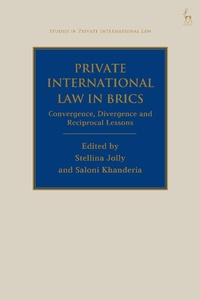
Private International Law in BRICS
Convergence, Divergence and Reciprocal Lessons
1. Auflage
Erschienen am 8. August 2024
672 Seiten
978-1-5099-6616-5 (ISBN)
Beschreibung

This book examines the convergences, divergences and reciprocal lessons that the BRICS countries (Brazil, Russia, India, China and South Africa) share with one another in developing the principles of private international law.
The chapters provide a thematic understanding of the cornerstones of private international law in each of the BRICS countries: namely, (1) the procedure to initiate claims in civil and commercial matters, (2) the law that would govern such matters in litigation and arbitration, as well as (3) the mechanism to recognise and enforce foreign judgments and arbitral awards.
Written by leading private international law scholars and practitioners, the chapters draw on domestic legislation and its interpretation through cases decided by the courts in each of these emerging economies, and explicitly cover the rules applicable in contractual and non-contractual concerns and issues of choice of court agreements. Issues around marriage, divorce, matrimonial property, succession and surrogacy are also addressed, considering the implication of such aspects through the increased movement of persons.
The book is a useful comparative resource for the governments of the BRICS countries, legislators, traders, academics, researchers and students looking for an in-depth discussion of the reciprocal lessons that these countries may have to offer one another on these issues.
The chapters provide a thematic understanding of the cornerstones of private international law in each of the BRICS countries: namely, (1) the procedure to initiate claims in civil and commercial matters, (2) the law that would govern such matters in litigation and arbitration, as well as (3) the mechanism to recognise and enforce foreign judgments and arbitral awards.
Written by leading private international law scholars and practitioners, the chapters draw on domestic legislation and its interpretation through cases decided by the courts in each of these emerging economies, and explicitly cover the rules applicable in contractual and non-contractual concerns and issues of choice of court agreements. Issues around marriage, divorce, matrimonial property, succession and surrogacy are also addressed, considering the implication of such aspects through the increased movement of persons.
The book is a useful comparative resource for the governments of the BRICS countries, legislators, traders, academics, researchers and students looking for an in-depth discussion of the reciprocal lessons that these countries may have to offer one another on these issues.
Weitere Details
Reihe
Auflage
1. Auflage
Sprache
Englisch
Verlagsort
London
Großbritannien
Verlagsgruppe
Bloomsbury Publishing PLC
Zielgruppe
Für höhere Schule und Studium
Für Beruf und Forschung
ISBN-13
978-1-5099-6616-5 (9781509966165)
Copyright in bibliographic data and cover images is held by Nielsen Book Services Limited or by the publishers or by their respective licensors: all rights reserved.
Schweitzer Klassifikation
Weitere Ausgaben
Andere Ausgaben
Stellina Jolly | Saloni Khanderia
Private International Law in BRICS
Convergence, Divergence and Reciprocal Lessons
Buch
ca. 02/2026
Hart Publishing
102,00 €
Noch nicht erschienen
Stellina Jolly | Saloni Khanderia
Private International Law in BRICS
Convergence, Divergence and Reciprocal Lessons
Buch
08/2024
Hart Publishing
195,40 €
Versand in 15-20 Tagen
Personen
Stellina Jolly is Senior Associate Professor at the Faculty of Legal Studies, South Asian University, India.
Saloni Khanderia is Professor of Private Law and Private International Law at OP Jindal Global University, Sonipat, India.
Saloni Khanderia is Professor of Private Law and Private International Law at OP Jindal Global University, Sonipat, India.
Inhalt
Foreword, Mr Dammu Ravi (Ministry of External Affairs, India and India's BRICS Sherpa, 2023)
Marta Pertegás Sender (University of Antwerp, Belgium; Maastricht University, the Netherlands)
Part 1
1. Introduction: Thematic Statement, Stellina Jolly (South Asian University, India; University of Johannesburg, South Africa) and Saloni Khanderia (OP Jindal Global University, Sonipat, India; University of Johannesburg, South Africa)
2. The Internal Unity of Private International Law, Sagi Peari (University of Western Australia)
Part 2: The Jurisdiction of Courts and the Initiation of Claims in International Civil and Commercial Matters
3. Brazil, Agatha Brandão de Oliveira (University of Lucerne, Switzerland) and Felipe Albuquerque (Sciences Po School of Law, France)
4. Russia, Natalia Erpyleva (Russian Presidential Academy of National Economy and Public Administration, Russia)
5. India, Saloni Khanderia (OP Jindal Global University, Sonipat, India; University of Johannesburg, South Africa)
6. China, Zheng Sophia Tang (Wuhan University Institute of International Law, China; University of Newcastle, UK) and Ting Liao (Wuhan University Institute of International Law, China)
7. South Africa, Garth J. Bouwers (University of Johannesburg, South Africa)
8. Concluding Remarks, Stellina Jolly (South Asian University, India; University of Johannesburg, South Africa) and Saloni Khanderia (OP Jindal Global University, Sonipat, India; University of Johannesburg, South Africa)
Part 3: Private International Law in Personal Matters
9. Brazil, Marcos Vinícius Torres (Federal University of Rio de Janeiro, Brazil)
10. Russia, Voytovich Elena (Russian Presidential Academy of National Economy and Public Administration, Russia)
11. India, Stellina Jolly (South Asian University, India; University of Johannesburg, South Africa)
12. China, Guangjian Tu (University of Macau, China)
13. South Africa, Marlene Wethmar Lemmer (University of South Africa)
14. Concluding Remarks
Stellina Jolly (South Asian University, India; University of Johannesburg, South Africa) and Saloni Khanderia (OP Jindal Global University, Sonipat, India; University of Johannesburg, South Africa)
Part 4: Private International Law of Obligations
15. Brazil, Claudia Lima Marques (Federal University of Rio Grande do Sul, Brazil) and Tatiana Squeff (Federal University of Uberlandia, Brazil)
16. Russia, Vladimir Orlov (Herzen State Pedagogical University of Russia; University of Helsinki, Finland)
17. India, Saloni Khanderia (OP Jindal Global University, Sonipat, India; University of Johannesburg, South Africa)
18. China, Guangjian Tu (University of Macau, China)
19. South Africa, Jan L Neels (University of Johannesburg, South Africa)
20. Concluding Remarks, Stellina Jolly (South Asian University, India; University of Johannesburg, South Africa) and Saloni Khanderia (OP Jindal Global University, Sonipat, India; University of Johannesburg, South Africa)
Part 5: The Execution of Foreign Decisions in International Civil and Commercial Matters
21. Brazil, Claudia Lima Marques (Federal University of Rio Grande do Sul, Brazil) and Tatiana Squeff (Federal University of Uberlandia, Brazil)
22. Russia. Stepan Sultanov (KIAP, Russia)
23. India, Saloni Khanderia (OP Jindal Global University, Sonipat, India; University of Johannesburg, South Africa)
24. China, Wenliang Zhang (Renmin University of China)
25. South Africa, Pontian Okoli (University of Stirling, UK)
26. Concluding Remarks, Stellina Jolly (South Asian University, India; University of Johannesburg, South Africa) and Saloni Khanderia (OP Jindal Global University, Sonipat, India; University of Johannesburg, South Africa)
Part 6
27. Private International Law in BRICS and the EU - Some Reciprocal Lessons, Anatol Dutta (Ludwig Maximilians University of Munich, Germany)
28. Concluding Remarks: Convergences, Divergences and Some Reciprocal Lessons, Stellina Jolly (South Asian University, India; University of Johannesburg, South Africa) and Saloni Khanderia (OP Jindal Global University, Sonipat, India; University of Johannesburg, South Africa)
Marta Pertegás Sender (University of Antwerp, Belgium; Maastricht University, the Netherlands)
Part 1
1. Introduction: Thematic Statement, Stellina Jolly (South Asian University, India; University of Johannesburg, South Africa) and Saloni Khanderia (OP Jindal Global University, Sonipat, India; University of Johannesburg, South Africa)
2. The Internal Unity of Private International Law, Sagi Peari (University of Western Australia)
Part 2: The Jurisdiction of Courts and the Initiation of Claims in International Civil and Commercial Matters
3. Brazil, Agatha Brandão de Oliveira (University of Lucerne, Switzerland) and Felipe Albuquerque (Sciences Po School of Law, France)
4. Russia, Natalia Erpyleva (Russian Presidential Academy of National Economy and Public Administration, Russia)
5. India, Saloni Khanderia (OP Jindal Global University, Sonipat, India; University of Johannesburg, South Africa)
6. China, Zheng Sophia Tang (Wuhan University Institute of International Law, China; University of Newcastle, UK) and Ting Liao (Wuhan University Institute of International Law, China)
7. South Africa, Garth J. Bouwers (University of Johannesburg, South Africa)
8. Concluding Remarks, Stellina Jolly (South Asian University, India; University of Johannesburg, South Africa) and Saloni Khanderia (OP Jindal Global University, Sonipat, India; University of Johannesburg, South Africa)
Part 3: Private International Law in Personal Matters
9. Brazil, Marcos Vinícius Torres (Federal University of Rio de Janeiro, Brazil)
10. Russia, Voytovich Elena (Russian Presidential Academy of National Economy and Public Administration, Russia)
11. India, Stellina Jolly (South Asian University, India; University of Johannesburg, South Africa)
12. China, Guangjian Tu (University of Macau, China)
13. South Africa, Marlene Wethmar Lemmer (University of South Africa)
14. Concluding Remarks
Stellina Jolly (South Asian University, India; University of Johannesburg, South Africa) and Saloni Khanderia (OP Jindal Global University, Sonipat, India; University of Johannesburg, South Africa)
Part 4: Private International Law of Obligations
15. Brazil, Claudia Lima Marques (Federal University of Rio Grande do Sul, Brazil) and Tatiana Squeff (Federal University of Uberlandia, Brazil)
16. Russia, Vladimir Orlov (Herzen State Pedagogical University of Russia; University of Helsinki, Finland)
17. India, Saloni Khanderia (OP Jindal Global University, Sonipat, India; University of Johannesburg, South Africa)
18. China, Guangjian Tu (University of Macau, China)
19. South Africa, Jan L Neels (University of Johannesburg, South Africa)
20. Concluding Remarks, Stellina Jolly (South Asian University, India; University of Johannesburg, South Africa) and Saloni Khanderia (OP Jindal Global University, Sonipat, India; University of Johannesburg, South Africa)
Part 5: The Execution of Foreign Decisions in International Civil and Commercial Matters
21. Brazil, Claudia Lima Marques (Federal University of Rio Grande do Sul, Brazil) and Tatiana Squeff (Federal University of Uberlandia, Brazil)
22. Russia. Stepan Sultanov (KIAP, Russia)
23. India, Saloni Khanderia (OP Jindal Global University, Sonipat, India; University of Johannesburg, South Africa)
24. China, Wenliang Zhang (Renmin University of China)
25. South Africa, Pontian Okoli (University of Stirling, UK)
26. Concluding Remarks, Stellina Jolly (South Asian University, India; University of Johannesburg, South Africa) and Saloni Khanderia (OP Jindal Global University, Sonipat, India; University of Johannesburg, South Africa)
Part 6
27. Private International Law in BRICS and the EU - Some Reciprocal Lessons, Anatol Dutta (Ludwig Maximilians University of Munich, Germany)
28. Concluding Remarks: Convergences, Divergences and Some Reciprocal Lessons, Stellina Jolly (South Asian University, India; University of Johannesburg, South Africa) and Saloni Khanderia (OP Jindal Global University, Sonipat, India; University of Johannesburg, South Africa)
