

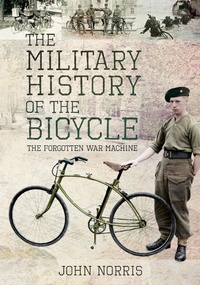
Military History of the Bicycle
The Forgotten War Machine
Erschienen am 23. März 2021
200 Seiten
978-1-5267-6354-9 (ISBN)
Beschreibung

Almost as soon as a viable metal-framed bike was invented, it was put to military use, offering a much cheaper, less fragile and less logistically demanding alternative to horse transport. Widely used in many armies from the late 19th century, through both world wars and beyond, the bicycle really is the forgotten war machine. John Norris traces traces the development of military cycling from first experiments, including early (often flawed) designs for armed and multi-passenger versions. He explains how any why bikes were used for rapid movement of infantry units as well as carrying messages and other tasks.
First used in the Franco-Prussian War of 1870-71, then by both sides in the Boer War, they were widely adopted throughout Europe before the First World War. In the Second World War, the Japanese used over fifty thousand bicycles in the conquest of Malaya and the German army used over three million, relying on them increasingly as petrol shortages immobilized motor transport. The Allies famously made use of folding and air-dropped bikes in Operation Market Garden and in Normandy. After WW2 bikes were used extensively in Vietnam, particularly along the Ho Chi Minh trail and some European armies maintained specialist bicycle units throughout the Cold War and into the 21st century. Specialized military bikes, collapsible for use by parachutists, are still being made for Special Forces units. John Norris examines the whole history of pedal-powered warfare and illustrates it with an array of high-quality photographs.
First used in the Franco-Prussian War of 1870-71, then by both sides in the Boer War, they were widely adopted throughout Europe before the First World War. In the Second World War, the Japanese used over fifty thousand bicycles in the conquest of Malaya and the German army used over three million, relying on them increasingly as petrol shortages immobilized motor transport. The Allies famously made use of folding and air-dropped bikes in Operation Market Garden and in Normandy. After WW2 bikes were used extensively in Vietnam, particularly along the Ho Chi Minh trail and some European armies maintained specialist bicycle units throughout the Cold War and into the 21st century. Specialized military bikes, collapsible for use by parachutists, are still being made for Special Forces units. John Norris examines the whole history of pedal-powered warfare and illustrates it with an array of high-quality photographs.
Weitere Details
Weitere Ausgaben
Andere Ausgaben
Buch
03/2021
Pen & Sword Military
25,00 €
Versand in 10-20 Tagen
Inhalt
- Cover
- Book Title
- Copyright
- Contents
- Acknowledgements
- Introduction
- Chapter 1 The Idea Takes Shape
- Chapter 2 Armies find their Wheels 1888-1914
- Chapter 3 Tyre Treads 1914-18
- Chapter 4 Wheels and Wings
- Chapter 5 The Great War Continues
- Chapter 6 Other Services Needed Bicycles
- Chapter 7 Evacuation of the Wounded
- Chapter 8 America Fights and the End of the War
- Chapter 9 The Wheels Turn Again 1930-45
- Chapter 10 Wheels Turn West: Blitzkrieg 1940
- Chapter 11 Hitler's Allies
- Chapter 12 Britain Stands Alone
- Chapter 13 The Wheels Move East: Other Theatres of War
- Chapter 14 Second Front: The Allies Return to Europe
- Chapter 15 The Battle for Berlin
- Chapter 16 Wheels in the Cold War
- Chapter 17 A Modern Trend
- References and Bibliography
- Index
