

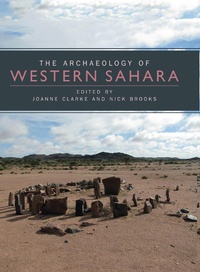
Archaeology of Western Sahara
A Synthesis of Fieldwork, 2002 to 2009
Erschienen am 31. August 2018
328 Seiten
978-1-78297-177-1 (ISBN)
Beschreibung

Contrary to much perceived wisdom, the Sahara is a rich and varied tapestry of diverse environments that sustain an array of ecosystems. Throughout its history, the Sahara has been a stage for human evolution, with human habitation, movement and lifeways shaped by a dynamic environment of successive phases of relative humidity and aridity driven by wider global climatic changes. The nature of human utilization of the landscape has undergone many changes, from the ephemeral and ill-defined lithic scatters of the Early Holocene to the dense and complex funerary landscapes of Late Holocene Pastoral period. Generally speaking, the living have left very little trace of their existence while funerary monuments endure, stamping the landscape with a cultural timelessness that marks certain regions of the desert as "special".
During the last ten years, the Western Sahara Project has undertaken large scale archaeological and environmental research that has begun to address the gaps in our knowledge of the archaeology and palaeoenvironments of Western Sahara, and to develop narratives of prehistoric cultural adaptation and change from the end of the Pleistocene to the Late Holocene and place it within its wider Saharan context.
A detailed discussion of past environmental change and a presentation of results from the environmental component of the extensive survey work are provided. A typology of built stone features - monuments and funerary architecture is presented together with the results of the archaeological component of the extensive survey work, focusing on stone features, but also including discussion of ceramics and rock art and the analysis of lithic assemblages. Chapters focusing on intensive survey work in key study areas consider the landscape contexts of monuments and the results of excavation of burial cairns and artifact scatters.
During the last ten years, the Western Sahara Project has undertaken large scale archaeological and environmental research that has begun to address the gaps in our knowledge of the archaeology and palaeoenvironments of Western Sahara, and to develop narratives of prehistoric cultural adaptation and change from the end of the Pleistocene to the Late Holocene and place it within its wider Saharan context.
A detailed discussion of past environmental change and a presentation of results from the environmental component of the extensive survey work are provided. A typology of built stone features - monuments and funerary architecture is presented together with the results of the archaeological component of the extensive survey work, focusing on stone features, but also including discussion of ceramics and rock art and the analysis of lithic assemblages. Chapters focusing on intensive survey work in key study areas consider the landscape contexts of monuments and the results of excavation of burial cairns and artifact scatters.
Weitere Details
Weitere Ausgaben
Andere Ausgaben
Buch
06/2018
Oxbow Books
87,90 €
Versand in 3-4 Wochen
Inhalt
- Cover
- Book Title
- Copyright
- Contents
- Acknowledgements
- List of Figures
- List of Tables
- List of Plates
- Chapter 1: The Archaeology of Western Sahara in Context - Joanne Clarke and Nick Brooks
- Introduction
- Aims and approach of this volume
- Geopolitical context
- The Western Sahara Project: history, context and aims
- Previous archaeological and environmental research in Western Sahara
- The archaeology of Western Sahara in regional context
- Chapter 2: The Environmental Survey - Sue J. McLaren, Nick Brooks, Helena White, Marijke van der Veen, Tony Gouldwell and Maria Guagnin
- Introduction
- Geology and topography
- Overview
- Northern Sector
- Southern Sector
- Present-day climate
- Past climatic contexts
- Holocene climate change in the Sahara
- Palaeo-environmental indicators in the Project study areas
- Results of environmental survey work
- Approach and methodology
- Results from the Northern Sector
- Results from the Southern Sector
- Discussion
- Chapter 3: Typology of Stone Features - Nick Brooks, Salvatore Garfi and Yves Gauthier
- Introduction
- Features, structures and monuments
- Typologies of stone features
- Morphological groups
- Cairns
- Falcate monuments ('Falcates')
- Other types of stone feature
- Petroforms
- Descriptions of stone features by groups and types
- Cairns
- Falcate monuments ('Falcates')
- Petroforms
- Other monument types
- Chapter 4: The Extensive Survey - Nick Brooks, Joanne Clarke, Yves Gauthier and Maria Guagnin
- Introduction
- Approach and methodology
- Rationale and approach
- Identifi cation of stone features using Google Earth imagery
- Presentation of data
- Results
- Types and numbers of features recorded
- Frequencies and distributions of stone features by morphological group and type
- Use of quartz in association with stone features
- Artefact concentrations (lithics and ceramics)
- Rock art
- Discussion
- Affi nities with the central Sahara
- Regional innovation
- Relative dating of monumental stone features
- Differences between the Northern and Southern Sectors
- Conclusions
- Chapter 5: Intensive Survey - Salvatore Garfi and Joanne Clarke
- Introduction
- Methods
- Topography of the TF1 Study Area
- Zone I: inselberg and pediment (central south)
- Zone II: dissected plain with tors (south)
- Zone III: rising and undulating ground (central north)
- Zone IV: dissected plain (north)
- Overview of archaeology
- Differing landscapes
- Other monument types
- Discussion
- Relationship of monuments to the landscape
- Patterns in monument types - spatially and to do with associated features
- Relationships with monuments farther afield
- Description of monuments and artefact scatter sites from the TF1 Study Area noted in the text
- Chapter 6: The Excavations - Joanne Clarke, Vicky Winton and Alexander Wasse
- Introduction
- 2005 Excavations
- WS023
- WS024
- Chipped stone from the vicinity of WS023 and WS024 (V. Winton)
- Degree of modifi cation and raw material reduction
- Raw materials
- Comparisons and interpretation
- Dating of the tumuli
- Discussion
- 2007 surface collection and excavation
- WS100
- WS103
- WS104
- WS107
- Dating
- Ceramics from the 2007 surface collections and excavations
- Discussion
- Chapter 7: The Chipped Stone - Anne Pirie
- Introduction
- WS100
- WS100.101
- WS100.102
- Discussion
- WS103
- WS103 Test pit (F023)
- Discussion
- WS104
- WS104.105
- WS104.106, Area 14
- WS104.106, Area 23
- WS107
- Areas 15-19 transects
- WS107, Area 20
- Area 21
- Area 22
- The small assemblages
- WS226, WS228, WS229
- WS400
- Discussion
- Palaeolithic occupation
- Early Holocene occupation
- Early Middle Holocene occupation
- Chapter 8: Western Sahara in Local and Regional Context - Joanne Clarke and Nick Brooks
- Introduction
- The changing face of the TF1 Study Area
- A landscape of meaning
- Burial monuments and social complexity
- An 'Atlantic' connection?
- Use of quartz and contrasting materials in funerary contexts
- Monument locations and alignments
- Western Saharan funerary practices in regional context
- Environmental contexts and human-environment interaction
- Conclusions
- Bibliography
- Index
- Plate section
- Back Cover
