

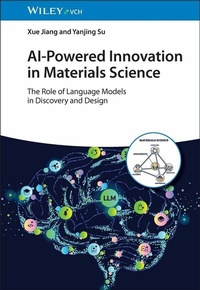
AI-Powered Innovation in Materials Science
The Role of Language Models in Discovery and Design
1. Auflage
Erschienen am 25. März 2026
576 Seiten
978-3-527-85583-4 (ISBN)
Beschreibung

This book offers a groundbreaking exploration of how language models and machine learning are revolutionizing every stage of materials research?from data mining and predictive modeling to autonomous experimentation and AI-driven discovery. Addressing a critical gap at the intersection of artificial intelligence and materials science, this book provides a comprehensive resource that combines foundational theory with practical applications. In addition, it offers timely expertise, actionable insights, interdisciplinary appeal, and accelerated innovation. This book serves as an essential reference for academia and industry, enabling faster, smarter materials development to tackle grand challenges in energy, sustainability, and advanced manufacturing.
Weitere Details
Weitere Ausgaben
Andere Ausgaben
Xue Jiang | Yanjing Su
AI-Powered Innovation in Materials Science
The Role of Language Models in Discovery and Design
Buch
04/2026
1. Auflage
Wiley-VCH
195,00 €
Versand in 5-7 Tagen
Personen
Xue Jiang is an Associate Professor at the University of Science and Technology Beijing, specializing in materials big data and intelligent materials R&D. She has led 6 competitive research projects, including the National Natural Science Foundation of China (NSFC) Young Scientists Fund, Guangdong Basic and Applied Basic Research Foundation, and key topics under Guangdong Provincial Key R&D Program. Additionally, she has contributed to 14 major national initiatives, such as the National Key R&D Program of China and NSFC Joint Key Projects. With 30 first/corresponding-author publications in top-tier journals (e.g., Acta Materialia, npj Computational Materials, Scripta Materialia), her work includes 25 SCI-indexed papers (12 in TOP journals) and 1 ESI Highly Cited Paper. She holds 22 authorized invention patents and software copyrights. An active educator, Dr. Jiang co-developed the "Materials Genome Engineering" curriculum series, teaching courses like Fundamentals of Materials Design, Materials Data Science, and Materials Big Data Technology. She has co-authored 3 academic books. As a core member of the National Advanced Materials Big Data Center and recipient of the 2023 Materials Genome Engineering Young Scientist Award, she serves on the CSTM Committee for Materials Genome Engineering and as a Youth Editorial Board Member of MGE Advances. She also reviews for prestigious journals (Nature Synthesis, npj Computational Materials, etc.).
Yanjing Su is a distinguished scholar and leading expert at the University of Science and Technology Beijing in materials big data, artificial intelligence, and corrosion science. With extensive expertise spanning fundamental research and industrial applications, he has made seminal contributions to the development of data-driven materials science and next-generation corrosion-resistant alloys. As a key advisor to China's national scientific initiatives, he serves on multiple high-level expert committees, including the Ministry of Industry and Information Technology's "Materials Genome Engineering Key Technologies" program, the National Key R&D Program on "Rare Earth New Materials," and the NSFC's major research plan on explainable AI technologies. His work has resulted in over 300 publications in top-tier journals including Acta Materialia, Corrosion Science, and npj Computational Materials, along with 4 influential academic monographs. His achievements have been recognized with numerous honors, including the National First Prize for Educational Achievement (China's highest teaching award) and six provincial/ministerial awards for scientific and technological progress. The integrated Materials Genome Engineering Platform he developed, combining databases, data acquisition, and machine learning tools, has become a valuable resource for both academic research and industrial R&D.
Yanjing Su is a distinguished scholar and leading expert at the University of Science and Technology Beijing in materials big data, artificial intelligence, and corrosion science. With extensive expertise spanning fundamental research and industrial applications, he has made seminal contributions to the development of data-driven materials science and next-generation corrosion-resistant alloys. As a key advisor to China's national scientific initiatives, he serves on multiple high-level expert committees, including the Ministry of Industry and Information Technology's "Materials Genome Engineering Key Technologies" program, the National Key R&D Program on "Rare Earth New Materials," and the NSFC's major research plan on explainable AI technologies. His work has resulted in over 300 publications in top-tier journals including Acta Materialia, Corrosion Science, and npj Computational Materials, along with 4 influential academic monographs. His achievements have been recognized with numerous honors, including the National First Prize for Educational Achievement (China's highest teaching award) and six provincial/ministerial awards for scientific and technological progress. The integrated Materials Genome Engineering Platform he developed, combining databases, data acquisition, and machine learning tools, has become a valuable resource for both academic research and industrial R&D.
Inhalt
Chapter 1: The Revolution of AI for Materials
Chapter 2: Fundamentals of Language Models and NLP
Chapter 3: Reinforcement Learning in Materials
Chapter 4: Large Language Models for Materials
Chapter 5: Materials Data Extraction from Literature by NLP and Large Language Models
Chapter 6: Predictive Modeling with Language-Augmented Approaches
Chapter 7: Chapter 7 Conversational Large Language Models for Materials Research
Chapter 8: Materials Agents for Autonomous Research
Chapter 9: Challenges and Future Developments
Chapter 2: Fundamentals of Language Models and NLP
Chapter 3: Reinforcement Learning in Materials
Chapter 4: Large Language Models for Materials
Chapter 5: Materials Data Extraction from Literature by NLP and Large Language Models
Chapter 6: Predictive Modeling with Language-Augmented Approaches
Chapter 7: Chapter 7 Conversational Large Language Models for Materials Research
Chapter 8: Materials Agents for Autonomous Research
Chapter 9: Challenges and Future Developments
