

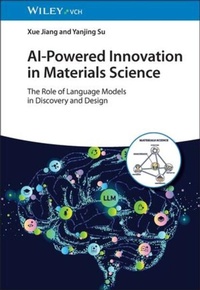
AI-Powered Innovation in Materials Science
Beschreibung

Weitere Details
Weitere Ausgaben
Andere Ausgaben
Personen
Yanjing Su is a distinguished scholar and leading expert at the University of Science and Technology Beijing in materials big data, artificial intelligence, and corrosion science. With extensive expertise spanning fundamental research and industrial applications, he has made seminal contributions to the development of data-driven materials science and next-generation corrosion-resistant alloys. As a key advisor to China's national scientific initiatives, he serves on multiple high-level expert committees, including the Ministry of Industry and Information Technology's "Materials Genome Engineering Key Technologies" program, the National Key R&D Program on "Rare Earth New Materials," and the NSFC's major research plan on explainable AI technologies. His work has resulted in over 300 publications in top-tier journals including Acta Materialia, Corrosion Science, and npj Computational Materials, along with 4 influential academic monographs. His achievements have been recognized with numerous honors, including the National First Prize for Educational Achievement (China's highest teaching award) and six provincial/ministerial awards for scientific and technological progress. The integrated Materials Genome Engineering Platform he developed, combining databases, data acquisition, and machine learning tools, has become a valuable resource for both academic research and industrial R&D.
Inhalt
Chapter 2: Fundamentals of Language Models and NLP
Chapter 3: Reinforcement Learning in Materials
Chapter 4: Large Language Models for Materials
Chapter 5: Materials Data Extraction from Literature by NLP and Large Language Models
Chapter 6: Predictive Modeling with Language-Augmented Approaches
Chapter 7: Chapter 7 Conversational Large Language Models for Materials Research
Chapter 8: Materials Agents for Autonomous Research
Chapter 9: Challenges and Future Developments
Chapter 1
The Revolution of AI for Materials
1.1 Introduction
The advancement of technology and the economy depend fundamentally on the creation of new materials, which serve as the foundation for transformative innovation in diverse sectors. To speed up this process, significant public and private resources are now being channeled into artificial intelligence (AI) and big data technologies. These converging efforts are forming a distinct interdisciplinary field often termed AI for Materials (AI4Mater), which synergizes computational modeling, data-driven science, and hands-on experimentation. AI acts as a unifying platform, merging the stages of design, manufacturing, and practical use, while simultaneously refining both digital simulations and physical lab processes [1]. Consequently, the entire pipeline for materials-from initial ideation to final application-is undergoing a fundamental restructuring. Machine learning integration is proving particularly valuable in tackling persistent issues in multi-scale computational models, and AI-enabled automation is significantly raising the speed and success rate of experimental research. With the help of more advanced data systems, these AI-driven improvements are set to change traditional research and development, modernize industrial processes, and make operations more efficient throughout materials science.
This chapter explains the goals of AI4Mater and looks at recent progress in areas such as materials database, machine learning, advanced computing, automated experiments, and intelligent manufacturing. It provides a plan for global cooperation, focusing on common data standards, shared and compatible databases, and open access to computing tools and AI models in materials research.
1.2 What Is AI4Mater?
1.2.1 Definition
AI4Mater is defined as a comprehensive ecosystem designed to operationalize AI throughout the entire materials science landscape. The framework is architecturally composed of three interdependent pillars: the materials data infrastructure, technical AI methodologies, and domain-specific applications, as visualized in Figure 1.1. The foundation of this hierarchy is the data infrastructure, which supports the system through rigorous protocols, ontologies, collaborative digital platforms, and advanced processing tools. Resting upon this bedrock are the specific AI4Mater techniques, which synthesize machine learning, high-throughput computing, autonomous experimentation, and intelligent manufacturing. These techniques act as the functional engine, enabling diverse applications ranging from initial material discovery and R&D to final manufacturing and performance validation. Collectively, these components drive scalability, maximize efficiency, and foster innovation across the materials value chain.
Figure 1.1 The components of AI4Mater.
1.2.2 History
Over the past 10 years or so, AI has changed how materials science is done. It has moved from scattered tests of single algorithms to a clear, data-focused way of doing research, as shown in Figure 1.2. This change can be described in three main stages:
- Phase 1 (before 2016): This early stage was marked by the materials science community first learning and adapting to machine learning methods. During this phase, the primary objective was to construct a computational baseline. Researchers began deploying a diverse algorithmic toolkit, ranging from regression, classification, and clustering to dimensionality reduction and early reinforcement learning-to interpret materials data. The emphasis was placed on validating the utility of these tools, establishing core computational protocols, and laying the groundwork for data-informed analysis.
- Phase 2 (2016-2020): The second period was defined by the ascendancy of informatics-driven design and the optimization of processing parameters. During this period, there was a significant increase in the use of large, complex datasets to understand the connections between materials structure and properties. This greatly shortened the time needed to develop new materials. As the velocity of both experimental and computational data generation increased, the focus shifted toward the effective management, integration, and exploitation of this information, cementing data governance as a critical pillar of modern materials research.
- Phase 3 (2020-present): The integration of advanced computation, data-driven analysis, generative AI, and automated experimentation is reshaping how materials science research is conducted. This era transcends mere efficiency; it is driven by data-led theoretical discovery and the autonomous generation of tailored material solutions. As these technologies mature, they promise to further disrupt the field, facilitating rapid, targeted innovation in response to specific industrial needs.
Figure 1.2 The history of AI4Mater.
The historical progression of AI in this domain illustrates a consistent trend toward the unification of disparate technological elements into a singular, synergistic ecosystem. By weaving AI into the fabric of computation, experimentation, and manufacturing, the field has achieved unprecedented levels of automation and intelligence. AI's capacity to navigate complex, multidimensional data allows for the seamless integration of modeling and validation through iterative, data-driven feedback loops. By linking design, experiment, and production into a continuous cycle, AI speeds up automatic improvement, greatly increasing the effectiveness of engineering work. From the early use of simple statistical learning to today's advanced, self-guided methods, each stage has built a stronger base for the next. This convergence has established a new operational reality where AI is no longer merely a support tool but the primary driver of discovery and design for the next generation of materials.
1.2.3 Motivation
The creation of new and better materials forms the essential foundation for technological progress. It drives major advances in fields such as renewable energy, aerospace, and next-generation electronics. However, traditional research and development methods, which depend heavily on trial and error and basic computer simulations, are now often seen as too slow and limiting. These approaches are often labor-intensive, capital-heavy, and constrained by current theoretical boundaries, thereby stalling the critical innovations required to tackle global imperatives like resource scarcity and energy sustainability. AI4Mater changes the current approach by offering a new way forward. It speeds up discovery, reduces risks in development, creates fresh scientific insights, and smoothly connects theoretical design with real-world production.
AI greatly speeds up research by predicting material properties before they are made, which cuts down on costly and repetitive lab tests. Data-driven analysis quickly identifies the most promising material combinations, while AI-assisted simulations and automated labs make the process of creating and testing materials faster and more efficient. Together, these abilities allow us to explore new areas of materials science and make discoveries faster than traditional methods ever could.
Across the development pipeline, AI reduces uncertainty by predicting performance, manufacturability, and durability. Early triage filters out weak candidates before major investment, and AI-optimized processes raise yield and improve sustainability.
AI does more than just speed up work-it also creates new knowledge. By combining experimental data, multi-scale simulations, and theory, AI uncovers latent patterns and produces clear design guidelines. Understandable models make complex relationships between structure, process, and properties clearer, sparking new ideas and deepening our fundamental knowledge.
AI-powered methods speed up the development of novel, high-performing materials-those that are stronger, tougher, more conductive, or have specially designed surfaces. By shortening the journey from idea to real-world use, AI enables major leaps forward in fields like energy storage, lightweight structures, and self-repairing materials, pushing the boundaries of what is possible.
AI connects design with manufacturing to support complete life cycle management. From choosing raw materials and improving processes to using in-line sensors, digital twins (DTs), and evaluating recyclability, AI provides flexible, smart control at every stage. This connected approach supports sustainability and helps turn lab discoveries into real-world benefits.
1.3 Foundations and Frontiers
In the United States, the launch of the Materials Genome Initiative (MGI) in 2011 marked a turning point for the field. MGI aimed to cut the cost and development time of new materials by half. This was to be achieved by combining fast, automated experiments, computer simulations, and modern digital data systems. For over a decade, the MGI has served as the backbone of the American materials innovation ecosystem, catalyzing cooperation between federal agencies, academia, and the private sector. The initiative's mandate was reinforced through strategic updates in 2014 and 2021, which deepened national investment in AI-guided discovery and intelligent R&D. The critical nature of these technologies was further validated by the National Academy of Sciences in its 2019 Decadal Survey, which positioned data science and AI as indispensable for resolving systemic inefficiencies in materials...
