

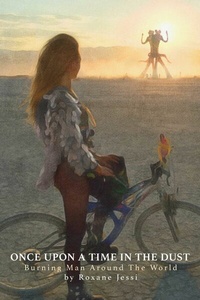
Once Upon a Time in the Dust
Beschreibung
Weitere Details
Inhalt
Totally shattered from my awe-inspiring adventure through the Latin American Burn scene, I land in Cape Town. The city is breathtaking. Table Mountain rises dramatically and verdantly from the land and the Atlantic Ocean skirts its edges, swelling gorgeously with waves. Trees lining the coast are blown sideways by the often-brutal force of the Capetonian winds, digging their roots deeper, craning their weathered necks over the road at gravity-defying angles.
The young and beautiful congregate and mingle in slick seaside bars. But against this polished exterior, the poverty here is dire and the racial divisions striking. Against this backdrop, a desire for a social experiment has sprung up in the southernmost point of a continent, deep in the desert.
From its infancy in 2007 AfrikaBurn has become the second biggest Burn movement in the Regional family, growing steadily to 13,000 inhabitants. It is centered around 11 Principles. The same set of 10 Burning Man Principles apply, but with the addition of "Each One Teach One," to encourage the passing of knowledge between community members. It is a city in its own right, attracting a mainly white population from all over South Africa, but swelling with a growing influx of European attendees. Still the South African contingent is strong and mighty, giving it a flavor that sets it aside from other Burns, manifesting in its brazen party-hungry citizens and towering earth-colored wooden art.
AfrikaBurn is the first of the regionals I ever experienced and combines my love for the continent and the Burns. I have always felt a strong pull to Africa, and have spent my career working on social projects here. Perhaps this is due to my grandmother being Black Caribbean of West African descent. Or maybe it is a byproduct of a childhood spent with my head in the clouds and dreams of a just world. I have traveled to over 15 African countries and lived for extended periods in the Democratic Republic of Congo (DRC) and Zimbabwe. The media tends to portray the continent in a uniform way but its 54 nations are anything but. It is a continent rich in contrasts and wealth, and there is a closeness to its communities that is unequaled in the world.
South Africa is packed with natural beauty, and the wilderness like the one found in the Tankwa desert, where the event is held, is astounding. I even considered moving to the country permanently given its breathtaking landscapes and easy access to the wider region. Driving through its nature reserves is an unforgettable experience, and the meeting of the two oceans, Atlantic and Indian, that straddle its shores permeates the air with salts that create flora unique to the country. I often visit the legendary Kirstenbosch botanical gardens in Cape Town, getting deliciously lost in its scented avenues. In the warm autumn evenings, I meet Capetonian friends and we gather for braais or barbecues in the city before the event starts, while I take in their easy-on-the-ear South African accents.
But despite being a friendly and welcoming country, the societal divisions here run deep as a legacy of its troubled history. It is unsafe to be out at night in many parts of the big cities, and the wealthy tend to live in heavily gated communities. Given the injustices that still exist, perhaps it is the desire to create a more just social order that has driven AfrikaBurn's growth, which was started by liberal South Africans committed to social change-the activism culture here is very strong.
The event is located in one of the most marginalized parts of the country, and its organizers have established a number of year-round initiatives to support the local community. This includes a post-event "collexudus" which feeds the local school for the entire year, as well as the "Hammer School" set up by the Department for Public Works (DPW) AfrikaBurn equivalent which teaches basic skills in carpentry and welding. While the makeup of the event is predominantly white, the organization is taking steps to bridge this gap by providing heavily discounted tickets and access grants to facilitate transport to the Burn. Beyond barriers to entry, they are also committed to integrating new attendees, for instance, through a mentorship program for people coming from townships.
Though there is still some way to go to make it fully representative of the Rainbow Nation, the event is one that has a distinctly African flavor and offers a magic that floods the soul, as only an experience in the backcountry of the cradle of mankind truly can.
Given the relentless Burn schedule I have set for myself, the usual preparations are condensed into one manic afternoon of buying the array of survival provisions which will sustain us for the week. This was to be my third time at AfrikaBurn, so this was not a virgin journey for me.
In a haze of delirium, we board the bus which leaves at midnight to hit the infamous tire-shredding dirt track that leads to the event site. Cape Town, the Mother City, arguably the most orderly and sanitized in Africa, fades into the distance as we rumble towards the wildness of the Tankwa desert that we will call home for the next week.
The journey is long, bumpy and frankly makes for a sore backside, but we make our way to the gates at dawn against the backdrop of a trademark African sunrise. The giant orb rises steadily, sending its powerful rays darting across the arid landscape. Tankwa's characteristic shrubs are burnt gold by its light, lining the dirt track that leads to the gates of the ephemeral city. The temperature starts to soar along with our anticipation.
This year the theme is Working Title, representing the temporary name that is given to a project during its development. This is in stark contrast to the previous year's theme Play, which resonates well with the Burner spirit, inviting careless abandon and tomfoolery to accompany an event where creative light-hearted participation is the name of the game.
However, a Burn is not brought together without effort from its participants and it is this fact that's often crowded out by the otherworldly pictures of the event. They paint an idyllic and superficial picture of life on the desert, but are largely silent about the less sexy elbow grease that goes into erecting a city and community out of thin air as a place to live arm-in-arm for a week. This includes basic necessities like porta-potties for participants. It is worth taking a moment to appreciate the work that goes into the compost toilets at AfrikaBurn. They are roofless and open to the elements, offering the best overhead views of the African star-studded sky at night-a far more enjoyable moment than offered by their enclosed plastic cousins.
The organizers describe this year's theme as one that "invites you to engage with the level to which you are responsible for defining Tankwa Town, a temporary city in a participant-driven society." Engagement is a word that so aptly defines the social movement that is this Burn. Disengagement rules so much of our default worlds: disengagement from our communities, disengagement from the natural world, disengagement from ourselves. Here all of these worlds collide and give one a sense of reconnection that is so lacking in our daily lives. There is no dull tapping of the computer keys, or silent blinking in the disruptive glare of our phones. There is the realness of interaction with the natural elements, of being embraced by a multitude of kindred spirits, of finally listening to the stillness of one's inner voice.
Registration complete, the virgins amongst us dive to the ground and rise to their feet giggling and euphoric, covered in Tankwa dust, starkly different from the fine white sort of the Nevada playa, a term which there derives from the geologist's word for a dry lakebed, but which across the Regional world has come to signify any ground on which a Burn event takes place. Here it is earthy and coarse but no less sacred, and as we gaze across its vast and desolate plains, we imagine the land being walked by the peoples who were sustained by it for centuries.
The sound of the welcome bell still ringing in our ears, we go forth into the arid landscape, rocky underfoot. The African sun is harsh by this time. We haul our weary selves and belongings across the dusty stretch and start looking for our camp. All along the avenues that line Tankwa town, camps are setting up. They form the buitekring-outer circle in Afrikaans-where the citizens will build their makeshift homes for the week, while the binnekring-inner circle-is equivalent to the Esplanade in Black Rock City. Further afield, in what would be deep playa in BRC the night lights up with the thousand lights of roving art cars and revelers crossing the African desert.
I am camping with AfrikaBurn's Burners Without Borders (BWB) equivalent called Outreach. Although many regions participate in creating social programs in their year-round communities and there are many local BWB chapters, AfrikaBurn is notable in its focus on this area.
As a true exemplar of the Burn's "Radical Inclusion" principle, Outreach offers grants to artists from the local community looking to attend AfrikaBurn. The Spark Grants program was launched in 2017, offering microgrants for community-based projects. In 2018, eleven grants are awarded aimed at increasing diversity at the event, as well as urban and Tankwa upliftment. This includes organizing for a group of traveling circus performers to take part and perform in...
