

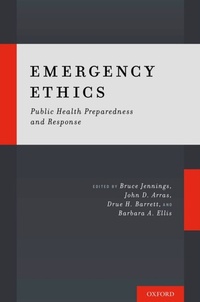
Emergency Ethics
Public Health Preparedness and Response
1. Auflage
Erschienen am 1. März 2016
256 Seiten
978-0-19-027076-6 (ISBN)
Beschreibung

Emergency Ethics brings together leading scholars in the fields of public health ethics and bioethics to discuss disaster or emergency ethics and ethical aspects of preparedness and response with specific application to public health policy and practice. The book fills a gap in the existing public health ethics literature by providing a comprehensive ethical conception of emergency preparedness as a distinctive form of civic "practice" brought about by the interrelationships and coordination of many groups, disciplines, and interests and drawing on numerous bodies of knowledge and expertise. It addresses particular aspects of preparedness and response plans, particular decisions that planners and communities have to make, decisions that require balancing many diverse and sometimes conflicting values and identifying and applying a framework of basic ethical principles for preparedness planning, emergency response, and post-disaster recovery. It also explores the relationship between emergency preparedness to other facets of public health practice.
The book begins with a broad and synthetic overview of emergency ethics that addresses the central components and ethically significant issues arising in public health preparedness planning, disaster response, and recovery. Following that overview are five chapters that in a philosophically innovative and detailed way delve deeply into important and problematic issues in emergency planning and response, including the allocation of scarce resources, conducting ethical research in the context of public health emergencies, the obligations of public health professionals, communication and engagement with the public, and special moral obligations surrounding vulnerable populations.
Weitere Details
Weitere Ausgaben
Andere Ausgaben
Bruce Jennings | John D. Arras | Drue H. Barrett
Emergency Ethics
Public Health Preparedness and Response
Buch
04/2016
Oxford University Press Inc
88,30 €
Versand in 15-20 Tagen
Personen
Bruce Jennings is Director of Bioethics at the Center for Humans and Nature.
John D. Arras (1945-2015) Porterfield Professor of Biomedical Ethics and Professor of Philosophy and Public Health Sciences at the University of Virginia.
Drue H. Barrett is Lead of the Public Health Ethics Unit in the Office of Scientific Integrity, Office of the Associate Director for Science at the Centers for Disease Control and Prevention.
Barbara A. Ellis is Deputy Director of the Office of Science Quality, Office of the Associate Director for Science at the Centers for Disease Control and Prevention.
Inhalt
Preface
Acknowledgments
Contributors
Introduction
Barbara A. Ellis, Drue H. Barrett, John Arras, and Bruce Jennings
Chapter 1 Ethical Aspects of Emergency Preparedness and Response
Bruce Jennings and John Arras
Chapter 2 Justice, Resource Allocation, and Emergency Preparedness: Issues Regarding Stockpiling
Norman Daniels
Chapter 3 Vulnerable Populations in the Context of Public Health Emergency Preparedness Planning and Response
Madison Powers
Chapter 4 Public Engagement in Emergency Preparedness and Response: Ethical Perspectives in Public Health Practice
Ruth Gaare Bernheim
Chapter 5 Professional, Civic, and Personal Obligations in Public Health Emergency Planning and Response
Angus Dawson
Chapter 6 Research in a Public Health Crisis
Alex John London
Index
