

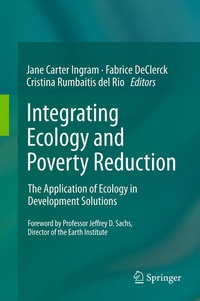
Integrating Ecology and Poverty Reduction
Beschreibung

Weitere Details
Weitere Ausgaben
Andere Ausgaben
Personen
The three editors of this volume, Jane Carter Ingram, Fabrice DeClerck, and Cristina Rumbatis del Rio, have collaborated on multiple projects addressing the role of ecology in poverty reduction and began working together at the Earth Institute of Columbia University. Their educational and professional backgrounds in ecology, geography, and sustainable development have served as the inspiration for this book and their professional pursuits. The editors hope that the issues presented and explored in this volume will serve to encourage ecological scientists and practitioners in international development fields to collaborate together to identify creative, sustainable and viable solutions to challenges preventing poverty alleviation around the world. J. Carter Ingram is the lead of the Ecosystem Services and Payments for Ecosystem Services group at the Wildlife Conservation Society in New York, NY. Cristina Rumbaitis del Rio is an Associate Director at the Rockefeller Foundation in New York, NY (USA). Fabrice DeClerck is a professor of community and landscape ecology at CATIE in Costa Rica.
Inhalt
Chapter 1. Introduction: Changing Societal Paradigms-Education and Gender as Critical Starting Points, Authors:Fabrice DeClerck and Jane Carter Ingram.- Chapter 2: Changing Societal Paradigms-Education and Gender as Critical Starting Points: Education, Ecology and Poverty Reduction, Authors: Robin Sears and Angela M. Stewart.- Chapter 3: Changing Societal Paradigms-Education and Gender as Critical Starting Points: Why Gender Matters to Ecological Management and Poverty, Author: Isabelle Guttierez.- Chapter 4. Introduction to Population Growth, Ecology and Poverty, Author: Alex de Sherbinin.- Chapter 5. Population Growth, Ecology and Poverty, Authors: Jason Bremner, Jason Davis, and David Carr.- Chapter 6. Alliances, conflicts and mediations: the role of population mobility in the integration of ecology into poverty reduction, Authors: Susana Adamo, Sara Curran.- Chapter 7. Urbanization, poverty reduction and ecosystem integrity, Authors: Peter Marcotullio, Hunter College, Sandra Baptista and Alex de Sherbinin.- Chapter 8. Introduction to Innovative Financing for Conservation and Poverty Reduction, Author: Jane Carter Ingram.- Chapter 9. Innovative Financing: Payments for Ecosystem Services- an Introduction, Author: Michael Jenkins.- Chapter 10. Innovative Financing: The potential of carbon offsetting projects in the forestry sector for poverty reduction in developing countries, Authors: Manuel Estrada, Esteve Corbera.- Chapter 11. Innovative Financing: The Development of Payments for Ecosystem Services as a Community-based Conservation Strategy in East Africa, Authors: Hassan Sachedina, Fred Nelson.- Chapter 12. Innovative Financing: 12. Innovative Financing: Poverty,Payments and Ecosystem Services in the Eastern Arc Mountains of Tanzania, Author: Brendan Fisher.- Chapter 36. Innovative Financing: Prioritizing and targeting payments for ecosystem services for energy, biodiversity conservation and poverty alleviation, Authors: Natalia Estrada Carmona and Fabrice DeClerck.- Chapter 13. Introduction to Ecosystem Based Management for Conservation and Poverty Reduction, Author: Jane Carter Ingram.- Chapter 14. Governing Ecosystems for Conservation and
Poverty Reduction: Ecological Principles for Managing Sustainable Fisheries, Author: Caleb McClenn.- Chapter 15. Governing Ecosystems for Conservation and Poverty Reduction: Land Use Zoning as a Tool for Balancing Conservation and Poverty Reduction, Author: Lisa Naughton.- Chapter 16. . Governing Ecosystems for Conservation and Poverty Reduction: The Role of Protected Areas for Poverty Reduction, Author: Maggie Holland.- Chapter 17. Looking Ahead: The Future and Evolving Role of Ecology in Society
,
Author: Shahid Naeem.- Chapter 18. Conclusions, Authors: Jane Carter Ingram, Fabrice DeClerck, Cristina Rumbaitis del Rio
