
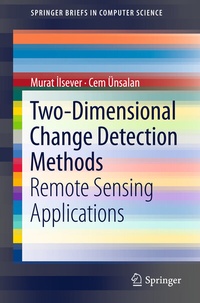
Two-Dimensional Change Detection Methods
Beschreibung
Alles über E-Books | Antworten auf Fragen rund um E-Books, Kopierschutz und Dateiformate finden Sie in unserem Info- & Hilfebereich.
Change detection using remotely sensed images has many applications, such as urban monitoring, land-cover change analysis, and disaster management. This work investigates two-dimensional change detection methods. The existing methods in the literature are grouped into four categories: pixel-based, transformation-based, texture analysis-based, and structure-based. In addition to testing existing methods, four new change detection methods are introduced: fuzzy logic-based, shadow detection-based, local feature-based, and bipartite graph matching-based. The latter two methods form the basis for a structural analysis of change detection. Three thresholding algorithms are compared, and their effects on the performance of change detection methods are measured. These tests on existing and novel change detection methods make use of a total of 35 panchromatic and multi-spectral Ikonos image sets. Quantitative test results and their interpretations are provided.
Weitere Details
Weitere Ausgaben
Andere Ausgaben
Inhalt
Introduction.- Pixel-Based Change Detection Methods.- Transformation-Based Change Detection Methods.- Structure-Based Change Detection Methods.- Fusion of Change Detection Methods.- Experiments.- Final Comments.

Systemvoraussetzungen
Dateiformat: PDF
Kopierschutz: Wasserzeichen-DRM (Digital Rights Management)
Systemvoraussetzungen:
- Computer (Windows; MacOS X; Linux): Verwenden Sie zum Lesen die kostenlose Software Adobe Reader, Adobe Digital Editions oder einen anderen PDF-Viewer Ihrer Wahl (siehe E-Book Hilfe).
- Tablet/Smartphone (Android; iOS): Installieren Sie bereits vor dem Download die kostenlose App Adobe Digital Editions oder die App PocketBook (siehe E-Book Hilfe).
- E-Book-Reader: Bookeen, Kobo, Pocketbook, Sony, Tolino u.v.a.m.
Das Dateiformat PDF zeigt auf jeder Hardware eine Buchseite stets identisch an. Daher ist eine PDF auch für ein komplexes Layout geeignet, wie es bei Lehr- und Fachbüchern verwendet wird (Bilder, Tabellen, Spalten, Fußnoten). Bei kleinen Displays von E-Readern oder Smartphones sind PDF leider eher nervig, weil zu viel Scrollen notwendig ist. Mit Wasserzeichen-DRM wird hier ein „weicher” Kopierschutz verwendet. Daher ist technisch zwar alles möglich – sogar eine unzulässige Weitergabe. Aber an sichtbaren und unsichtbaren Stellen wird der Käufer des E-Books als Wasserzeichen hinterlegt, sodass im Falle eines Missbrauchs die Spur zurückverfolgt werden kann.
Weitere Informationen finden Sie in unserer E-Book Hilfe.