

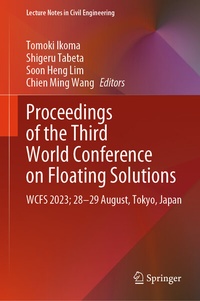
Proceedings of the Third World Conference on Floating Solutions
Beschreibung

This book includes peer-reviewed articles from the Third World Conference on Floating Solutions WCFS 2023 Japan with an aim to pioneer the SDGs and Next SDGs by making the most use of oceans and water. In recent years, the safety and security of people's lives around the world have been threatened by frequent floods and rising sea levels attributable to climate change. The COP 26 has set a common global goal of limiting the temperature rise to 1.5 degrees Celsius above pre-industrial levels. It is an urgent task to cope with climate change as well as to utilize decarbonized and renewable energy. The UN is promoting the SDGs which aim to achieve 17 Goals between 2015 and 2030. However, efforts to reach the Goals will not end in 2030 but will be an ongoing challenge for humanity beyond 2030. Here, we tentatively call the Goals to be achieved after the SDGs as "Next SDGs."
Ocean and water have the potential to provide solutions to the disasters such as flooding and sea level rise due to climate change. In this context, WCFS 2023 presents ocean and water as the urban infrastructure and explores new technology and feasible solutions. In particular, it is necessary to consider urban planning, marine architecture, port planning connecting land and sea, disaster prevention, renewable energy, and food production on the sea and water. Further, it is indispensable that knowledge, experience, dream, and strong desire to realize these challenges are supported by a diversity of people.
Weitere Details
Weitere Ausgaben
Andere Ausgaben
Personen
Prof. Tomoki Ikoma is a professor in the Department of Oceanic Architecture and Engineering, College of Science and Technology at Nihon University and a fellow at the Institute of Industrial Science, University of Tokyo, and a professor in the Department of Oceanic Architecture and Engineering, College of Science and Technology at Nihon University. His research interests are in the areas of hydrodynamics and interaction between a floating structure and ocean waves, including Very Large Floating Structures (VLFS).
Prof. Shigeru Tabeta is currently at the University of Tokyo. His research interests are ocean utilization technologies for solving global environmental problems, environmental regeneration of coastal zones for a sustainable society, marine environmental problems in rapidly developing East Asian countries, modelling of marine ecosystems and socio-economic systems, and so on.
Mr. Lim Soon Heng has a five-decade-long career in the marine industry,much of which with Keppel Corporation. He has considerable experience in the planning and the design of shipyards including floating docks, piers, and wharves. He is excited by the opportunities that mega-floating structures can offer to address so many of humanity's problems, including rising sea levels and climate change. This is facilitated by the skill sets that marine engineers and naval architects have acquired, particularly from the offshore rig-building technology. Floating structures are economically attractive compared to land-based structures if their full life cycle is taken into consideration. He believes if Singapore cannot get it right in two important challenges, the future ahead is one slippery slope: It has to find viable strategies to resolve its energy resilience and its land scarcity. In that regard, floating structures offer robust solutions.
Prof. Chien Ming Wang is a professor in Structural Engineering, University of Queensland. He is a fellow of the Australian Academy of Technology and Engineering, a fellow of the Institution of Structural Engineers, and a fellow of the Society of Floating Solutions (Singapore). He is the leader of the Blue Economy Cooperative Research Centre research program on offshore engineering and technology. His research interests are in the areas of structural stability, vibration, optimization, plated structures, and very large floating structures. He has published over 500 journal papers and 10 books on these topics. He has won many awards including Nishino Medal, JN Reddy Medal, Singapore's Minister of National Development's R&D Award for Floating Wetlands at Punggol Waterway, Lewis Kent Award, IES Prestigious Engineering Achievement Award, and Grand Prize of Next Generation Container Port Challenge.
Inhalt
- Intro
- Committees
- Preface
- Sponsors
- Contents
- Urban Planning
- Developing a Sustainable and Smart Floating Structure Solution for Enhancing Liveability in Hong Kong's Crowded Built Environment
- 1 Introduction
- 2 Vision for a Sustainable and Smart Floating Structure Solution (S2FS2) in Hong Kong
- 3 Challenges for Developing S2FS2
- 3.1 Material Challenges
- 3.2 Structural Challenges
- 3.3 Construction Challenges
- 3.4 Stability Challenges
- 3.5 Sustainability Challenges
- 4 Estimated Cost Savings
- 5 Conclusions
- References
- Sustainable Water City-A Case Study in Singapore
- 1 Introduction
- 2 Aim of Constructing the Water City in Singapore
- 3 A Novel Concept of Floating Water City in Singapore
- 4 Construction of a Floating Water City
- 5 Multi-dimensional Water Supply System in a Floating Water City
- 6 Water Supply and Demand in a Floating Water City
- 7 Inclination of High-Rise Towers on a Floating Platform Subject to the Highest Wind Intensity
- 8 Conclusion
- References
- Designing Floating Urban Realities: On the Urban Design of Floating High-Density Environments in the Dutch Context
- 1 Introduction
- 1.1 Research Goal
- 1.2 Research Questions and Method
- 1.3 Collaboration
- 2 Results
- 2.1 Qualities of the Floating City of the Future
- 2.2 Design Principles of the Floating City of the Future
- 2.3 Case Studies
- 3 Conclusions and Reflection
- References
- Proposal of Floating City Concept Instead of Landfill with Artificial Ground that Has a Free Rebuilding System
- 1 Design of Floating Artificial Ground System as a Substitute for Landfill
- 1.1 Existing Artificial Ground
- 2 Structural System of Artificial Ground and Fixing Method of Building
- 2.1 Inventing a Three-Layer Structure System
- 2.2 Developed a Method for Anchoring Buildings
- 3 Case Study 1 with Virtual Site Using Floating Artificial Ground System
- 3.1 Plot Model Planning and Design
- 3.2 Draft Design and Layout Plan
- 3.3 Loading and Design of Concrete Floating Structure
- 3.4 Verification of Static Stability and Restoring Force
- 4 Case Study 2 of Virtual Site Using Floating Artificial Ground System
- 4.1 Assumed Area and City Planning Proposal
- 4.2 Planning and Design of Plot Model
- 4.3 Loading
- 4.4 Verification of Static Stability
- 4.5 Proposal of Floating City Concept Using Floating Artificial Ground
- 5 Conclude
- References
- From Floating Prototype to Floating Community: Designing Resilient Floating Communities by Using Participatory Approaches
- 1 Introduction
- 2 Method
- 2.1 Participatory Approach
- 2.2 Forming the Framework
- 2.3 Developing Fundamental Urban Elements
- 2.4 Analysing the Arrangement of Urban Elements on the Microclimate
- 3 Results
- 3.1 Participatory Approach
- 3.2 Fundamental Urban Elements
- 3.3 Analysing the Arrangement of Urban Elements on Microclimate
- 4 Conclusions
- References
- Floating Urban Development-Sustainable Growth and Affordable Housing
- 1 Introduction
- 1.1 Motivations and Literature Review
- 1.2 Modular Floating Structures (MFS)
- 1.3 Research Question and Main Objectives
- 1.4 Criteria
- 2 Methodology
- 2.1 Building Typologies
- 2.2 Neighborhood Scale
- 2.3 Spatial Layouts
- 3 The Analysis System: ANSYS-AQWA
- 3.1 First-Order Solution (Linear and Monochromatic)
- 3.2 Equation of Motion (EOM) and the Response Amplitude Operator (RAO)
- 4 Research Implementation
- 5 Preliminary Results
- 5.1 Wave Diffraction Characteristics-Graphical Supervisor AQWA (GSA)
- 5.2 RAO
- 5.3 Summary of the Presented Results
- 6 Discussion
- 6.1 Machine Learning for Spatial Optimization
- 6.2 Design and Policy for Sustainability and Affordability
- References
- Challenges and Success Factors of Realizing Floating Projects-From the Perspectives of Dutch Experts in Floating City Development
- 1 Introduction
- 1.1 Background
- 1.2 Research Objective and Scope
- 2 Literature Review
- 3 Research Methodology
- 3.1 Project Selection
- 3.2 Interview Guideline
- 4 Results
- 4.1 Success Factors
- 4.2 Challenges
- 4.3 Upscaling
- 4.4 Discussion
- 5 Conclusions and Recommendations
- Appendix
- References
- Amid Geopolitical Conflicts, Are Floating Nuclear Power Plants Safe?
- 1 Global Warming
- 1.1 Capturing and Storing Carbon is Costly and Ineffective
- 2 Nuclear Power
- 2.1 Radiation Misinformation
- 2.2 Radiation in Everyday Life
- 2.3 Is Nuclear Power Affordable?
- 3 Small Modular Reactors (SMR)
- 3.1 Underground Nuclear Power Plant
- 4 Floating Nuclear Power Plant (FNPP)
- 4.1 Vulnerability
- 5 Energy Security and the Threat of War
- 6 Protecting FNPPs Against Wilful Damage
- 7 The Tools to Realise the Concept
- 7.1 The Hardware
- 7.2 The Software
- 8 Layout of the Equipment in the Lagoon
- 8.1 The Barrage and Lagoon
- 8.2 Floating Crane
- 8.3 Floating Workshop
- 8.4 Spent Fuel and New Fuel Storage
- 8.5 Life Span of Reactors
- 8.6 Desalination and Green Hydrogen
- 8.7 Rest and Recreation Facilities
- 9 Guardrails for the Lagoon
- 10 Public-Private Partnership (PPP)
- 10.1 The Role of the Government
- 10.2 The Role of the FNPP, Desalination Plant and Hydrogen Plant Owners
- 11 Conclusion
- References
- Development of the Legal Definition of the Floating City: Judicial Interpretation of Structural Characteristics of Floating Homes and Developments
- 1 Introduction
- 1.1 Floating Structures as Part of Our Wetter Urban Future
- 1.2 The Structural Characteristics of Floating Structures and Its Impact on the Legal Status of Floating Structures and Cities
- 2 What Is the Legal Status of a Floating Structure?
- 3 Structural Characteristics and the Legal Status of 'Floating Cities'
- 4 Legal Consequences of Defining the Floating Structure and Floating City in International Law
- 5 Conclusion
- References
- Sustainable Floating City Production Systems-Moving Towards Industry 5.0
- 1 Introduction
- 2 Literature Review
- 2.1 Floating Urban Development
- 2.2 Industry 4.0
- 2.3 Industry 5.0
- 3 Industrial Trends for the Development of Floating Solutions
- 4 Synergies Between Industry 4.0, Industry 5.0, and Floating City Production Systems
- 5 Discussion and Conclusions
- References
- Current Status of Underwater Space Utilization and Challenges to Contribute to a Sustainable Society
- 1 Introduction
- 2 History of Underwater Structures
- 2.1 Existing Industries
- 3 Underwater Habitat
- 3.1 Realized Facilities
- 3.2 Facilities Under Conception
- 3.3 Summary and Classification
- 4 New Needs for Underwater Space Utilization
- 4.1 Underwater Data Center
- 4.2 Carbon Capture and Storage
- 5 Conclusion
- References
- Architecture
- A Performance-Based Design Framework for Floating Architecture. Trade-Offs and Correlations Between Requirements for Multiple Criteria Decision-Making Optimization
- 1 Introduction
- 1.1 Potential of Floating Solutions as Adaptation and Mitigation Strategies
- 1.2 Performance-Based Design for Floating Architecture
- 2 Research Aims and Questions
- 2.1 Research Gap
- 2.2 Research Questions
- 3 Methodology
- 4 Results and Discussion
- References
- A Study on Planning of Sustainable Floating Architecture Outside a Bay Utilizing Submerged Breakwater Reef That Sequesters CO2
- 1 Coastal Development for Sustainable Oceanic Spatial Integration
- 1.1 Objectives
- 1.2 Contents
- 1.3 Methodology
- 2 Overarching Goal to Meet 'Below 2 °C' Objective with Floating Architecture
- 2.1 Oceans and Their CO2 Abundance
- 2.2 Direct Aqueous CCS and Storing CO2 in Artificial Reefs
- 2.3 Floating Architecture as a Zero-Carbon-Ready Building
- 3 Green Floating Architectural Planning
- 3.1 Design: Coastal Carbon Sink Outside a Bay
- 3.2 Design
- Construction, and Installation
- 3.3 Building Artificial Reef
- Sequential CO2 Sequestration and Storage
- 4 Conclusion
- References
- Stochastic Response Evaluation for Random Wind and Wave Actions of Module-Linked Floating Structures with a Wind Turbine
- 1 Introduction
- 2 Analytical Model and Conditions
- 3 Response Evaluation of Floating Structure with Wind Turbine Module
- 3.1 Fluid-Coupled Equation of Motion of Structure
- 3.2 Response Evaluation for Mean Wind Speed
- 3.3 Response Evaluation for Variable Wind
- 3.4 Response Evaluation for Irregular Wave
- 4 Wet-Mode Analysis and Wet-Mode Superposition
- 5 Stationary Random Response
- 6 Numerical Examples and Discussions
- 6.1 Analytical Model
- 6.2 Variable Wind and Wave Spectra
- 6.3 Hydroelastic Response of F-Type
- 6.4 Hydroelastic Response of M-Type
- 6.5 Hydroelastic Response of A-Type
- 6.6 Hydroelastic Response of N-Type
- 7 Conclusions
- References
- A Design Proposal of Floating Leisure and Culture Facilities in Saemangeum Area
- 1 Introduction
- 2 Situation of the Site
- 3 Some Advantages and Disadvantages of Floating Architectures in Saemanguem Lake
- 4 Design Proposal
- 4.1 Prime Points of the Planning
- 4.2 Suggested Architectural Programs
- 4.3 Concept Drawings
- 4.4 Outline of Project Cost (Base Year: 2022)
- 4.5 Legal and Administrative Requests to the Saemangeum Development Authority
- 5 Conclusion
- References
- From Floating Architecture to Seaside Landscape. The Case of the Island of Roses
- 1 Invention of the Sea
- 2 Floating Bathing Establishments, Marine Architecture, and the Development of Tourist Town Along the Adriatic
- 3 The Island of Roses
- 4 The Identity of the Adriatic Coastal City
- 5 Conclusions
- References
- "SeaSurveyor": An Innovative Floating Solution for Establishing Marine Protection Areas in Shallow International Waters
- 1 The Miracle of New York
- 2 Shallow International Waters
- 3 Surveillance of MPAs
- 4 The SeaSurveyor
- 5 Cost-Efficiency
- 6 Result
- References
- An Innovative Design Concept of Modular Pneumatic Floating Platforms
- 1 Introduction
- 2 Pneumatic Floating Structure
- 2.1 History and Principle of Pneumatic Floating Structures
- 3 Design Concept of Multi-component Pneumatic Floating Platforms
- 4 Proposed Floating Water World for Expo'25
- 4.1 Brief Overview
- 4.2 Design Concept of the Expo Water World
- 4.3 Design Concept of the Expo Floating Tower
- 5 Some Experimental Studies on Pneumatic Structure
- 5.1 General
- 5.2 Inclination Test for Static Stability
- 5.3 Motion Tests of Pneumatic Structure in Regular Waves
- 5.4 Effect of Membrane in Pneumatic Module on Motions
- 6 Concluding Remarks
- References
- Multi-body Analysis of Modular Floating Islands: Optimisation of Connector Stiffness
- 1 Introduction
- 2 Methodology
- 2.1 Case Study of Analysis
- 2.2 Numerical Model
- 2.3 Calculation of the Connector Stiffness Matrix
- 2.4 Design Criteria
- 3 Results
- 3.1 Regular Wave Analysis
- 3.2 Irregular Wave Analysis
- 4 Conclusions and Further Works
- References
- Technology and Innovation
- Experimental Study of Free-Surface Profiles of an Aircushion-Type Floating Platform with a Moonpool
- 1 Introduction
- 2 Platform Information
- 3 Arrangement of Water Basin Experiment
- 4 The Measurement of Free Surface
- 5 Results and Discussion of Experimental Results
- 5.1 Motion Response in Regular Wave
- 5.2 Free-Surface Profiles in Regular Wave Tests
- 6 Conclusions and Future Work
- References
- A Systematic Methodological Routine for Analyzing Numerical Analysis Results: Tools for Parametric Design Routines of Floating Structures
- 1 Introduction
- 2 Working Example Description
- 3 Wrangling and Preprocessing
- 3.1 Data Wrangling and Integration
- 3.2 Preprocessing
- 4 Preliminary Inspection-Choice of Projection Field
- 5 Trend Detection
- 6 Statistical Tools for Comparative Analysis
- 7 Reporting Standards
- 8 Conclusion
- References
- Floating Environmental Deck Structures-Design Construction Challenges
- 1 Introduction
- 2 Regulatory Development for Floating Structures in Singapore and the Technical Challenges
- 3 Hull Design Concept
- 4 Retention Mooring System
- 5 Access and Mechanical Service
- 6 Structural Analysis
- 7 Marine Wave Analysis
- 8 Finite Element Analysis
- 9 Construction
- 10 Slip Way Launching
- 11 Towing
- 12 Instrumentation and Monitoring
- 13 Conclusion
- References
- Effects of a Moonpool on Steady Wave Drifting Forces on a Floating Pontoon
- 1 Introduction
- 2 Research Methodology
- 3 Standing Wave Drifting Force Results
- 3.1 Draft Effects
- 3.2 Effect of Moonpool Length
- 3.3 Impact of Moonpool Width
- 4 Conclusion
- References
- Hydroelastic Responses of Very Large Floating Structures in Damage Conditions
- 1 Introduction
- 2 Methodology
- 2.1 Problem Formulation
- 2.2 Damage Models
- 3 Results and Discussion
- 3.1 Model Validation
- 3.2 Parametric Study
- 4 Conclusions
- References
- Using Inerter for Offshore Floating Platform Vibration Control
- 1 Introduction
- 2 Tuned Heave Plate Inerter (THPI)
- 2.1 Analytical Model
- 2.2 Control Effectiveness
- 3 Inerter-Based Vibration Isolation System
- 3.1 Analytical Model
- 3.2 Control Effectiveness
- 4 Rotational Inertia Damper
- 4.1 Mechanical Model
- 4.2 Control Effectiveness
- 5 Conclusions
- References
- Food and Others
- Recent Developments in Offshore Fish Pens
- 1 Introduction
- 2 Fish Pen Designs for Nearshore Farm Sites
- 3 Fish Pen Designs for Offshore Farm Sites
- 3.1 Large and Robust Offshore Fish Pens
- 3.2 Flexible and Submersible Offshore Fish Pens
- 4 Integration or Co-location of Offshore Fish Farm with Other Marine Sectors
- 4.1 Blue Growth Farm
- 4.2 GIEC's Semi-submersible Wave-Powered Aquaculture Pen
- 4.3 Hex Box
- 4.4 FOWT-SFFC
- 4.5 COSPAR
- 4.6 Genghai No. 1
- 5 Concluding Remarks
- References
- Numerical Simulation of the Three-Dimensional Sloshing and Internal Free Surface Oscillation Control in a Closed Fish Cage Using the Particle Method
- 1 Introduction
- 2 Numerical Model
- 2.1 Governing Equations
- 2.2 Discretization Methods
- 2.3 Pressure Calculation and Time Steps
- 3 Numerical Conditions
- 3.1 Sloshing in a Cylindrical Closed Fish Cage Tank
- 3.2 Closed Fish Cage with Horizontal Plate and Netting Panels
- 4 Model Validations
- 5 Results and Discussions
- 5.1 Results of Validations
- 5.2 Sloshing-Induced Run-Up Height and Internal Flow Velocity in a Circular Closed Fish Cage
- 5.3 Run-Up Height Variation of a Circular Closed Fish Cage with Netting Panel and Horizontal Plate
- 6 Conclusions
- References
- Impacts of Sessile Organisms Attached to Artificial Floating Structures on the Surrounding Environment: Review and Update in Tokyo Bay
- 1 Introduction
- 2 Summary of the Previous Studies for Mega-Float Project
- 2.1 Field Investigation
- 2.2 Modeling of Sessile Organisms
- 3 Initiation of Field Investigation Since FY2023
- 4 Concluding Remarks
- References
- Conceptual Design and Environmental-Economic Assessment for an Integrated Ocean-Based Climate Solution
- 1 Introduction
- 2 Conceptual System and Assessment Methodology
- 2.1 Conceptual System
- 2.2 Assessment Methodology
- 3 Assumed Application and Performance
- 3.1 Application in South China Sea
- 3.2 Potential Analysis of Applications in East and Southeast Asia
- 3.3 Options for Improving System Performance in Sub-tropic Area
- 4 Discussions and Conclusion
- References
- Survey on the Management of Marine Tourism in Zamami Village, Okinawa, Japan
- 1 Introduction
- 1.1 Objective
- 1.2 Previous Studies
- 1.3 Methods
- 2 History of Marine Tourism in Zamami Village
- 3 Issues Concerning Marine Tourism in Zamami Village
- 3.1 Coral Bleaching Phenomenon and Dive Spot Destruction
- 3.2 Environmental Issues Such as Garbage
- 3.3 Related Facility Issues
- 4 Development of Local Management Activities in Zamami Village
- 4.1 Preservation of Dive Sites and Extermination of Crown-Of-Thorns Starfish
- 4.2 Underwater and Beach Cleaning
- 4.3 Facility Maintenance
- 5 Introduction and Distribution of Churashima Tax
- 5.1 About Earmarked Taxes
- 5.2 Reasons for Setting the Churashima Tax
- 5.3 Background to the Consideration of Introducing a Churashima Tax
- 5.4 Details of the Churashima Tax
- 5.5 Use of the Churashima Tax
- 5.6 Functions and Challenges of Earmarked Taxes in Regional Management
- 6 Summary
- References
- Study on the Increase in Annual Maximum Significant Wave Height Due to the Intensification of Typhoons Using NOWPHAS Wave Observation Data
- 1 Introduction
- 2 Analysis of NOWPHAS Data
- 2.1 Current Status of the Maximum Significant Wave Height
- 2.2 Identification of the Type of Weather Disturbance
- 3 Analysis of RSMC Best Track Data
- 3.1 Statistical Analysis
- 3.2 Analysis of Typhoons on Maps
- 4 Sea Surface Temperature (SST)
- 4.1 Global and North Pacific Normal Difference
- 4.2 Normal Difference in the Seas Around Japan
- 5 Conclusion
- References
- Stakeholder Acceptance of Large-Scale Floating Developments: Insights from Social Theory and Realized Projects in the Netherlands
- 1 Introduction
- 2 Methods
- 2.1 Lessons from the Thinktank (1): the Floating Pavilion in Rotterdam and Floating Ecohomes in Delft (NL)
- 2.2 Lessons from the Thinktank (2): Bottlenecks and Enablers for Floating Projects
- 3 Insights from the Literature on Resilience, Transformative Adaptation, and Receptivity
- 3.1 Resilience
- 3.2 Transformative Capacity
- 3.3 Receptivity for Transformative Change
- 3.4 The Transition to Transformative Floating Structures
- 4 Thinktank Results: Lessons from Realized Floating Projects
- 4.1 Success Factors Floating Pavilion and Floating Ecohomes Projects
- 4.2 Investigating Bottlenecks and Enablers for Floating Projects
- 5 Discussion
- 6 Future Outlook: Floating Communities as Testing Space for Transformation
- 7 Conclusion
- References
- Low Carbon Energy
- Case Studies of SMR Liquefaction for FLNG Applications
- 1 Introduction
- 1.1 Model Analysis for SMR Process
- 2 Theory/Calculation
- 2.1 Exergy
- 2.2 Work Done
- 2.3 Compressor Power
- 2.4 Logarithmic Mean Temperature Difference (LMTD)
- 2.5 Heat Exchanger
- 3 Simulation for SMR Process
- 3.1 Methodology
- 3.2 Aspen HYSYS Model
- 4 Simulation Results
- 4.1 UA, LMTD, and Cold Duty
- 4.2 Exergy Destruction
- 4.3 Power Consumption
- 4.4 Natural Gas Inlet Pressure Effect on SMR-PRICO Process
- 4.5 Discussion
- 5 Conclusions
- References
- Review of Recent Research and Developments on Wave Energy Production
- 1 Introduction
- 2 Wave Energy Resources
- 3 Wave Energy Harvesting Technology
- 3.1 Types of Wave Energy Converters
- 3.2 Power Take-Off Systems
- 4 Economics of Wave Energy
- 5 Co-location and Integration with Other Purpose Marine Structures
- 5.1 Offshore Wind and Wave Energy Converters
- 5.2 Breakwaters and Wave Energy Converters
- 5.3 Floating Platforms and Wave Energy Converters
- 5.4 Aquaculture Platforms and Wave Energy Converters
- 6 Modeling and Optimization of WECs
- 7 Concluding Remarks
- References
- Innovative Modular Floating Structure for Harvesting Solar Energy in Harsh Marine Environment
- 1 Introduction
- 2 Conceptual Design
- 3 Hydrostatic and Stability Performances
- 4 Experimental Studies
- 5 Conclusions
- References
- Floating OTEC Plant-A Design and Coupled Dynamics
- 1 What is OTEC?
- 2 System Configuration of a Floating OTEC Plant
- 2.1 Floating Platform
- 2.2 Station Keeping System
- 2.3 Deep Seawater Intake System
- 3 Study Case
- 4 Dynamic Analysis and Environmental Loads
- 4.1 Models and Environmental Loads
- 4.2 Analysis Procedure
- 5 Analysis Results
- 6 Conclusion
- References
- A Basic Investigation of Resonance Characteristics of PW-OWC-Type WECs
- 1 Introduction
- 2 Calculation Method
- 2.1 Basic Theory and Boundary Conditions
- 2.2 Boundary Integral Equation
- 2.3 Power Absorption Ratio
- 2.4 Dynamic Absorber Model
- 3 Calculation Model
- 4 Results and Discussion
- 5 Conclusion
- References
- Offshore Wind and Low Carbon
- Study of the Fairlead Connections of a Prestressed Concrete Spar Platform Supporting a 10 MW Floating Offshore Wind Turbine
- 1 Introduction
- 2 The Geometry of a Proposed Concrete Spar
- 3 Structural Finite Element Model and Analysis
- 3.1 Finite Element Model of the Proposed Spar
- 3.2 Finite Element Model of the Connection Zone
- 3.3 Material Properties and Structural Boundary Conditions
- 3.4 Loading Conditions
- 3.5 Stress-Strain Localization
- 4 Fatigue Analysis
- 4.1 Loading Conditions
- 4.2 Fatigue Life Estimation
- 5 Conclusion
- References
- Influence of Concrete Material Property on Failure Mode of Steel-Concrete Connection Under Monotonic Load
- 1 Introduction
- 2 Pull-Out Test
- 2.1 Materials and Mixed Proportion of the Specimens
- 2.2 Casting and Curing
- 2.3 Experimental Setup
- 2.4 Experimental Results
- 3 Structural Finite Element Model and Analysis
- 3.1 Finite Element Model
- 3.2 Material Properties
- 3.3 Analysis Results
- 4 Discussion of Experimental and Analytical Results
- 5 Conclusion
- References
- Numerical Study on Cause and Characteristics of Low-Frequency Yaw Motion of a Slack-Moored FOWT
- 1 Introduction
- 2 Low-Frequency Motions
- 3 Numerical Simulation Model
- 3.1 Analysis Model
- 3.2 Numerical Simulation Methods
- 4 Numerical Simulation Result and Discussion
- 4.1 Confirmation of the Natural Periods
- 4.2 Result of Low-Frequency Yaw Motion in Two Wave Components
- 4.3 Result of Low-Frequency Yaw Motion in Three Wave Components
- 5 Conclusions
- References
- Wave Motion Characteristics of a Low-Rigidity FOWT with a Guy-Wire Supported Tower and Single-Point Mooring Configuration
- 1 Introduction
- 2 Experimental Setup
- 2.1 Reduced-Scale Model
- 2.2 Tank and Test Conditions
- 3 Numerical Method
- 3.1 Summary of UTWind
- 3.2 Development of the Guy-Wire Tension Calculation
- 3.3 UTWind Code Model
- 4 Results
- 4.1 Free Decay Tests
- 4.2 Regular Wave Test
- 5 Conclusion
- References
- A Study on Wave-Free Configurations and Motion Responses for Advanced SPAR-Type FOWTs
- 1 Introduction
- 2 Theory
- 3 Calculation Model
- 4 Results and Considerations
- 4.1 Effects of Changes in Floating Body Shape
- 4.2 Effects of Changes in Floating Body Dimensions
- 5 Conclusion
- References
- Development of a Simulation Tool for Floating Offshore Wind Turbines Using MBDyn
- 1 Introduction
- 2 Multibody Dynamics Solver MBDyn
- 2.1 MBDyn
- 2.2 Extension of MBDyn
- 3 Modules for External Forces
- 3.1 Hydrodynamic Force Module
- 3.2 Mooring Force Module
- 3.3 Aeroelasticity Module Using AeroDyn
- 3.4 Wind Turbine Control Module
- 4 Analysis Model
- 4.1 NREL 5 MW OC3-Hywind
- 4.2 Analysis Conditions
- 5 Numerical Results and Discussions
- 5.1 Steady Wind, Rigid-Body Model
- 5.2 Steady Wind, Rigid-Body Spring Model
- 5.3 Stochastic Turbulent Wind, Rigid-Body Spring Model
- 6 Conclusions
- References
- Overview of FOWT Demo Projects Cost and Analyses of Hull Design Features
- 1 Overview of the FOWT Demo Projects
- 1.1 Hywind and TetraSpar in Scandinavia
- 1.2 WindFloat in Portugal/USA and VolturnUS
- 1.3 Japan
- 1.4 Fuyao and Sanxia in China
- 1.5 Floatgen and Sath in Southern Europe
- 2 Demo Projects Analysis
- 2.1 Developments for Taiwan
- 3 Principal Dimensions
- 4 Stability
- 5 Conclusions
- 5.1 Demo Projects
- 5.2 Floater Design
- References
- Basic Study of Barge Type Floater with Large Wind Turbine System by Using Numeral Simulation
- 1 Introduction
- 2 Concepts of Parametric Study Models
- 2.1 Design Basis
- 2.2 Parametric Study Models
- 3 Evaluation of Intact Stability
- 3.1 Intact Stability Criteria in the Guideline
- 3.2 Evaluation Result for Type-1 Through Type-4
- 4 Evaluation of Hydrodynamic Characteristics
- 4.1 Surge Motion (x1)
- 4.2 Heave Motion (x3)
- 4.3 Pitch Motion (x5)
- 4.4 Examples of the Relation Between Accrual Site Condition
- 5 Special Attention to the Design of the Barge Type Floater
- 6 Conclusions
- References
- Climate Change and Disaster
- Amphibious Buildings as a Response to Increased Flood Risk-European Case Study
- 1 Introduction
- 2 State of Knowledge
- 2.1 Urban Flooding in Europe
- 2.2 Amphibious Building Concept
- 3 Methods
- 4 Case Study
- 4.1 Gouden Kust Amphibious Houses, Maasbommel, Netherlands
- 4.2 Amenity Building, Resort Marina Oolderhuuske, Roermond, Province Limburg, Netherlands
- 4.3 Amphibious Chalet, Resort Marina Oolderhuuske, Roermond, Provincie Limburg, Netherlands
- 4.4 Amphibious House by Baca, Marlow, England
- 4.5 Amphibious Pavilions, Warsaw, Poland
- 4.6 Case Comparison
- 5 Results
- 5.1 Site Selection and Flood Risk Analysis
- 5.2 Function, Standard, and Size
- 5.3 Spatial Context and Architectural Form
- 5.4 Technology (Structural Design, Materials, and Utilities)
- 5.5 Maintenance and Flood Performance
- 5.6 SWOT Analysis
- 6 Discussion
- 7 Conclusions
- References
- Study on Applicability of the MPS Two-Phase Flow Model to Submarine Landslide Problem and the Basic Characteristics of Impact Pressure on Mooring Anchors of Offshore Wind Turbines
- 1 Introduction
- 2 Research Method: Moving Particle Semi-implicit (MPS) Method
- 2.1 Governing Equations of the MPS Method
- 2.2 Treatment of Liquefied Soil
- 3 Applicability of MPS Multiphase Flow Model to Submarine Landslide Flow Phenomena
- 3.1 Reproduction Calculations and Comparisons of Submarine Landslide Flow in a Water Tank of a Drum-Type Centrifuge
- 3.2 Impacts of Submarine Landslide Flow on the Mooring Anchors for Floating Offshore Wind Turbines
- 4 Conclusion
- References
- Fundamental Research on Tsunami-Resistant Design for Coastal Architectures Considering Hazard Chains
- 1 Introduction
- 2 Overview of Shimizu Port
- 3 Research Methodology
- 3.1 Tsunami Propagation and Run-Up Simulation
- 3.2 Tsunami Propagation and Run-Up Simulation Conditions
- 3.3 Floating Body Response Simulation
- 3.4 Floating Body Response Simulation Conditions
- 4 Results and Discussion
- 4.1 Tsunami Propagation and Run-Up Simulation
- 4.2 Simulation of Floating Body Response
- 5 Creation of Port Tsunami Hazard Maps
- 6 Conclusion
- References
- Numerical Study of the Variation of the Velocity of a Tsunami-Drifting Object in Front of a Building Just Before Impact at Different Angles of Tsunami Incidence
- 1 Introduction
- 2 Methods
- 3 Tsunami Run-Up Stream
- 3.1 Calculation Conditions
- 3.2 Confirmation of Steady State
- 3.3 Cross-Sectional Flow Velocity
- 3.4 Surface Velocity
- 4 Simulation of Tsunami Drift Behavior
- 4.1 Drift Velocity
- 4.2 Influence of Initial Position of Debris
- 5 Conclusion
- References
- Study on the Tsunami Disaster Prevention Measure by the Deep-Draft Type Floating Tsunami Protection Wharf for a Vessel Moored at a Wharf
- 1 Introduction
- 2 Numerical Simulation
- 2.1 MPS Method
- 2.2 Overview of Calculation Conditions
- 2.3 Vessel and Mooring Conditions
- 2.4 Tsunami Conditions
- 3 Results and Discussion
- 3.1 Prevention Performance for the Leading Wave
- 3.2 Prevention Performance for the Backwash
- 4 Conclusions
- References
- A Study on the Layout and Structure of the Cloister of Itsukushima Shrine from Hydrodynamic Aspects
- 1 Introduction
- 2 Objective
- 3 Erection of Maritime Shrine Buildings and Response to Natural Disasters
- 3.1 Disaster Mitigating Devices on the Shrine Pavilions
- 3.2 Problems in the History of Storm Surge Damage to Shrine Buildings and Countermeasures
- 4 A Study of the Hydrodynamic Characteristics of the Itsukushima Shrine Corridor
- 4.1 Wave Conditions Around Itsukushima Shrine
- 4.2 Hydrodynamic Study on the Buoyancy Reduction Effect of the Circling Screen Board
- 4.3 Study on the Effect of Corridor Screen on Reducing Transmitted Waves
- 5 Conclusion
- References
