

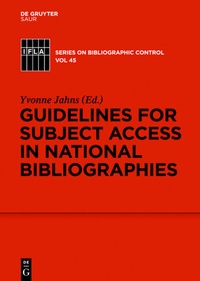
Guidelines for Subject Access in National Bibliographies
Beschreibung

In a networked and globalized world of information the form of national bibliographies may have changed, however their major function remains unchanged: to inform about a country's publication landscape, its cultural and intellectual heritage. Subject access offers a major route into this landscape providing information about the dispersion of publications in specific fields of knowledge and topics contained in a particular national publishing output. The Guidelines for Subject Access in National Bibliographies give graded recommendations concerning subject indexing policies for national bibliographic agencies and illustrating various policies by providing best practice examples.
Weitere Details
Weitere Ausgaben
Andere Ausgaben
Personen
Inhalt
2 - 1. Introduction [Seite 10]
2.1 - 1.1 Subject access in national bibliographies [Seite 10]
2.2 - 1.2 IFLA's Working Group on Guidelines for Subject Access by National Bibliographic Agencies [Seite 11]
2.3 - 1.3 Outline of the Guidelines [Seite 15]
3 - 2. Users of national bibliographies and subject access [Seite 18]
3.1 - 2.1 Users of national bibliographies [Seite 18]
3.2 - 2.2 Use of subject access in national bibliographies [Seite 19]
3.3 - 2.3 Outcome of this review [Seite 22]
4 - 3. Subject access standards and tools [Seite 24]
4.1 - 3.1 Natural and controlled language indexing [Seite 24]
4.2 - 3.2 Features of controlled indexing languages [Seite 25]
4.3 - 3.3 Importance of standard indexing tools [Seite 26]
4.4 - 3.4 Verbal indexing schemes [Seite 27]
4.4.1 - 3.4.1 Subject heading lists [Seite 28]
4.4.2 - 3.4.2 Thesauri [Seite 29]
4.4.3 - 3.4.3 Pre-coordination and post-coordination [Seite 30]
4.5 - 3.5 Classification schemes [Seite 31]
4.5.1 - 3.5.1 Dewey Decimal Classification [Seite 33]
4.5.2 - 3.5.2 Universal Decimal Classification [Seite 34]
4.5.3 - 3.5.3 Library of Congress Classification [Seite 35]
4.6 - 3.6 Automatic indexing [Seite 35]
4.7 - 3.7 Other subject access tools [Seite 37]
5 - 4. Functionality and interface of national bibliographies [Seite 40]
5.1 - 4.1 Presentation of national bibliographies [Seite 40]
5.2 - 4.2 General recommendations [Seite 41]
5.3 - 4.3 Online catalogue functionalities [Seite 42]
5.4 - 4.4 Online catalogue interfaces [Seite 43]
5.5 - 4.5 Online catalogue queries [Seite 44]
5.6 - 4.6 Other catalogue features [Seite 44]
6 - 5. Application scenarios (indexing / access levels) [Seite 46]
6.1 - 5.1 Different levels of subject access [Seite 46]
6.2 - 5.2 Selection criteria for subject access levels [Seite 47]
6.2.1 - 5.2.1 Characteristics of materials [Seite 48]
6.2.2 - 5.2.2 Users [Seite 49]
6.2.3 - 5.2.3 Other considerations [Seite 49]
6.3 - 5.3 Decision matrix [Seite 50]
7 - 6. Indexing policies of National Bibliographic Agencies [Seite 52]
7.1 - 6.1 Communicating the indexing policy [Seite 52]
7.2 - 6.2 Content of the indexing policy [Seite 52]
8 - 7. Examples of subject access provided by National Bibliographic Agencies [Seite 54]
8.1 - 7.1 Subject access rules and standards used by National Bibliographic Agencies [Seite 54]
8.1.1 - 7.1.1 Classification schemes [Seite 54]
8.1.1.1 - 7.1.1.1 Dewey Decimal Classification (DDC) and adaptations [Seite 55]
8.1.1.2 - 7.1.1.2 Universal Decimal Classification (UDC) [Seite 61]
8.1.1.3 - 7.1.1.3 Library of Congress Classification (LCC) [Seite 65]
8.1.1.4 - 7.1.1.4 National classification schemes [Seite 65]
8.1.1.5 - 7.1.1.5 Broad subject categorisation schemes [Seite 72]
8.1.2 - 7.1.2 Verbal indexing schemes [Seite 74]
8.1.2.1 - 7.1.2.1 Library of Congress Subject Headings (LCSH) and adaptations [Seite 74]
8.1.2.2 - 7.1.2.2 Other subject heading lists or thesauri [Seite 80]
8.2 - 7.2 National examples of indexing level policies [Seite 91]
8.3 - 7.3 National examples of published indexing policies [Seite 93]
9 - 8. List of recommendations [Seite 94]
10 - Glossary [Seite 96]
11 - Bibliography [Seite 110]
12 - Annex 1: Working Group history [Seite 114]
13 - Annex 2: Members of the IFLA Working Group on Guidelines for Subject Access by National Bibliographic Agencies [Seite 118]
