

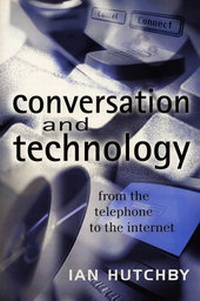
Conversation and Technology
From the Telephone to the Internet
Erschienen am 25. April 2013
228 Seiten
978-0-7456-7752-1 (ISBN)
Beschreibung

We live in a world where social interaction is increasinglymediated by technological devices. In this book, Ian Hutchbyexplores the impact these technologies have on our attempts tocommunicate. Focusing on four examples - telephones, computerizedexpert systems at work, speech-based systems dealing with enquiriesfrom the public, and multi-user spaces on the Internet - Hutchbyasks: are we increasingly technologized conversationalists, or istechnology increasingly conversationalized?
Conversation and Technology draws on recent theory andempirical research in conversation analysis, ethnomethodology andthe social construction of technology. In novel contributions toeach of these areas, Hutchby argues that the ways in which weinteract can be profoundly shaped by technological media, while atthe same time we ourselves are shapers of both the cultural andinteractional properties of these technologies.
The book begins by examining a variety of theoretical perspectiveson this issue. Hutchby offers a critical appraisal of recentsociological thinking, which has tended to over-estimate society'sinfluence on technological development. Instead he calls for a newappreciation of the relationship between human communication andtechnology. Using a range of case studies to illustrate hisargument, Hutchby explores the multiplicity of ways in whichtechnology affects our ordinary conversational practices.
Readers in areas as diverse as sociology, communication studies,psychology, computer science and management studies will find muchof interest in this account of the human and communicativeproperties of various forms of modern communication technology.
Conversation and Technology draws on recent theory andempirical research in conversation analysis, ethnomethodology andthe social construction of technology. In novel contributions toeach of these areas, Hutchby argues that the ways in which weinteract can be profoundly shaped by technological media, while atthe same time we ourselves are shapers of both the cultural andinteractional properties of these technologies.
The book begins by examining a variety of theoretical perspectiveson this issue. Hutchby offers a critical appraisal of recentsociological thinking, which has tended to over-estimate society'sinfluence on technological development. Instead he calls for a newappreciation of the relationship between human communication andtechnology. Using a range of case studies to illustrate hisargument, Hutchby explores the multiplicity of ways in whichtechnology affects our ordinary conversational practices.
Readers in areas as diverse as sociology, communication studies,psychology, computer science and management studies will find muchof interest in this account of the human and communicativeproperties of various forms of modern communication technology.
Weitere Details
Weitere Ausgaben
Andere Ausgaben
Buch
12/2000
1. Auflage
Polity Press
94,25 €
Versand in 15-20 Tagen
Buch
11/2000
1. Auflage
Polity Press
27,00 €
Artikel z.Zt. nicht lieferbar
Person
Ian Hutchby is Senior Lecturer in Sociology andCommunication at Brunel
University and Honorary Research Fellow in the School of SocialSciences at Cardiff University. His research involves theapplication of conversation analysis to various areas oftechnologically-mediated interaction, including the distinctiveproperties of broadcast talk and the possibilities of human-machineinteraction; as well as the analysis of children's communicativecompetence
University and Honorary Research Fellow in the School of SocialSciences at Cardiff University. His research involves theapplication of conversation analysis to various areas oftechnologically-mediated interaction, including the distinctiveproperties of broadcast talk and the possibilities of human-machineinteraction; as well as the analysis of children's communicativecompetence
Inhalt
Chapter 1: Introduction: Technologies for Communication.
Chapter 2: The Communicative Affordances of TechnologicalArtifacts.
Chapter 3: Communication as Computation?.
Chapter 4: Talk in Interaction.
Chapter 5: The Telephone: Technology of Sociability.
Chapter 6: Telephone Interaction and Social Identity.
Chapter 7: Technological Mediation and AsymmetricalInteraction.
Chapter 8: Computers, Humans, Conversation.
Chapter 9: Virtual Conversation.
Chapter 10: Conclusion: A Reversion to the Real?.
Appendix: Transcription Conventions.
Bibliography.
Index
Chapter 2: The Communicative Affordances of TechnologicalArtifacts.
Chapter 3: Communication as Computation?.
Chapter 4: Talk in Interaction.
Chapter 5: The Telephone: Technology of Sociability.
Chapter 6: Telephone Interaction and Social Identity.
Chapter 7: Technological Mediation and AsymmetricalInteraction.
Chapter 8: Computers, Humans, Conversation.
Chapter 9: Virtual Conversation.
Chapter 10: Conclusion: A Reversion to the Real?.
Appendix: Transcription Conventions.
Bibliography.
Index
