

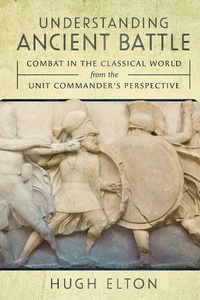
Understanding Ancient Battle
Combat in the Classical World from the Unit Commander's Perspective
Erschienen am 30. Januar 2024
208 Seiten
978-1-5267-5400-4 (ISBN)
Beschreibung

Traditional military history of battles focussed on the strategies of great leaders, though in modern times many scholars have discussed the 'face of battle', describing the personal experience of the ordinary soldier. But in between, there still lies a major gap in our understanding of ancient combat: the officer's battle. This focuses on how units actually fought and manoeuvred in battle. Hugh Elton seeks to redress this through analysis of the interaction of equipment, morale, leadership, and terrain.
After discussing source material and the general model of warfare the author follows, this book outlines by major periods what we know of equipment, organization and tactics, then shows how battle worked in a series of case studies including include Marathon, Issus, Cannae, Cynoscephalae, Mons Graupius, and Adrianople. A total of twenty-four battles are analyzed between the fifth-century BCE and the sixth century CE, covering the wars described by the great historians between Herodotus and Procopius, including accounts written by the soldiers Xenophon, Julius Caesar, and Ammianus Marcellinus.
After discussing source material and the general model of warfare the author follows, this book outlines by major periods what we know of equipment, organization and tactics, then shows how battle worked in a series of case studies including include Marathon, Issus, Cannae, Cynoscephalae, Mons Graupius, and Adrianople. A total of twenty-four battles are analyzed between the fifth-century BCE and the sixth century CE, covering the wars described by the great historians between Herodotus and Procopius, including accounts written by the soldiers Xenophon, Julius Caesar, and Ammianus Marcellinus.
Weitere Details
Weitere Ausgaben
Andere Ausgaben
Hugh Elton
Understanding Ancient Battle
Combat in the Classical World from the Unit Commander's Perspective
Buch
11/2023
Pen & Sword Military
25,00 €
Versand in 10-20 Tagen
Inhalt
- Cover
- Book Title page
- Copyright page
- Contents
- Note on Units of Measurement, Names and Ancient Sources
- Note on Terminology
- List of Illustrations
- Preface
- Location Map of the Battles
- Chapter 1 Introduction
- 1.1 Literary Sources
- 1.2 Technical Military Writing
- 1.3 Material Evidence
- 1.4 Modern Historiography of Battle
- 1.5 This Book
- Chapter 2 Ancient Battle: An Overview
- 2.1 Leadership, Friction and Luck
- 2.2 Training and Discipline
- 2.4 Infantry and Cavalry Spacing
- 2.5 Deployment for Battle
- 2.6 Manoeuvre During Battle
- 2.7 Light Infantry and Missile Weapons
- 2.8 Morale and the Will to Engage
- 2.9 Infantry Combat
- 2.10 Cavalry Combat
- 2.11 Pursuit
- 2.12 Conclusion
- Chapter 3 The Classical Greek Period
- 3.1 Sources
- 3.2 Greek Equipment and Organization
- 3.3 Persian Equipment and Organization
- 3.4 The Battle of Marathon, 490 bce
- 3.5 The Battle of Delium, 424 bce
- 3.6 The Battle of Cunaxa, 401 bce
- 3.7 The Battle of Leuctra, 371 bce
- 3.8 Battle in the Classical Period
- 3.8.1 Who was a regimental commander?
- 3.8.2 Training and discipline
- 3.8.3 Infantry and cavalry spacing
- 3.8.4 Deployment for battle
- 3.8.5 Manoeuvre during battle
- 3.8.6 Morale and the will to engage
- 3.8.7 Infantry combat
- 3.8.8 Cavalry combat
- 3.8.9 Pursuit
- 3.9 Conclusion
- Chapter 4 The Hellenistic Period
- 4.1 Sources
- 4.2 Equipment and Organization
- 4.3 The Battle of Issus, 333 bce
- 4.3 The Battle of Issus, 333 bce
- 4.4 Elephants
- 4.5 The Battle of Gabiene, 316 bce
- 4.6 The Battle of Sellasia, 222 bce
- 4.7 Battle in the Hellenistic Period
- 4.7.1 Who was a regimental commander?
- 4.7.2 Training and discipline
- 4.7.3 Infantry and cavalry spacing
- 4.7.4 Deployment for battle
- 4.7.5 Manoeuvre during battle
- 4.7.6 Morale and the will to engage
- 4.7.7 Infantry combat
- 4.7.8 Cavalry combat
- 4.7.9 Pursuit
- 4.8 Conclusion
- Chapter 5 The Second Romano-Punic War
- 5.1 Source Material
- 5.2 Roman Equipment and Organization
- 5.3 Carthaginian Equipment and Organization
- 5.4 The Battle of Cannae, 216 bce
- 5.5 The Battle of Ilipa, 206 bce
- 5.6 The Battle of Zama, 202 bce
- 5.7 Battle in the Second Romano-Punic War
- 5.7.1 Who was a regimental commander?
- 5.7.2 Training and discipline
- 5.7.3 Infantry and cavalry spacing
- 5.7.4 Deployment for battle
- 5.7.5 Manoeuvre during battle
- 5.7.6 Morale and the will to engage
- 5.7.7 Infantry combat
- 5.7.8 Cavalry combat
- 5.7.9 Pursuit
- Conclusion
- Chapter 6 The Romano-Macedonian Wars
- 6.1 Sources
- 6.2 The Battle of Cynoscephalae, 197 bce
- 6.3 The Battle of Magnesia, 190 bce
- 6.4 The Battle of Pydna, 168 bce
- 6.5 Conclusion
- Chapter 7 The Late Roman Republic
- 7.1 Sources
- 7.2 Roman Equipment and Organization
- 7.3 Organization and Equipment of Rome's Enemies
- 7.4 The Battle of the River Sabis, 57 bce
- 7.5 The Battle of Carrhae, 53 bce
- 7.6 The Battle of Pharsalus, 48 bce
- 7.7 The Battle of Zela, 47 bce
- 7.8 Scythed Chariots
- 7.9 Battle in the Late Roman Republican Period
- 7.9.1 Who was a regimental commander?
- 7.9.2 Training and discipline
- 7.9.3 Infantry and cavalry spacing
- 7.9.4 Deployment for battle
- 7.9.5 Manoeuvre during battle
- 7.9.6 Morale and the will to engage
- 7.9.7 Infantry combat
- 7.9.8 Cavalry combat
- 7.9.9 Pursuit
- 7.10 Conclusion
- Chapter 8 The Early Roman Empire
- 8.1 Sources
- 8.2 Roman Equipment and Organization
- 8.3 British, Germanic and Sarmatian Equipment and Organization
- 8.4 The Battle of Idistaviso, 16 ce
- 8.5 The Battle of Mons Graupius, 84 ce
- 8.6 Arrian, Ektaxis kata Alanos, 135 ce
- 8.7 Battle in the Early Roman Empire
- 8.7.1 Who was a regimental commander?
- 8.7.2 Training and discipline
- 8.7.3 Infantry and cavalry spacing
- 8.7.4 Deployment for battle
- 8.7.5 Manoeuvre during battle
- 8.7.6 Morale and the will to engage
- 8.7.7 Infantry combat
- 8.7.8 Cavalry combat
- 8.7.9 Pursuit
- 8.8 Conclusion
- Chapter 9 The Late Roman Empire
- 9.1 Sources
- 9.2 Late Roman Equipment and Organization
- 9.3 Germanic, Hun, and Avar Organization and Equipment
- 9.4 Sasanian Equipment and Organization
- 9.5 The Battle of Strasbourg, 357 ce
- 9.6 The Battle of Adrianople, 378 ce
- 9.7 The Battle of Callinicum, 531 ce
- 9.8 The Battle of Taginae, 552 ce
- 9.9 Battle in the Late Roman Empire
- 9.9.1 Who was a regimental commander?
- 9.9.2 Training and discipline
- 9.9.3 Infantry and cavalry spacing
- 9.9.4 Deployment for battle
- 9.9.5 Manoeuvre during battle
- 9.9.6 Morale and the will to engage
- 9.9.7 Infantry combat
- 9.9.8 Cavalry combat
- 9.9.9 Pursuit
- 9.10 Conclusion
- Chapter 10 Conclusion
- Further Reading
- Primary Sources
- Battle in General in All Periods
- Tactical Surveys in Other Periods
- Ancient Battle
- Surveys of Ancient Warfare
- Equipment
- Classical and Hellenistic Greek
- Middle Roman Republic
- Late Roman Republic and Early Roman Empire
- Late Roman Empire
