
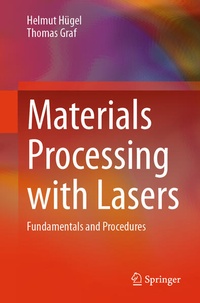
Materials Processing with Lasers
Beschreibung
Alles über E-Books | Antworten auf Fragen rund um E-Books, Kopierschutz und Dateiformate finden Sie in unserem Info- & Hilfebereich.
This textbook introduces the use of lasers in manufacturing. Starting with the generation and the properties of laser beams, it covers the interaction mechanisms between laser radiation and workpieces, which are essential for a successful process design. Selected, industrially relevant manufacturing processes are used to illustrate the link between fundamental knowledge and technological implementation. The content has been developed for teaching purposes and reflects the latest scientific findings from current research.
This textbook has been developed and recommended for university courses in Germany, Austria and Switzerland.Weitere Details
Weitere Ausgaben
Andere Ausgaben
Personen
Prof. Dr.-Ing. habil. Helmut Hügel , Emeritus and former director of the Institut für Strahlwerkzeuge (IFSW) at the University of Stuttgart, Germany.
Prof. Dr. phil. nat. Thomas Graf is director of the Institut für Strahlwerkzeuge (IFSW) at the University of Stuttgart, Germany.
Inhalt
Introduction: Manufacturing with Lasers.- The Laser Beam.- Systems Engineering.- Energy Deposition.- Thermal Effects in the Workpiece.- Modifications to the Incident Laser Beam.- Energetic Estimation of Achievable Process Results.- Cutting.- Welding.- Surface Modifications - Hardening.- Additive Manufacturing Processes.- Ablation Processes.

Systemvoraussetzungen
Dateiformat: PDF
Kopierschutz: Wasserzeichen-DRM (Digital Rights Management)
Systemvoraussetzungen:
- Computer (Windows; MacOS X; Linux): Verwenden Sie zum Lesen die kostenlose Software Adobe Reader, Adobe Digital Editions oder einen anderen PDF-Viewer Ihrer Wahl (siehe E-Book Hilfe).
- Tablet/Smartphone (Android; iOS): Installieren Sie bereits vor dem Download die kostenlose App Adobe Digital Editions oder die App PocketBook (siehe E-Book Hilfe).
- E-Book-Reader: Bookeen, Kobo, Pocketbook, Sony, Tolino u.v.a.m.
Das Dateiformat PDF zeigt auf jeder Hardware eine Buchseite stets identisch an. Daher ist eine PDF auch für ein komplexes Layout geeignet, wie es bei Lehr- und Fachbüchern verwendet wird (Bilder, Tabellen, Spalten, Fußnoten). Bei kleinen Displays von E-Readern oder Smartphones sind PDF leider eher nervig, weil zu viel Scrollen notwendig ist. Mit Wasserzeichen-DRM wird hier ein „weicher” Kopierschutz verwendet. Daher ist technisch zwar alles möglich – sogar eine unzulässige Weitergabe. Aber an sichtbaren und unsichtbaren Stellen wird der Käufer des E-Books als Wasserzeichen hinterlegt, sodass im Falle eines Missbrauchs die Spur zurückverfolgt werden kann.
Weitere Informationen finden Sie in unserer E-Book Hilfe.