

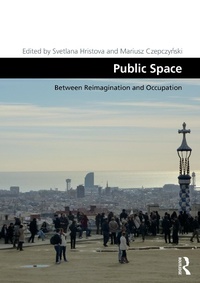
Public Space
Between Reimagination and Occupation
Erschienen am 14. September 2017
200 Seiten
978-1-317-07329-1 (ISBN)
Beschreibung

Public Space: Between Reimagination and Occupation examines contemporary public space as a result of intense social production reflecting contradictory trends: the long-lasting effects of the global crisis, manifested in supranational trade-offs between political influence, state power and private ownership; and the appearance of global counter-actors, enabled by the expansion of digital communication and networking technologies and rooted into new participatory cultures, easily growing into mobile cultures of protest.
The highlighted cases from Europe, Asia, Africa and North America reveal the roots of the pre-crisis processes of redistribution of capital and power as an aspect of the transition from the consumerist past into the post-consumerist present, by tracing the slow growth of social discontent that has led only a few years later to the mobilization of a new kind of self-conscious globally-acting class.
This edited volume brings together a broad range of interdisciplinary discussions and approaches, providing sociologists, cultural geographers, and urban planning academics and students with an opportunity to explore the various social, cultural, economic and political factors leading to reappropriation and reimagination of the urban commons in the cities within which we live.
The highlighted cases from Europe, Asia, Africa and North America reveal the roots of the pre-crisis processes of redistribution of capital and power as an aspect of the transition from the consumerist past into the post-consumerist present, by tracing the slow growth of social discontent that has led only a few years later to the mobilization of a new kind of self-conscious globally-acting class.
This edited volume brings together a broad range of interdisciplinary discussions and approaches, providing sociologists, cultural geographers, and urban planning academics and students with an opportunity to explore the various social, cultural, economic and political factors leading to reappropriation and reimagination of the urban commons in the cities within which we live.
Weitere Details
Reihe
Sprache
Englisch
Verlagsort
London
Großbritannien
Verlagsgruppe
Taylor & Francis Ltd
Zielgruppe
Für höhere Schule und Studium
Produkt-Hinweis
Reflowable
Illustrationen
3 Tables, black and white; 13 Line drawings, black and white; 2 Halftones, black and white; 18 Illustrations, black and white
Dateigröße
2,97 MB
ISBN-13
978-1-317-07329-1 (9781317073291)
Copyright in bibliographic data and cover images is held by Nielsen Book Services Limited or by the publishers or by their respective licensors: all rights reserved.
Schweitzer Klassifikation
Weitere Ausgaben
Andere Ausgaben
Buch
01/2019
1. Auflage
Routledge
71,10 €
Versand in 15-20 Tagen
Buch
09/2017
1. Auflage
Routledge
206,10 €
Versand in 10-20 Tagen
Personen
Svetlana Hristova is an urban sociologist, researcher, lecturer and associate professor at the Faculty of Arts of the South-West University in Blagoevgrad, Bulgaria. In 2009 she initiated the working group Urban Management and Cultural Policies of the City at ENCATC, which evolved into a thematic area with the same name. She is the author and editor of numerous publications on urban cultures, public spaces and sustainable development, such as Culture and Sustainability in European Cities: Imagining Europolis (2015).
Mariusz Czepczynski is a cultural geographer, and a professor at the Department of Spatial Management, University of Gdansk, Poland. He is also active in applicative consultancy and advisory work, recently for the mayor of Gdansk, the Polish Metropolitan Union, the City Hall of Lodz, DS Consulting and PwC. His research has focused on cultural landscapes, post-socialist cities, heritage and urban transformations, and the results have been published in several papers and books, including Cultural Landscapes of Post-Socialist Cities: Representation of Powers and Needs (2008).
Mariusz Czepczynski is a cultural geographer, and a professor at the Department of Spatial Management, University of Gdansk, Poland. He is also active in applicative consultancy and advisory work, recently for the mayor of Gdansk, the Polish Metropolitan Union, the City Hall of Lodz, DS Consulting and PwC. His research has focused on cultural landscapes, post-socialist cities, heritage and urban transformations, and the results have been published in several papers and books, including Cultural Landscapes of Post-Socialist Cities: Representation of Powers and Needs (2008).
Inhalt
Introduction
Svetlana Hristova and Mariusz Czepczynski
Part I. Concepts and Discourses: The Resilient Public Space
01. Re-Imagining Civil Society: Conflict and Control in the City's Public Spaces
Sharon Zukin
02. Public Space in a Global World: After the Spectacle
Svetlana Hristova
03. Seeing the Local in Global Cities
Jerome Krase
Part II. Contestations and Rights: Public and Civic
04. Civic Landscapes of Post-Socialist Cities: Urban Movements and the Recover of Public Spaces
Mariusz Czepczynski
05. Public Space, Memory and Protest during Post-Socialist Transformation: The Emergence of University Square (Piata Universitatii), Bucharest as a space of protest
Craig Young, Duncan Light and Daniela Dumbraveanu
06. Social Characteristic of Squares as Urban Spaces, Ulus and Kizilay Squares in Ankara
Nuray Bayraktar
07. Order and Heterotopia in an Urban Space: The Case of a Spanish Square
Francisco Adolfo Garcia Jerez
08. Contested Public Spaces and the Right to the City: The Case of Cairo's Historic Bazaar
Wael Salah Fahmi
Part III. Management and Governance: Transformation and Control
09. The Meaning of Public Space in the Context of Space-Time Behaviour in the 'Network City': From Socialist to Sociable Public Space
Anastasia Moiseeva, Remon Rooij and Harry Timmermans
10. The Restructuring of Urban Public Space in the 'Baltic Pearl'
Megan Dixon
11. Public Green Space in Vienna between Utopia and Political Strategy
Philipp Rode and Eva Schwab
12. The normative construction of a (public) urban space through the use of policy instruments: some reflections from northern Italy
Michela Semprebon
13. Negotiating Public Space in a Shopping Mall
Pavel Pospech
Conclusions: Rediscovering Public Space Globally
Svetlana Hristova and Mariusz Czepczynski
Note on Contributors
Index
Svetlana Hristova and Mariusz Czepczynski
Part I. Concepts and Discourses: The Resilient Public Space
01. Re-Imagining Civil Society: Conflict and Control in the City's Public Spaces
Sharon Zukin
02. Public Space in a Global World: After the Spectacle
Svetlana Hristova
03. Seeing the Local in Global Cities
Jerome Krase
Part II. Contestations and Rights: Public and Civic
04. Civic Landscapes of Post-Socialist Cities: Urban Movements and the Recover of Public Spaces
Mariusz Czepczynski
05. Public Space, Memory and Protest during Post-Socialist Transformation: The Emergence of University Square (Piata Universitatii), Bucharest as a space of protest
Craig Young, Duncan Light and Daniela Dumbraveanu
06. Social Characteristic of Squares as Urban Spaces, Ulus and Kizilay Squares in Ankara
Nuray Bayraktar
07. Order and Heterotopia in an Urban Space: The Case of a Spanish Square
Francisco Adolfo Garcia Jerez
08. Contested Public Spaces and the Right to the City: The Case of Cairo's Historic Bazaar
Wael Salah Fahmi
Part III. Management and Governance: Transformation and Control
09. The Meaning of Public Space in the Context of Space-Time Behaviour in the 'Network City': From Socialist to Sociable Public Space
Anastasia Moiseeva, Remon Rooij and Harry Timmermans
10. The Restructuring of Urban Public Space in the 'Baltic Pearl'
Megan Dixon
11. Public Green Space in Vienna between Utopia and Political Strategy
Philipp Rode and Eva Schwab
12. The normative construction of a (public) urban space through the use of policy instruments: some reflections from northern Italy
Michela Semprebon
13. Negotiating Public Space in a Shopping Mall
Pavel Pospech
Conclusions: Rediscovering Public Space Globally
Svetlana Hristova and Mariusz Czepczynski
Note on Contributors
Index
