

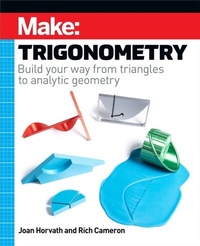
Make: Trigonometry
1. Auflage
Erschienen am 21. August 2023
356 Seiten
978-1-68045-821-3 (ISBN)
Beschreibung
Trigonometry has 2000-year-old roots in everyday useful endeavors, like finding the size of an object too big or far away to measure directly, or navigating from Point A to Point B. However, it is often taught very theoretically, with an emphasis on abstractions. Make: Trigonometry uses 3D printable models and readily-available physical objects like wire and cardboard tubes to develop intuition about concepts in trigonometry and basic analytic geometry. Readers will imagine the thought process of the people who invented these mathematical concepts, and can try out "e;math experiments"e; to see for themselves how ingenious ancient navigators and surveyors really were.The analytic geometry part of the book links equations to many of these intuitive concepts, which we explore through in-depth explanations of manipulative models of conic sections. This book is aimed at high school students who might be in Algebra II or Pre-Calculus. It shows the geometrical and practical sides of these topics that otherwise can drown in their own algebra.Make: Trigonometry builds on the basics of the authors' earlier book, Make: Geometry, and is intended as a bridge from that book to their Make: Calculus book. The user can read this book and understand the concepts from the photographs of 3D printable models alone. However, since many models are puzzle-like, we encourage the reader to print the models on any consumer-grade filament based 3D printer. The models are available for download in a freely-available open source repository. They were created in the free program OpenSCAD, and can be 3D printed or modified by the student in OpenSCAD to learn a little coding along the way.
Weitere Details
Weitere Ausgaben
Inhalt
- Cover
- Copyright
- Table of Contents
- Preface
- Who This Book Is For
- Teaching and Learning with This Book
- What You Will Need
- Acknowledgments
- About the Authors
- Chapter 1. Trigonometry and Analytic Geometry
- Trigonometry
- Analytic Geometry
- Structure of This Book
- Math Concepts to Know
- Chapter Key Points
- Chapter 2. 3D Printed Models
- OpenSCAD
- OpenSCAD Workflow
- Navigating on the Screen
- Comments
- Idiosyncrasies of OpenSCAD
- The Models
- Example 1: Changing a Parameter
- Example 2: Changing a Model with the Customizer
- Downloading the Models: Github
- Some Models Have Small Parts
- 3D Printing
- 3D Printing Workflow
- Materials
- Printing Tips
- If You Do Not Have a 3D Printer
- Chapter Key Points
- Terminology and Symbols
- References
- Chapter 3. Triangles and Trigonometry
- Angles of a Triangle
- Degrees, Radians, and Pi
- Prove Triangle Angles Add to 180°
- How to Use a Protractor
- Drawing and Labeling Triangles
- Congruent Triangles
- Similar Triangles
- Trigonometry Basics
- Pythagorean Theorem
- Squares and Square Roots
- Pythagoras' LEGO Bricks
- Sine, Cosine, Tangent
- Hypotenuse Model
- Complementary Angles
- Other Ratios
- Angles Greater Than 90°
- Finding the Length of a Side
- Arcsin, Arccos, Arctan
- Calculating with Sine and Cosine
- Measure Something Big
- Testing with a Known Object
- Garage Roof Height
- Chapter Key Points
- Terminology and Symbols
- References
- Answers
- Hypotenuse Model
- Calculating with Sine and Cosine
- Chapter 4. Coordinate Systems and Analytic Geometry
- Analytic Geometry
- Coordinate Systems
- Coordinate System Model
- Model Parameters
- Cartesian Coordinates
- Graphing a Line
- 3D Coordinates
- Polar Coordinates
- Cylindrical Coordinates
- Spherical Coordinates
- Making Curves and Surfaces
- Craft Materials Models
- 3D Printed Models
- Chapter Key Points
- Terminology and Symbols
- Chapter 5. The Unit Circle
- Beyond the Right Triangle
- Angles Between 90° and 180°
- Angles Between 180° and 270°
- Angles Between 270° and 360° (or -90° and 0°)
- Principal Value
- The Unit Circle
- Making 3D Printed Models
- Sine Versus Cosine
- Rolling Out a Sine Curve
- Phase
- Frequency
- Amplitude
- Angular Frequency
- Period
- Paper Models
- Graphing Trig Functions
- Graphing Sinusoids in Cartesian Coordinates
- Polar Graphs of Sinusoids
- Graphing in Radians
- Chapter Key Points
- Terminology and Symbols
- Chapter 6. Trig Identities to Logarithms
- Law of Sines
- Law of Cosines
- Special Triangles
- Cofunctions
- Squared Functions
- Sums of Angles and Double Angles
- Prosthaphaeresis
- Turning Multiplication into Addition
- Logarithms
- Slide Rules
- Powers and Roots
- Make a Slide Rule
- Paper Slide Rule
- Logs for Estimation
- Chapter Key Points
- Terminology and Symbols
- References
- Chapter 7. Navigation
- Measuring Angles and Distances
- Inclinometer
- Finding Latitude
- Polaris
- Southern Skies
- Sailing Down the Latitude
- Astrolabe
- Sextant
- Navigational Uses
- Measuring Height with a Sextant
- GPS
- Chapter Key Points
- Terminology and Symbols
- References
- Chapter 8. Making Waves
- Adding Waves
- Constructive and Destructive Interference
- Propagation in Space and Time
- Wave Interference Model
- Electromagnetic Waves
- Refraction
- Rotated Coordinate Systems
- Snell's Law
- Lenses
- Reflection
- Stokes' Relations
- Water and Sound Waves
- Modeling a Helicoid
- Chapter Key Points
- Terminology and Symbols
- References
- Chapter 9. Ellipses and Circles
- Conic Sections
- Anatomy of a Cone
- Conics Overview Model
- Circle Cross-section
- Ellipse Cross-section
- Parabola Cross-section
- Hyperbola Cross-section
- Cutting a Play-Doh Cone
- Conic Sections and Angles
- Ellipses and Circles
- Eccentricity
- Finding the Foci
- Equation of a Circle and an Ellipse
- Translating Circles and Ellipses
- Equations of Rotated Circles and Ellipses
- Area of an Ellipse
- Circumference of a Circle and an Ellipse
- Ellipses in the Wild
- Terminology and Symbols
- Chapter Key Points
- References
- Chapter 10. Parabolas and the Quadratic Formula
- Parabolas
- Focus and Directrix
- Drawing a Parabola
- The Parabola Model
- Assembling the Model
- Learning with the Model
- Equation of a Parabola
- Translating the Parabola
- Quadratic Equations
- Roots: The Fundamental Theorem of Algebra
- Completing the Square
- The Quadratic Formula
- Focus, Directrix and Vertex
- Changing the Curve
- Parabolas in the Wild
- Parabolic Mirrors
- Galileo Ramp
- Finding a Maximum or Minimum
- Terminology and Symbols
- Chapter Key Points
- References
- Chapter 11. Hyperbolas
- Hyperbola Conic Section
- Graphing a Hyperbola
- Foci and Directrix
- The Hyperbola Model
- Do Not Shrink This Model
- Assembling the Model
- Learning with the Model
- Model Limitations
- Equation of a Hyperbola
- Asymptotes
- Another Example
- Reciprocal Form
- Hyperbolic Mirrors
- Hyperbolic Trigonometry
- Terminology and Symbols
- Chapter Key Points
- References
- Chapter 12. Applications and Looking Ahead
- Tilings
- Tilings with Regular Polygons
- Aperiodic Tilings
- Robot Control
- Building the Robot Arm
- Wiring the Arm
- Programming the Arm
- Analyzing the Arm Motion
- Converting Cartesian to Spherical Coordinates
- The atan2 Function
- Walkthrough of the Arduino Code
- Running the Robot
- Building on this Project
- Looking Forward to Calculus
- Chapter Key Points
- Terminology and Symbols
- Resources
- Sources for this Chapter
- Websites and Search Terms
- Calculation Resources
- Books
- Appendix A. Topics Covered
- Index
