

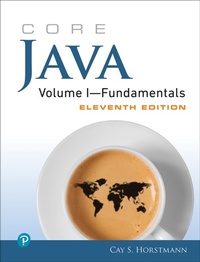
Core Java
Fundamentals, Volume 1
11. Auflage
Erschienen am 7. Juli 2021
912 Seiten
978-0-13-516718-2 (ISBN)
Beschreibung

The #1 Guide for Serious Programmers: Fully Updated for Java SE 9, 10 & 11
Cay Horstmann's Core Java, Volume I-Fundamentals, Eleventh Edition, is the definitive guide to writing robust, maintainable code with the Java SE 9, 10, and 11 language and libraries. Horstmann writes for serious programmers who use Java in production projects, and need a deep, practical understanding of the language and API. Throughout, he delivers what you need most: hundreds of real (non-toy) examples revealing the most powerful, effective ways to get the job done.
Updated examples reflect the new var keyword and take advantage of improvements in the Java API. You'll learn how to use JShell's new Read-Eval-Print Loop (REPL) for more rapid and exploratory development, and apply new features of the APIs for streams, input/output, processes, and concurrency.
In this first of two volumes, Horstmann offers in-depth coverage of fundamental Java and UI programming, including object-oriented programming, generics, collections, lambda expressions, Swing design, concurrency, and functional programming. If you're an experienced programmer moving to Java SE 9, 10, or 11, there's no better source for expert insight, solutions, and code.
Master foundational techniques, idioms, and best practices for writing superior Java code
Efficiently implement encapsulation and inheritance
Use sound principles of object-oriented design
Leverage the full power of objects with interfaces, lambda expressions, and inner classes
Harden programs through effective exception handling and debugging
Write safer, more reusable code with generic programming
Improve performance and efficiency with Java's standard collections
Build cross-platform GUIs with the Swing toolkit
Fully utilize multicore processors with Java's improved concurrency
See Core Java, Volume II-Advanced Features, Eleventh Edition (ISBN-13: 978-0-13-516631-4), for expert coverage of Java 9, 10, and 11 enterprise features, the module system, annotations, networking, security, and advanced UI programming.
Register your book for convenient access to downloads, updates, and/or corrections as they become available. See inside book for details.
Cay Horstmann's Core Java, Volume I-Fundamentals, Eleventh Edition, is the definitive guide to writing robust, maintainable code with the Java SE 9, 10, and 11 language and libraries. Horstmann writes for serious programmers who use Java in production projects, and need a deep, practical understanding of the language and API. Throughout, he delivers what you need most: hundreds of real (non-toy) examples revealing the most powerful, effective ways to get the job done.
Updated examples reflect the new var keyword and take advantage of improvements in the Java API. You'll learn how to use JShell's new Read-Eval-Print Loop (REPL) for more rapid and exploratory development, and apply new features of the APIs for streams, input/output, processes, and concurrency.
In this first of two volumes, Horstmann offers in-depth coverage of fundamental Java and UI programming, including object-oriented programming, generics, collections, lambda expressions, Swing design, concurrency, and functional programming. If you're an experienced programmer moving to Java SE 9, 10, or 11, there's no better source for expert insight, solutions, and code.
Master foundational techniques, idioms, and best practices for writing superior Java code
Efficiently implement encapsulation and inheritance
Use sound principles of object-oriented design
Leverage the full power of objects with interfaces, lambda expressions, and inner classes
Harden programs through effective exception handling and debugging
Write safer, more reusable code with generic programming
Improve performance and efficiency with Java's standard collections
Build cross-platform GUIs with the Swing toolkit
Fully utilize multicore processors with Java's improved concurrency
See Core Java, Volume II-Advanced Features, Eleventh Edition (ISBN-13: 978-0-13-516631-4), for expert coverage of Java 9, 10, and 11 enterprise features, the module system, annotations, networking, security, and advanced UI programming.
Register your book for convenient access to downloads, updates, and/or corrections as they become available. See inside book for details.
Alle Preise
Weitere Details
Auflage
11th edition
Sprache
Englisch
Verlagsort
Hoboken
USA
Verlagsgruppe
Pearson Education (US)
Zielgruppe
Für Beruf und Forschung
Dateigröße
62,39 MB
ISBN-13
978-0-13-516718-2 (9780135167182)
Copyright in bibliographic data and cover images is held by Nielsen Book Services Limited or by the publishers or by their respective licensors: all rights reserved.
Schweitzer Klassifikation
Weitere Ausgaben
Nachauflagen
E-Book
05/2022
12. Auflage
Addison Wesley
56,49 €
Als Download verfügbar
E-Book
02/2022
12. Auflage
Addison Wesley
56,49 €
Als Download verfügbar
Andere Ausgaben
Buch
07/2020
11. Auflage
Pearson
54,31 €
Versand in 15-20 Tagen
Person
Cay S. Horstmann is a professor of computer science at San Jose State University and a Java Champion. He is also the author of Core Java (R), Volumes I and II , Eleventh Edition (forthcoming from Pearson in 2018), Core Java SE 9 for the Impatient, Second Edition (Addison-Wesley, 2018), and Scala for the Impatient, Second Edition (Addison-Wesley, 2017). He has written more than a dozen other books for professional programmers and computer science students.
Inhalt
1. An Introduction to Java
2. The Java Programming Environment
3. Fundamental Programming Structures in Java
4. Objects and Classes
5. Inheritance
6. Interfaces and Inner Classes
7. Exceptions, Assertions, Logging, and Debugging
8. Generic Programming
9. Collections
10. Graphics Programming
11. Event Handling
12. User Interface Components with Swing
13. Deploying Applications and Applets
14. Concurrency
2. The Java Programming Environment
3. Fundamental Programming Structures in Java
4. Objects and Classes
5. Inheritance
6. Interfaces and Inner Classes
7. Exceptions, Assertions, Logging, and Debugging
8. Generic Programming
9. Collections
10. Graphics Programming
11. Event Handling
12. User Interface Components with Swing
13. Deploying Applications and Applets
14. Concurrency
