

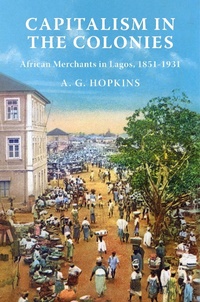
Capitalism in the Colonies
African Merchants in Lagos, 1851-1931
1. Auflage
Erschienen am 17. Juli 2024
464 Seiten
978-0-691-25895-9 (ISBN)
Beschreibung

An account that challenges the conventional views of African merchants under colonialism, examining the emergence and changing fortunes of indigenous entrepreneurs in Lagos, Nigeria
In Capitalism in the Colonies, A. G. Hopkins provides the first substantial assessment of the fortunes of African entrepreneurs under colonial rule. Examining the lives and careers of 100 merchants in Lagos, Nigeria, between 1850 and 1931, Hopkins challenges conventional views of the contribution made by indigenous entrepreneurs to the long-run economic development of Nigeria. He argues that African merchants in Lagos not only survived, but were also responsible for key innovations in trade, construction, farming, and finance that are essential for understanding the development of Nigeria's economy.
The book is based on a large, representative sample and covers a time span that traces mercantile fortunes over two and three generations. Drawing on a wide range of sources, Hopkins shows that indigenous entrepreneurs were far more adventurous than expatriate firms. African merchants in Lagos pioneered motor vehicles, sewing machines, publishing, tanneries, and new types of internal trade. They founded the construction industry that built Lagos into a major port city, moved inland to start the cocoa-farming industry, and developed the finance sector that is still vital to Nigeria's economy. They also took the lead in changing single-owned businesses into limited liability companies, creating freehold property rights and promoting wage labour. In short, Hopkins argues, they were the capitalists who introduced the institutions of capitalism into Nigeria. The story of African merchants in Nigeria reminds us, he writes, that economic structures have no life of their own until they are animated by the actions of creative individuals.
In Capitalism in the Colonies, A. G. Hopkins provides the first substantial assessment of the fortunes of African entrepreneurs under colonial rule. Examining the lives and careers of 100 merchants in Lagos, Nigeria, between 1850 and 1931, Hopkins challenges conventional views of the contribution made by indigenous entrepreneurs to the long-run economic development of Nigeria. He argues that African merchants in Lagos not only survived, but were also responsible for key innovations in trade, construction, farming, and finance that are essential for understanding the development of Nigeria's economy.
The book is based on a large, representative sample and covers a time span that traces mercantile fortunes over two and three generations. Drawing on a wide range of sources, Hopkins shows that indigenous entrepreneurs were far more adventurous than expatriate firms. African merchants in Lagos pioneered motor vehicles, sewing machines, publishing, tanneries, and new types of internal trade. They founded the construction industry that built Lagos into a major port city, moved inland to start the cocoa-farming industry, and developed the finance sector that is still vital to Nigeria's economy. They also took the lead in changing single-owned businesses into limited liability companies, creating freehold property rights and promoting wage labour. In short, Hopkins argues, they were the capitalists who introduced the institutions of capitalism into Nigeria. The story of African merchants in Nigeria reminds us, he writes, that economic structures have no life of their own until they are animated by the actions of creative individuals.
Weitere Details
Weitere Ausgaben
Andere Ausgaben
Buch
07/2024
Princeton University Press
52,50 €
Versand in 10-20 Tagen
Person
A. G. Hopkins is Emeritus Smuts Professor of Commonwealth History at the University of Cambridge and an Emeritus Fellow of Pembroke College, Cambridge. He is the author of An Economic History of West Africa, American Empire: A Global History (Princeton), Africa, Empire, and World Disorder: Historical Essays, and (with P. J. Cain) British Imperialism, 1688-2016.
Inhalt
- Cover
- Contents
- List of Illustrations
- Preface
- Acknowledgements
- Orthography, Currency Values, and Weights
- Abbreviations
- Prologue: A Gunboat for Christmas, 1851
- Chapter 1: The Global Meets the Local
- The Revival of Economic History
- Port Cities in History
- The Colonial Port City
- Entrepreneurship in a Colonial Context
- The Entrepreneurs of Lagos
- Cases and Sources
- Three Shocks
- Signposts
- Part I: The Shock of 1851
- Chapter 2: Creating a Cosmopolitan Frontier, 1851-1880
- The Expansion of Legitimate Commerce
- Business Uncertainty under the Consulate
- Founding a New Colony
- Settling In: The Town and Its Inhabitants
- The Saro Draw Lines in the Sand
- The New Order Established
- Chapter 3: The Mercantile Community
- The New Commercial Environment
- Property Becomes Big Business
- Winners and Losers
- Men of the Marina
- Taking Stock
- Chapter 4: Chief Daniel Taiwo and His Network
- Becoming a Lagosian
- From Kosoko to Glover
- 'The Head of All the Markets in the Colony'
- Business and Politics
- The Closing Years
- Conclusion
- Chapter 5: James Davies, King of the Merchant Princes
- A Saro Story-With Royal Connections
- Davies and Taiwo: An Unexpected Alliance
- From the Heights to the Depths
- Returning to Business
- Halfway
- Part II: The Shock of 1892
- Chapter 6: Crisis and Transition, 1880-1900
- The Commercial Outlook
- Business Uncertainty under the Colony
- Expanding the Colony
- The Commercial Consequences of Colonial Expansion
- The Port and Its People
- Reverberations
- Chapter 7: The Mercantile Community
- The Consequences of the Invasion of Yorubaland
- Failure and Success
- The End of a Golden Age
- 'Decline' in Context
- Chapter 8: Merchants as Money Lenders: Richard Blaize and Isaac Williams
- Context
- Richard Beale Blaize: Beginnings
- Diversification: Property and Money Lending
- A Family Man
- Newspapers and Politics
- Blaize's Legacy
- Isaac Benjamin Williams: Early Life
- The Import Trade
- Property, Mortgages, and Rentals
- Family and Church
- Two Lives Compared
- Chapter 9: James Davies: The First of the Cocoa Farmers
- Acquiring Woodland Estate
- Developing the Estate in the 1880s
- The Estate Farm Book, 1896-1899
- Ijon as a Centre of Innovation
- Output and Profits
- Final Years
- A Full Life
- Chapter 10: The Changing Economic Environment, 1900-1914
- Commercial Expansion and Colonial Development Policy
- The New Commercial Environment
- Institutional Innovation
- Political Aspects of Entrepreneurial Motivation
- The Port and Its Inhabitants
- The Consequences of the Second Shock
- Chapter 11: Accommodation and Diversification
- Mercantile Fortunes
- Accommodating Colonial Rule
- Diversifying the Economy
- Pioneers of Mechanisation
- Financial Innovation
- Bouncing Back
- Chapter 12: Negotiating Colonial Rule: Josiah Doherty and Samuel Pearse
- The Doherty Family: Beginnings
- Josiah Doherty Founds His Own Business
- Feeling the Strain, 1914-1928
- The Man in the Merchant
- Samuel Pearse: The Great Survivor
- Calabar and the Ivory Boom
- The War and Its Aftermath
- Final Years
- Two Kinds of Success
- Chapter 13: Jacob Coker and the New Farming Frontier at Agege
- From Commerce to Farming
- The Agege Plantation Complex
- The Farming Community
- The Agege Planters' Union
- Costs and Benefits
- From Davies to Coker
- Part III: The Shock of 1914
- Chapter 14: War and Its Consequences
- The Fortunes of War
- The Changing Commercial Environment
- Boom and Bust
- The Mercantile Community
- Co-operation and Innovation
- The Outcome
- Chapter 15: Peter Thomas: From Meteor to Falling Star
- The Making of a Civil Servant
- From Government Official to Merchant
- The Exigencies of War
- Life at the Top
- The Long Descent
- The Final Phase
- A Vision Postponed
- Chapter 16: A Conclusion, a Conundrum, and a Speculation
- Conclusion: Capitalists and the Spread of Capitalism
- Conundrum: The Missing Years
- Speculation: Development in the Long Run
- Epilogue: Congestion for Christmas, 2022
- Appendix: Lagos Entrepreneurs, 1851-1931
- Sources
- Index
