

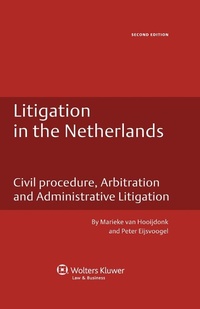
Litigation in the Netherlands
Civil Procedure, Arbitration and Administrative Litigation
2. Auflage
Erschienen am 24. Februar 2009
248 Seiten
978-90-411-4228-3 (ISBN)
Beschreibung

This book offers the ideal way for a foreign lawyer to get in touch with litigation practice and procedure in the Netherlands. Whether a lawyer comes to Dutch litigation in the normal course of business, or whether the brief and inexpensive kort geding (preliminary relief proceedings) is the main attraction, this concise guide provides a solid understanding of the practical implications of Dutch litigation
Weitere Details
Weitere Ausgaben
Andere Ausgaben
Marieke van Hooijdonk | Peter V. Eijsvoogel
Litigation in the Netherlands
Civil Procedure, Arbitration and Administrative Litigation
Buch
12/2012
2. Auflage
Kluwer Law International
94,50 €
Versand in 10-20 Tagen
Inhalt
- Intro
- Title
- Copyright
- Foreword to the First Edition
- Table of Contents
- Preface
- Chapter 1 Civil Procedure
- 1. Introduction
- 2. Differences Between Netherlands and Common Law
- 2.1 No Jury and the Role of the Judge
- 2.2 Evidence
- 2.2.1 Order
- 2.2.2 Admissibility
- 2.2.3 Burden of Proof
- 2.2.4 Witness Hearings
- 2.2.5 No Document Discovery or Depositions
- 2.3 Available Remedies
- 2.4 Duration of Proceedings
- 2.5 Costs of Litigation
- 3. Court System, Parties, Sources of Law and Fair Trial
- 3.1 The Court System
- 3.1.1 District Courts
- 3.1.1.1 General
- 3.1.1.2 Cantonal Division of the District Court
- 3.1.2 Courts of Appeal
- 3.1.3 Supreme Court
- 3.2 Parties, Attorneys and Judges
- 3.2.1 Parties
- 3.2.2 Attorneys
- 3.2.3 Judges
- 3.3 Sources of Law
- 3.4 Fair Trial, Due Process and Abuse of a Procedural Right
- 4. Jurisdiction
- 4.1 Introduction
- 4.2 International Jurisdiction
- 4.2.1 Sources of International Jurisdiction
- 4.2.2 The EC Regulation
- 4.2.3 National Rules
- 4.2.3.1 General
- 4.2.3.2 Attachment Creating Jurisdiction
- 4.2.3.3 Jurisdiction and Petition Proceedings
- 4.2.3.4 No Forum Non Conveniens
- 4.2.4 Lis Pendens
- 4.3 Absolute Jurisdiction
- 4.4 Venue (Relative Jurisdiction)
- 5. Evidence
- 5.1 Rules of Evidence
- 5.1.1 General
- 5.1.2 Range of Application
- 5.1.3 Burden of Proof
- 5.1.4 Admissibility of Evidence
- 5.2 Types of Evidence
- 5.2.1 Documents
- 5.2.1.1 Value as Evidence
- 5.2.1.2 Submission
- 5.2.2 Witnesses
- 5.2.2.1 General
- 5.2.2.2 Value as Evidence
- 5.2.2.3 Written Witness Declarations
- 5.2.2.4 Witness Hearings
- 5.2.2.5 Preliminary Witness Hearing
- 5.2.3 Experts
- 5.2.3.1 General
- 5.2.3.2 Preliminary Expert's Report
- 5.3 Attorney-Client Privilege
- 5.4 Pre-trial Discovery or Disclosure
- 5.5 International Aspects
- 5.5.1 Formal and Substantive Rules of Evidence
- 5.5.2 Taking of Evidence Abroad
- 5.5.3 Foreign Law
- 6. The Proceedings
- 6.1 Course of the Proceedings at First Instance
- 6.1.1 General
- 6.1.2 Service of Process
- 6.1.2.1 Commencement of the Proceedings
- 6.1.2.2 Service of Process on Dutch Defendants
- 6.1.2.3 Service of Process on Foreign Defendants
- 6.1.2.4 Minimum Period between Service and Appearance in Court
- 6.1.3 Default
- 6.1.4 Written Statements
- 6.1.4.1 General
- 6.1.4.2 Writ of Summons
- 6.1.4.3 Statement of Defence
- 6.1.4.4 Statement of Reply and Statement of Rejoinder
- 6.1.4.5 Amendment of Claim
- 6.1.5 Order to Appear in Court
- 6.1.6 Closing Arguments
- 6.1.6.1 Request for Closing Arguments
- 6.1.6.2 Nature of Closing Arguments
- 6.1.7 Termination of Proceedings
- 6.1.7.1 Removal from Docket List
- 6.1.7.2 Withdrawal
- 6.1.7.3 Prejudice of the Right To Take Action
- 6.1.8 Judgments
- 6.1.8.1 General
- 6.1.8.2 Requirements of a Judgment
- 6.1.8.3 Interim Judgments
- 6.1.8.4 Final Judgments
- 6.1.8.5 Binding Force
- 6.1.8.6 Provisionally Enforceable Notwithstanding an Appeal
- 6.1.8.7 Rectification, Correction and Supplementation of Judgment
- 6.1.9 Litigation Costs and Attorneys' Fees
- 6.2 Motion Practice
- 6.2.1 Introduction
- 6.2.2 Procedural Aspects of Motion Practice
- 6.2.3 Motion to Dismiss for Lack of Jurisdiction
- 6.2.4 Motion to Consolidate with Another Pending Case
- 6.2.5 Motion to Join or Intervene as a Party
- 6.2.6 Motion for Indemnification Proceedings
- 6.2.7 Motion for Security for Litigation Costs
- 6.2.8 Motion for Provisional Relief
- 6.2.9 Other Motions
- 6.3 Main Available Remedies
- 6.3.1 Specific Performance
- 6.3.2 Damages
- 6.3.3 Rescission
- 6.3.4 Annulment
- 6.3.5 Declaration of Law
- 6.3.6 Injunction
- 6.4 Appeal
- 6.4.1 Appeal to the Courts of Appeal
- 6.4.1.1 Appealable Judgments
- 6.4.1.2 Period for Lodging an Appeal
- 6.4.1.3 Standard and Scope of Review
- 6.4.1.4 The Proceedings
- 6.4.2 Appeal to the Supreme Court
- 6.4.2.1 Appealable Judgments
- 6.4.2.2 Period for Lodging an Appeal
- 6.4.2.3 Standard and Scope of Review
- 6.4.2.4 The Proceedings
- 6.4.3 Revocation
- 6.5 Petition Proceedings
- 6.5.1 Nature of Petition Proceedings
- 6.5.2 Jurisdiction
- 6.5.3 The Proceedings
- 6.5.4 Orders
- 7. Corporate Litigation in the Enterprise Court
- 7.1 Role of the Enterprise Court
- 7.2 Enquiry Proceedings
- 7.2.1 Introduction
- 7.2.2 Aim of the Enquiry Proceedings
- 7.2.3 Parties Entitled to Ask for an Enquiry
- 7.2.3.1 Shareholders, Holders of Depositary Receipts for Shares, Pledgees and Holders of a Right of Usufruct
- 7.2.3.2 The Company
- 7.2.3.3 Trade Unions and Works Councils
- 7.2.3.4 Other Parties
- 7.2.3.5 Attorney-general
- 7.2.4 Prior Written Notice
- 7.2.5 Subject of the Enquiry
- 7.2.6 First Stage: Request for Enquiry
- 7.2.6.1 Interested Parties
- 7.2.6.2 Sufficient Grounds to Doubt as to Whether the Company Is Pursuing a Proper Policy or a Proper Course of Affairs
- 7.2.7 Second Stage: Enquiry
- 7.2.7.1 Duties and Powers of the Investigators
- 7.2.7.2 Witnesses
- 7.2.7.3 Investigator's Report
- 7.2.7.4 Costs of the Investigation
- 7.2.8 Third Stage: Decision
- 7.2.8.1 Determination of Mismanagement
- 7.2.8.2 Types of Measures
- 7.2.9 Provisional Measures
- 7.2.9.1 General
- 7.2.9.2 The Proceedings
- 7.2.9.3 Types of Provisional Measures
- 7.2.10 Appeal to the Supreme Court
- 7.2.11 Effect of a Finding of Mismanagement
- 7.3 Forced Exit Proceedings
- 7.3.1 General
- 7.3.2 The Proceedings
- 7.3.2.1 Jurisdiction
- 7.3.2.2 First Stage: Conditions for Forced Exit
- 7.3.2.3 Second Stage: Price Determination and Judgment
- 7.3.2.4 Consequences of a Judgment being Overturned on Appeal
- 7.3.3 Alternative Proceedings
- 7.4 Squeeze-Out Proceedings
- 7.4.1 General
- 7.4.2 The Proceedings
- 7.4.3 Squeeze-Out Price
- 7.4.4 Squeeze-Out Proceedings after a Public Bid
- 7.4.5 Judgment
- 7.5 Proceedings to Challenge Annual Accounts
- 7.5.1 General
- 7.5.2 The Proceedings
- 7.5.3 Decision
- 7.5.4 The Netherlands Authority for the Financial Markets
- 7.6 Other Proceedings in the Enterprise Court
- 8. Derivative Actions, Class Actions and Class Settlements
- 8.1 Derivative Actions
- 8.2 Class Actions
- 8.3 Class Settlements
- 8.3.1 General
- 8.3.2 The Proceedings
- 8.3.2.1 First Stage: Settlement Agreement
- 8.3.2.2 Second Stage: Petition
- 8.3.2.3 Third Stage: Opting Out
- 8.3.2.4 Fourth Stage: Distribution of Funds
- 8.3.3 International settlements
- 8.3.4 Evaluation of the WCAM
- 9. Provisional Remedies
- 9.1 Preliminary Relief Proceedings
- 9.1.1 General
- 9.1.2 Requirements
- 9.1.3 Available Remedies
- 9.1.4 The Proceedings
- 9.1.5 Judgment
- 9.1.6 Appeal
- 9.2 Pre-judgment Attachment
- 9.2.1 General
- 9.2.2 Types of Attachment
- 9.2.3 The Proceedings
- 9.2.3.1 Petition to the Court
- 9.2.3.2 Instituting Main Proceedings
- 9.2.4 Lifting the Attachment
- 9.2.5 Liability for Wrongful Attachment
- 9.2.6 Conversion into Executory Attachment
- 10. Enforcement and Recognition of Judgments
- 10.1 General
- 10.2 Enforcement of Dutch Judgments
- 10.2.1 Enforcement of Monetary Judgments
- 10.2.2 Enforcement of Other Judgments
- 10.2.3 Disputes Regarding Enforcement
- 10.3 Enforcement of Foreign Judgments
- 10.3.1 General
- 10.3.2 Enforcement and Recognition Treaty Applicable
- 10.3.3 Specific European Regulations
- 10.3.4 Absence of an Enforcement and Recognition Treaty
- Chapter 2 Arbitration
- 1. Introduction
- 1.1 General
- 1.2 Applicable Rules
- 2. Arbitration Agreement
- 2.1 Requirements of an Arbitration Agreement
- 2.2 Place of Arbitration
- 2.3 Jurisdiction of the Civil Courts
- 3. Arbitration Proceedings under the Arbitration Act
- 3.1 The Arbitral Tribunal
- 3.1.1 Appointment of Arbitrators
- 3.1.2 Jurisdiction
- 3.1.3 Challenge of Arbitrators
- 3.2 The Arbitration Proceedings
- 3.2.1 Commencement of the Proceedings
- 3.2.2 The Proceedings
- 3.2.3 Evidence
- 3.2.3.1 Documents
- 3.2.3.2 Witnesses and Experts
- 3.2.3.3 Joinder of Third Parties
- 3.2.3.4 Consolidation
- 3.3 Confidentiality
- 3.4 Preliminary Relief
- 3.5 Costs
- 4. Arbitral Award
- 4.1 General
- 4.2 Laws and Rules Applicable to the Merits of the Dispute
- 4.3 Requirements of an Arbitral Award
- 4.4 Binding Force and Appeal
- 4.5 Rectification, Correction and Supplementation of Award
- 4.6 Enforcement
- 4.7 Setting Aside and Revocation
- 4.7.1 General
- 4.7.2 Setting Aside
- 4.7.3 Revocation
- 4.7.4 Consequences
- 5. Arbitration Outside the Netherlands
- 5.1 Jurisdiction of the Dutch Civil Courts
- 5.2 Enforcement of Foreign Arbitral Awards
- 6. Arbitration under the NAI Arbitration Rules
- 6.1 General
- 6.2 Appointment of Arbitrators
- 6.3 The Proceedings
- 6.4 Confidentiality
- 6.5 Provisional Measures
- 6.6 Rules Applicable to the Merits of the Dispute
- 6.7 Costs
- 6.8 Publication of Award
- 7. Expert Determination
- 8. Mediation
- Chapter 3 Administrative Litigation
- 1. General Introduction
- 1.1 Administrative Law and Administrative Litigation
- 1.2 Importance of Administrative Law
- 1.3 Sources of Administrative Law
- 1.4 General Administrative Law Act
- 2. The System of Dutch Administrative Litigation
- 2.1 Introduction
- 2.2 Admissibility (1): Order
- 2.3 Admissibility (2): Administrative Authority
- 2.4 Admissibility (3): Interested Party
- 2.5 No Review of Legislation or of Internally Binding Policy Rules
- 2.6 Civil Law Remedies Available
- 3. Administrative Review and Other Pre-proceedings
- 3.1 Three Types of Pre-proceedings at Government Level
- 3.2 Objection Proceedings
- 3.2.1 General
- 3.2.2 Jurisdiction
- 3.2.3. Notice of Objection
- 3.2.4 Time Allowed for Filing a Notice of Objection
- 3.2.5 The Proceedings
- 3.2.6 Reviewed Order
- 3.2.7 Costs
- 3.3 Public Preparatory Procedure
- 4. Judicial Review by the Administrative Courts: Appeal and Higher Appeal
- 4.1 Jurisdiction
- 4.1.1 General
- 4.1.2 Subject Matter Jurisdiction and Territorial Jurisdiction at First Instance
- 4.1.3 Direct Appeal
- 4.1.4 Appellate Jurisdiction
- 4.2 Parties
- 4.3 Representation
- 4.4 Filing the Appeal
- 4.5 Scope of the Appeal
- 4.6 The Proceedings
- 4.6.1 General
- 4.6.2 Documents and Written Submissions
- 4.6.3 Confidential Documents
- 4.6.4 Hearing
- 4.6.5 Evidence
- 4.7 Judgment
- 4.8 Court Fees, Costs and Damages
- 4.8.1 Court Fees
- 4.8.2 Costs
- 4.8.3 Damages
- 4.9 Special Appeal Proceedings
- 4.9.1 Simplified Proceedings
- 4.9.2 Accelerated Proceedings
- 5. Preliminary Relief
- 5.1 General
- 5.2 Requirements
- 5.2.1 Jurisdiction
- 5.2.2 Admissibility
- 5.2.3 Substantive Criterion
- 5.3 Available Remedies
- 5.4 The Proceedings
- 5.5 Judgment
- 5.5.1 General
- 5.5.2 Simultaneous Judgment on the Merits
- 5.6 No Appeal, Only Alteration or Termination
- 6. Judicial Review by the Civil Courts
- 6.1 Jurisdiction
- 6.2 Admissibility
- 6.3 Doctrine of Formal Legal Effect
- 6.4 Procedure
- 7. Complaints Proceedings
- 7.1 General
- 7.2 Internal Complaints Proceedings
- 7.3 External Complaints Proceedings
- 7.3.1 General
- 7.3.2 Requirements
- 7.3.3 Procedure
- 8. Supervision and Enforcement
- 8.1 Introduction
- 8.2 General Provisions on Administrative Enforcement
- 8.3 Supervisory Powers
- 8.4 Instruction under Threat of Administrative Coercion
- 8.5 Instruction under Threat of Penalty Payments
- 8.6 Administrative Fine
- 8.7 Withdrawal of a Favourable Order
- 8.8 Discretion in Relation to Enforcement
- Glossary English to Dutch
- Glossary Dutch to English
- List of Abbreviations
- International Litigation Contacts Allen & Overy LLP
